
How to Read to a Wriggly Baby (Because They Were Never Meant to Sit Still)
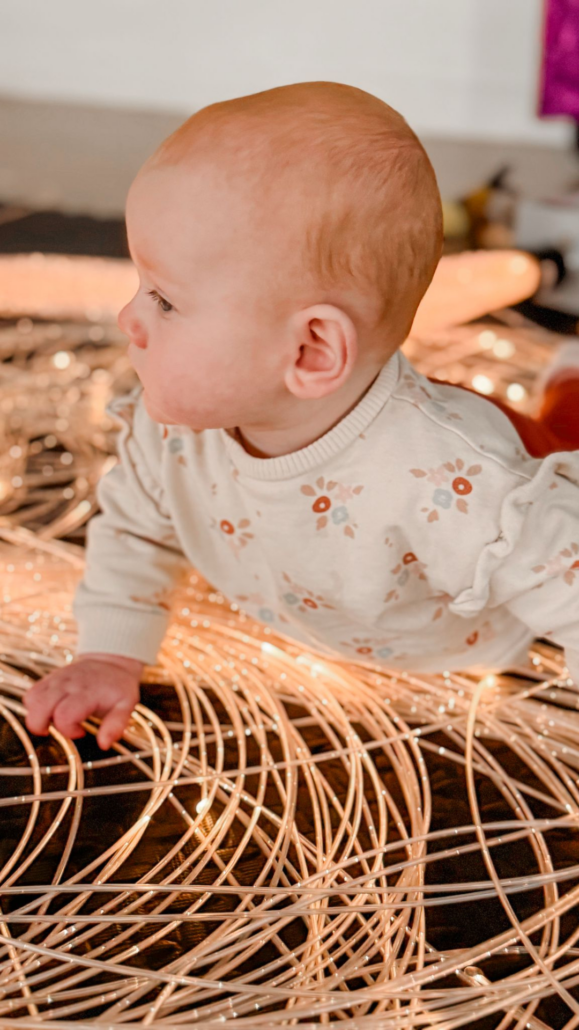
How to Read to a Wriggly Baby (Because They Were Never Meant to Sit Still)
You imagined cosy story times.
A comfy chair.
A beautiful picture book.
Your baby snuggled on your lap, gazing up at every page while you read in your best storyteller voice.
Instead…
You get halfway through the first page before they’ve rolled away, grabbed the book upside down, crawled towards the dog or decided that chewing the corner looks far more interesting than listening to The Gruffalo.
If you’ve ever closed a book thinking, “Maybe they’re just not interested yet,” you’re certainly not alone.
It’s one of the questions we hear most often from new parents.
“How do I read to my baby when they won’t sit still?”
The answer might surprise you.
You don’t.
Or at least, you don’t expect them to.
Because babies weren’t designed to experience stories by sitting quietly.
They’re designed to experience them with their whole body.
We’ve accidentally given ourselves the wrong picture of story time
Most of us grew up with story time looking the same.
Sit down.
Be quiet.
Listen carefully.
Turn the page.
It’s a wonderful way for older children to enjoy books, but babies are in a completely different stage of development.
Before they can concentrate on the words, they’re learning through movement, touch, sound, faces, repetition and relationships.
For them, the story isn’t just inside the book.
The story is you.
It’s the way your voice changes when the bear appears.
The smile on your face when you turn the page.
The feel of the cardboard under their fingers.
The excitement of reaching for the puppet before you’ve even introduced the character.
They’re absorbing so much more than the words.
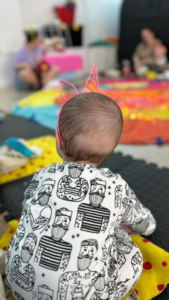
Movement isn’t getting in the way of learning—it’s helping it
When adults struggle to concentrate, we often sit more still.
Babies tend to do the opposite.
Movement is one of the ways they process information.
That little wiggle while you’re reading.
The reaching.
The rolling.
The kicking.
Even crawling away for a moment before coming back.
It’s all part of how babies learn.
As they move, they’re connecting what they hear with what they see, feel and experience. Those repeated experiences strengthen the brain pathways that support attention, memory and language over time.
So if your baby keeps standing up halfway through a story, it doesn’t mean they’re not enjoying it.
It simply means they’re being a baby.
Your baby is listening… even when it doesn’t look like it
One of the biggest surprises for parents is discovering just how much babies absorb while appearing completely distracted.
You might be reading while they stare at the ceiling.
Or while they’re fascinated by the ribbon sticking out of the page.
Or while they’re trying to post the book underneath the sofa.
It can feel as though your words are going in one ear and out the other.
But babies are incredible listeners.
Long before they understand every word, they’re learning the rhythm of language.
They’re recognising familiar voices.
They’re hearing repeated sounds.
They’re beginning to predict what comes next.
Every shared story is helping to build those foundations, even if your audience has wandered off halfway through.
Why babies love stories they can touch
Have you ever noticed how babies instinctively reach towards books?
Not because they’re trying to turn the page properly.
Because they’re curious.
They want to hold it.
Pat it.
Scrunch it.
Sometimes chew it.
That exploration is every bit as important as hearing the words.
Touch helps babies make sense of what they’re experiencing.
It’s why sensory books, textures, songs and movement feel so natural during the first year.
They’re meeting babies exactly where they are developmentally.
This is why sensory storytelling works so well
At Adventure Babies, we don’t expect babies to sit in a neat circle and listen quietly from beginning to end.
If we did, we’d all leave feeling disappointed.
Instead, we build stories that babies can step into.
A splash of bubbles becomes the sea.
Silky scarves become butterfly wings.
Puppets peek out from behind the pages.
Songs invite little hands to wave, clap and reach.
Parents often tell us afterwards, “I didn’t think my baby would sit through a story.”
The truth is—they didn’t.
They experienced it.
They explored it.
They laughed, reached, wriggled, listened, watched and joined in.
And that’s exactly what early literacy should look like.
The pressure to ‘do story time properly’
Social media has given us some beautiful images of parenthood.
Perfect nurseries.
Perfect bookshelves.
Perfectly behaved babies listening to stories.
Real life looks rather different.
Books get chewed.
Pages get turned too quickly.
Stories get interrupted by hiccups, feeds, nappy changes and sudden fascination with your shoelaces.
None of that means you’re doing it wrong.
In fact, those everyday, imperfect moments are often the ones your baby learns the most from.
Reading isn’t about finishing the book.
It’s about sharing the experience.
So what does ‘reading to your baby’ actually look like?
Sometimes it’s one page before nap time.
Sometimes it’s singing the same rhyme while they bounce on your knee.
Sometimes it’s pointing to one picture because that’s all they’re interested in today.
Sometimes it’s reading three words before they crawl off, then carrying on anyway because they can still hear your voice.
It all counts.
Every shared moment around books is helping your baby build positive associations with reading.
And those positive feelings are what create lifelong readers.
You’re not just reading a story. You’re building a reader.
One day your baby will sit beside you and ask for “just one more story.”
One day they’ll finish your favourite rhyme before you do.
One day they’ll proudly turn every page themselves.
Those moments don’t begin when they can finally sit still.
They begin now.
With the wriggling.
The reaching.
The giggling.
The interruptions.
The cuddles.
And yes… sometimes with a slightly soggy board book.
Because learning to love books was never about sitting perfectly still.
It was always about sharing them together.
Keep exploring
If this reassured you, you might also enjoy:
- Why Do Babies Put Everything in Their Mouth?
- How to Stimulate Your Baby’s Brain
- Why Babies Love Repetition (Even When You’re Tired of the Same Book!)
Helpful resources
For more evidence-based information about reading and early communication, visit: