Why Does My Baby Love Looking at Other Babies? The Beautiful Reason They’re Fascinated by Each Other
There is a moment that happens in almost every Adventure Babies class.
It isn’t always during the big exciting parts of the story. It isn’t necessarily when the bubbles appear or when a puppet suddenly pops out from behind a book. Sometimes it happens in the quietest moments, when a group of babies are simply sitting, lying or wriggling alongside each other.
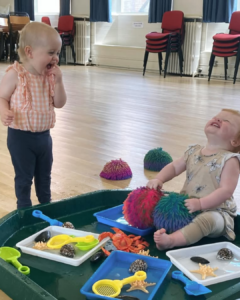
One baby notices another.
Their eyes meet.
And suddenly, everything else in the room disappears.
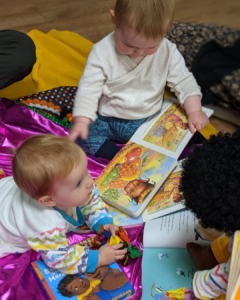
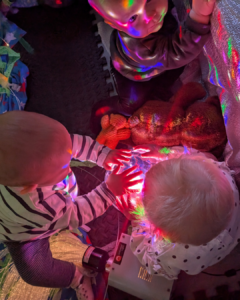
They stare with complete fascination. One baby might smile. The other might respond with an excited kick of their legs or a little squeal of delight. Sometimes they reach towards each other. Sometimes they simply watch, as if they are trying to work out this tiny person who looks a little bit like them but moves in completely unpredictable ways.
The parents usually notice too.
Someone will smile and say, “I think they’ve just made their first friend.”
It is such a lovely thought.
And while babies aren’t quite arranging playdates or forming friendships in the way older children do, something incredibly important is happening in that moment.
Your baby is beginning to understand other people.
That might sound like a simple thing, but for a baby in their first year of life, it is one of the biggest discoveries they will ever make.
Why does my baby stare at other babies?
If you have ever searched “why does my baby stare at other babies?” you are certainly not alone.
It is one of those wonderfully ordinary baby behaviours that makes parents curious. You might notice it at the park, in a café, at baby groups or even when another baby appears on the television. Your little one can become completely captivated.
It can look like they are doing nothing more than staring.
But babies are rarely doing “nothing”.
One of the things that fascinates us most about babies is how much learning happens in moments that appear incredibly simple. A baby watching another baby is gathering information. They are noticing movement, facial expressions, sounds and reactions. They are beginning to build an understanding of how people communicate.
Long before they can wave hello, share a toy or join in a conversation, babies are studying the world of relationships around them.
They are learning that faces change.
They are learning that smiles can be returned.
They are learning that sounds can create responses.
They are learning that people are connected.
And they are learning all of this simply by being around other people.
Babies are social long before they can be “sociable”
When we talk about baby development, we often focus on the milestones that are easy to see.
The first roll.
The first crawl.
The first steps.
The first words.
These moments are wonderful, and of course every parent celebrates them. But some of the most important development happens much earlier and much more quietly.
A baby smiling back when you smile.
A baby turning towards a familiar voice.
A baby watching another child laugh.
These moments rarely make it into a milestone book, but they are the foundations everything else is built upon.
Babies are born with an incredible drive to connect. From the earliest days, they are drawn towards faces, voices and human interaction. They are not passive little observers waiting for the world to teach them. They are active participants, constantly trying to understand the people around them.
This is why your baby can spend so long watching another baby. They are not just looking at a smaller person in the room. They are experiencing one of their first opportunities to notice someone who is learning, moving and communicating in a similar way to them.
There is something very special about that.
The first year is about connection before communication
One of the biggest misconceptions about babies is that communication starts when they say their first word.
It doesn’t.
Communication begins much earlier.
It begins with eye contact. It begins with taking turns making sounds. It begins with a baby watching your face while you speak. It begins with those little moments where you realise your baby is not just hearing you—they are connecting with you.
The wonderful thing is that babies practise these skills everywhere.
They practise them with you during nappy changes and cuddles. They practise them during songs in the kitchen. They practise them when they watch another baby smile during a class.
This is why environments filled with warm, responsive interactions are so important during the first year.
The work of organisations such as Speech and Language UK highlights how babies develop communication through everyday interactions with the people around them. It is not about sitting a baby down and trying to teach them language. It is about creating thousands of small opportunities for connection.
This is something we see every week at Adventure Babies.
A baby who has never met another child before might arrive looking around cautiously. They might spend the first few sessions simply watching. They might sit close to their grown-up and take everything in.
And then, gradually, something changes.
They begin to recognise the songs.
They begin to smile when the familiar puppet appears.
They begin to notice the babies around them.
They begin to feel that this is a place where they belong.
Babies don’t need to play together yet to learn from each other
One of the questions parents often ask is, “They’re so little… will they actually get anything from being around other babies?”
It is such a natural question.
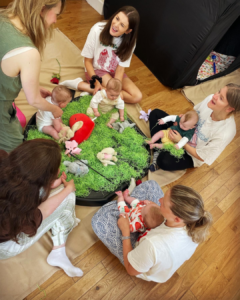
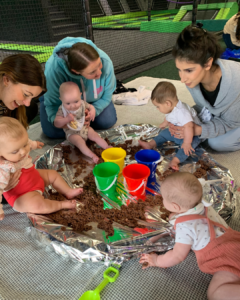
When you look at a group of very young babies together, it can appear as though they are all doing completely separate things. One baby is lying on a mat looking at the ceiling. Another is fascinated by their own fingers. Someone else is happily chewing a toy while another baby is having a very important conversation with a piece of muslin.
It doesn’t look like a traditional idea of play.
But babies are not meant to play like older children yet.
The first year of life is about building the foundations that make later play possible. Before babies can share toys, take turns or create games together, they need to understand people. They need to learn that faces, voices, actions and emotions are connected.
Watching another baby is part of that process.
A baby who sees another child reach for a toy is beginning to notice movement. A baby who hears another baby laugh is experiencing the rhythm of social interaction. A baby who watches another child respond to a song is beginning to understand that people can share the same experience.
These tiny moments might not look significant to us, but to a developing brain they are full of information.
This is why we often say that babies don’t need to be “playing together” to benefit from being together.
They are learning simply by sharing space.
The magic of shared experiences
There is something about being in a room full of babies that feels different from almost anywhere else.
Perhaps it is because babies are completely themselves. They do not worry about whether they are making the right noise, moving in the right way or joining in at the right time. They simply respond to what interests them.
A song starts, and one baby begins bouncing.
Another watches.
A puppet appears, and one baby reaches forward.
Another follows their gaze.
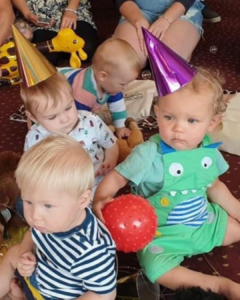
A group of parents starts singing, and suddenly all these little brains are experiencing something together.
This is known as shared attention, and it is a hugely important part of early communication development. It is the moment when two people are focused on the same thing and know that they are sharing that experience.
Think about the moments you naturally create with your baby every day.
You point at a bird outside the window and say, “Look!”
Your baby follows your gaze.
You smile.
They smile back.
That tiny exchange is communication.
Now imagine a whole room full of opportunities like that.
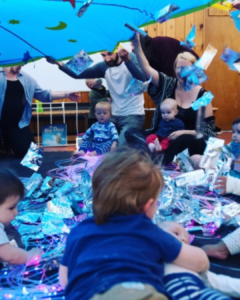
A story begins. Everyone looks towards the same puppet. A song starts. Everyone joins in with the same actions. A baby laughs. Another baby notices.
This is why sensory storytelling works so beautifully for young children. The story becomes something that happens between people, not something that is simply delivered to them.
At Adventure Babies, we bring books to life through music, movement, sensory experiences and imagination because babies learn best when they are involved. They are not expected to sit quietly and absorb information. They are encouraged to explore, respond and connect.
If you have ever worried that your baby is too young for books or that they do not “pay attention” during story time, our blog on how to read to a wriggly baby explores why movement, exploration and curiosity are actually important parts of learning.
Baby classes are not just for babies
There is another part of this story that we think deserves just as much attention.
The parent.
Because while your baby is learning about the world around them, you are learning too.
Nobody really tells you before having a baby quite how much your world changes. The days can become wonderfully full, but they can also become surprisingly small. Conversations that once happened naturally throughout the day are replaced by explaining your lunch choices to someone who cannot yet answer back.
You can love your baby more than anything in the world and still miss having people around who understand exactly what this stage feels like.
That is why community matters.
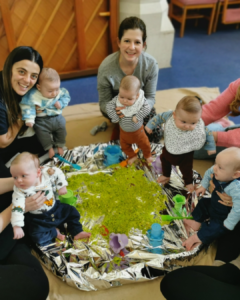
A baby class is often the first place many new parents walk into where nobody is surprised if you arrive late because there was a nappy disaster five minutes before leaving the house. Nobody looks twice if your baby cries halfway through a story. Nobody minds if you spend the first ten minutes just watching because you are still finding your confidence.
Everyone understands.
At Adventure Babies, we have always believed that supporting babies means supporting the people who care for them too.
The sensory play, stories and developmental activities are important, but so are the conversations before class starts, the friendships formed afterwards and the reassurance that comes from realising you are not the only person wondering if you are doing things right.
Over the years, we have watched friendships begin in our classes that continue long after babies have grown out of them. Parents who arrived not knowing anyone leave with people they can message on a difficult day, meet for coffee or celebrate milestones with.
Those connections are not an added extra.
They are part of the magic.
Why stories bring babies together
Books have always been about connection.
Before children can follow a storyline, understand characters or answer questions about what they have heard, they experience something much more fundamental.
They experience closeness.
They experience the sound of a familiar voice.
They experience the warmth of being held.
They experience the joy on a parent’s face when a favourite character appears.
The BookTrust highlights the importance of sharing books from birth because reading together supports language development, imagination and emotional connection. But anyone who has shared a story with a baby knows it is about much more than the words on the page.
It is about the relationship built around those words.
This is why we encourage parents not to worry if their baby does not sit still through a whole book. A baby turning the pages too quickly, touching the pictures, looking around the room or even trying to eat the book is still engaging with the experience.
They are learning what books mean.
They are learning that stories are connected with comfort, laughter and time with someone they love.
If your baby is currently more interested in exploring the book than listening to it, you might enjoy our blog on why babies put everything in their mouth, which explains why those early sensory experiences are such an important part of development.
The moment that stays with us
After all these years of running Adventure Babies classes, there are certain moments that never stop feeling special.
It is not always the big moments.
It is not always the first steps or the first words.
Sometimes it is a baby who used to sit quietly at the edge of the group suddenly reaching out for a puppet.
Sometimes it is a parent telling us that coming to class was the first time they had left the house that week.
Sometimes it is two babies who spent months smiling at each other now toddling into class together, their parents laughing about how they “remember” each other.
Those moments remind us that development is not just about milestones.
It is about relationships.
It is about confidence.
It is about giving babies opportunities to explore and giving parents spaces where they feel supported.
Your baby is learning more than you realise
So, why does your baby stare at other babies?
Because they are curious.
Because they are social.
Because they are beginning to understand the world they are part of.
That little stare across the room is not just a cute moment to capture on your phone. It is your baby’s growing brain gathering information about people, communication and connection.
And perhaps the most beautiful part is that while your baby is discovering the world around them, you are too.
You are finding your rhythm.
You are meeting people who understand.
You are creating memories in the middle of a season that can sometimes feel both magical and overwhelming.
At Adventure Babies, we believe every baby deserves the chance to explore, discover and fall in love with learning. But we also believe every parent deserves to feel part of a community while they do it.
Because babies do not grow in isolation.
They grow through connection.
And sometimes the very first connection they make outside their family begins with simply looking across the room and seeing another baby looking back.