How to Help Your Baby Learn to Talk (Before They Say Their First Word)
If you’ve ever found yourself narrating your supermarket shop to a baby who can’t even hold their own head up yet, you’ve probably wondered at least once…
“Do they actually understand any of this?”
The answer might surprise you.
Long before babies say their first “mama” or “dada”, their brains are working overtime. Every cuddle, every silly face, every story, every song and every conversation is building the foundations for communication.
In fact, one of the biggest jobs your baby’s brain is doing in their first year isn’t learning to crawl or sit up.
It’s learning language.
And here’s the exciting bit…
You don’t need flashcards, educational apps or expensive toys to help it happen.
You just need meaningful experiences.
That’s exactly why everything we do at Adventure Babies is built around stories, sensory exploration and responsive interaction.
Your baby’s brain is making millions of connections
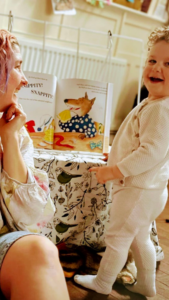
During the first three years of life, your baby’s brain develops faster than it ever will again.
Researchers estimate that over one million new neural connections are formed every second during early childhood. These connections create the foundation for thinking, remembering, understanding language, problem solving and social skills.
This incredible process is known as cognitive development—the way babies learn to think, process information and make sense of the world around them.
But cognitive development doesn’t happen separately from communication.
The two grow together.
Every time your baby hears your voice, watches your face, listens to a story or notices your reactions, they’re learning much more than words.
They’re learning that communication has meaning.
Before babies can talk, they have to learn how conversations work
One of the biggest misconceptions about speech development is that it starts with first words.
It doesn’t.
Long before speech comes:
- listening
- watching facial expressions
- recognising familiar voices
- understanding patterns
- taking turns
- making eye contact
- copying sounds
- paying attention
These early communication skills are every bit as important as saying words themselves.
That’s why you’ll often see babies in Adventure Babies classes staring intently at their grown-up while they read a story or joining in with repetitive sounds and actions.
It might look like simple fun.
In reality, they’re practising the building blocks of conversation.
The most important age for communication development
Parents often ask us:
“When should I start reading to my baby?”
Our answer is always…
From the very beginning.
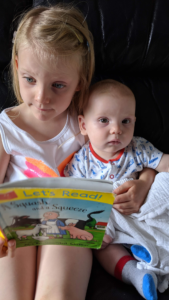
Even newborn babies benefit from hearing language every day.
The most rapid period of communication development happens between birth and three years, but the foundations begin long before babies say their first word.
Between 0 and 12 months, babies are learning:
- how speech sounds
- how conversations flow
- how voices express emotion
- how books work
- how words connect with real objects
- how people communicate with one another
Every experience is adding another piece to the puzzle.
The earlier these experiences begin, the richer those foundations become.
Why stories are so powerful for brain development
Books aren’t just about reading.
They’re about relationships.
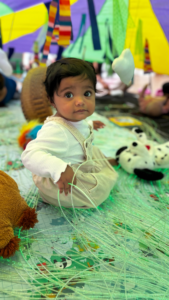
When you cuddle up together with a story, your baby is learning to:
- focus their attention
- listen for patterns
- recognise repeated words
- predict what happens next
- remember familiar characters
- associate language with positive emotions
All of these skills strengthen cognitive development while supporting future speech and language.
That’s one reason repetitive stories are so valuable.
Although adults sometimes tire of reading the same book for the hundredth time, babies absolutely love repetition.
Every repetition strengthens the neural pathways involved in memory, understanding and communication.
Why sensory play helps babies learn language
Some people think sensory play is mainly about textures and messy fun.
It is fun—but it’s doing much more than that.
When babies explore different sensory experiences, they’re constantly building connections between what they see, hear, touch, smell and eventually describe.
As adults, we naturally add language to those experiences.
“That’s cold.”
“Can you hear the rain?”
“The feathers are so soft.”
“Look how bright that light is.”
These shared experiences give words real meaning.
Rather than learning vocabulary in isolation, babies experience it through play.
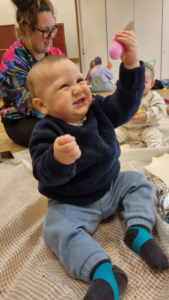
At Adventure Babies, every sensory activity is linked to a story, creating rich opportunities for babies to hear meaningful language in context while exploring with all their senses.
How Adventure Babies supports communication and cognitive development
Every part of an Adventure Babies class has been designed with baby development in mind.
Our immersive storytelling experiences combine books, music, sensory play and movement to create an environment where babies naturally want to engage.
Throughout each session, babies are encouraged to:
- listen to rich language
- hear repeated words and phrases
- observe facial expressions
- experience turn-taking
- build joint attention with their grown-up
- explore new vocabulary through sensory experiences
- develop memory through familiar stories and routines
Perhaps even more importantly, our classes help parents discover just how much their baby is already capable of.
Many parents leave saying things like:
“I didn’t realise my baby was paying so much attention.”
The truth is—they usually are.
Sometimes they simply need the right environment to show us.
Our sessions also give parents ideas they can easily recreate at home using books they already own, helping learning continue long after the class has finished.
👉 Find your nearest Adventure Babies class and discover how sensory storytelling can support your baby’s communication journey.
Five simple things you can do at home
You don’t need to turn your home into a classroom.
The best communication opportunities happen during everyday life.
Narrate your day
Talk through what you’re doing.
“I’m putting your socks on.”
“Can you hear the washing machine?”
Your baby is absorbing thousands of words every day.
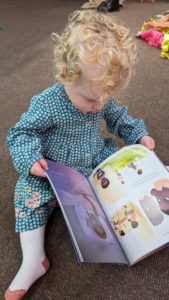
Read every day
Even five or ten minutes makes a difference.
The goal isn’t finishing the book.
It’s enjoying it together.
Pause and wait
When your baby babbles or smiles, pause before responding.
This teaches the back-and-forth rhythm of conversation.
Sing nursery rhymes
Songs slow language down, making patterns easier for babies to recognise and remember.
Follow your baby’s interests
If they’re fascinated by leaves, bubbles or dogs, talk about those things.
Babies learn best when they’re already interested.
Every conversation counts
It’s easy to worry that you’re not doing enough.
But the good news is this:
You don’t have to be perfect.
Your baby doesn’t need constant entertainment or a packed schedule of activities.
What they do need is responsive interaction, shared experiences and lots of opportunities to hear language in meaningful ways.
A cuddle while reading a book.
A smile during a nursery rhyme.
A conversation while folding the washing.
These ordinary moments are quietly shaping extraordinary brains.
At Adventure Babies, we’re passionate about helping parents make the most of them.
Because every story shared today is helping build tomorrow’s confident communicator.
Join an Adventure Babies Class
If you’re looking for a baby class that’s grounded in child development while still feeling magical, relaxed and full of fun, we’d love to welcome you.
Our sensory storytelling classes are designed for babies from birth onwards, giving parents the confidence to support their baby’s communication, cognitive development and love of books from the very beginning.
Find your nearest Adventure Babies class today and start your own storytelling adventure.