How Do Babies Learn? The Tiny Moments That Matter More Than You Think
If you have ever spent an afternoon worrying that you should be doing more with your baby, welcome to the club.
Most parents arrive there eventually.
Usually somewhere between scrolling past a social media post involving hand-painted sensory activities created from sustainably harvested moon dust and looking down at their own baby, who is currently fascinated by a receipt.
The pressure to constantly entertain, stimulate and enrich babies can feel relentless.
Are they getting enough sensory play?
Enough tummy time?
Enough books?
Enough activities?
Should you have bought the developmental toy?
Joined another class?
Created a sensory bin from seventeen carefully curated natural materials?
Meanwhile your baby is sitting on your lap watching the washing machine spin as though they have secured front-row tickets to the greatest show ever created.
And here is the thing many parents do not realise.
Your baby is learning.
A lot.
In fact, some of the most powerful learning experiences happen during the moments that look completely ordinary to us.
How Do Babies Learn? Not Quite How You Might Think
When adults think about learning, we often imagine lessons, instructions and information.
Babies have a completely different approach.
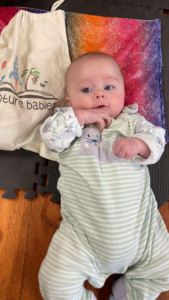
They learn by experiencing.
By watching.
Listening.
Touching.
Moving.
Connecting.
Every single day, your baby is gathering information about how the world works through thousands of tiny interactions.
Long before they understand words, they are studying faces.
Long before they can crawl, they are learning how movement feels.
Long before they can speak, they are absorbing language.
According to Harvard Center on the Developing Child
, a baby’s brain forms over one million neural connections every second during the earliest years of life. These connections are built through responsive relationships and everyday experiences.
Not through perfection.
Not through expensive equipment.
Through connection.
Your Baby Thinks You Are Fascinating
One of the funniest things about babies is how deeply interested they are in things adults find completely boring.
You may be unloading the dishwasher.
Your baby thinks this is a live performance worthy of a standing ovation.
You may be folding laundry.
Your baby watches with the concentration of somebody preparing for a university entrance exam.
You may simply be making toast.
Your baby is absolutely captivated.
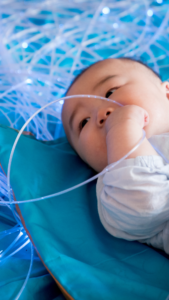
This is because babies are constantly observing.
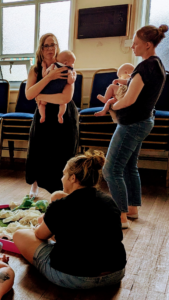
They are learning from your facial expressions, your voice, your movements and your reactions. They are discovering patterns, routines and social communication through the ordinary business of everyday life.
To your baby, you are not just making lunch.
You are demonstrating how humans interact with the world.
And honestly, they cannot get enough of it.
The Magic Hidden Inside Everyday Moments
Parents often underestimate how much learning happens outside of organised activities.
A walk around the block exposes your baby to changing light, sounds, smells and movement.
Watching leaves move in the wind teaches visual tracking and attention.
Listening to birds provides rich sensory experiences.
Feeling a breeze across their face introduces entirely new sensations.
Even sitting quietly together in the garden can become a remarkable developmental experience for a young baby.
According to NHS Start for Life
, talking, singing, reading and interacting with babies throughout the day all help support communication and language development.
Notice that none of those things require batteries.
Or Pinterest.
Or a £50 developmental toy.
Why Reading Together Matters So Much
Of all the tiny moments that support learning, sharing books together remains one of the most powerful.
Not because your baby understands the story.
Most young babies have absolutely no idea what happens in the book.
What they are responding to is something much bigger.
The rhythm of your voice.
The closeness of sitting together.
The repetition.
The pictures.
The emotional connection.
When you read to your baby, you are building language, attention, attachment and communication all at once.
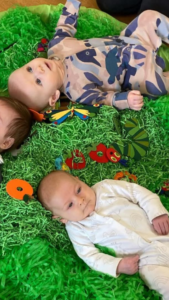
This is one of the reasons sensory storytelling sits at the heart of Adventure Babies classes
.
Books are not simply something children listen to.
They become experiences.
Stories are explored through movement, sensory play, music, imagination and shared discovery because that is how young children naturally engage with the world.
Not by sitting quietly and absorbing information, but by experiencing it.

Your Baby Is Learning From Other People Too
One of the loveliest things about babies is how interested they are in humans.
Especially other babies.
Parents often assume social development happens much later, but even very young babies are fascinated by faces, voices and interactions.
When your baby watches you chatting to another parent, they are learning.
When they hear conversations, they are learning.
When they observe another baby exploring, smiling or making noises, they are learning.
This is one of the hidden benefits of baby classes that often gets overlooked.
The sensory play is wonderful.
The stories are wonderful.
But so is simply being together.
At Adventure Babies, babies are surrounded by language, faces, emotions, movement and shared experiences. They are learning about people as much as they are learning about sensory play.
And while babies are building those early social foundations, parents are often building something important too.
Friendships.
Community.
A village.
The Problem With Modern Parenting Pressure
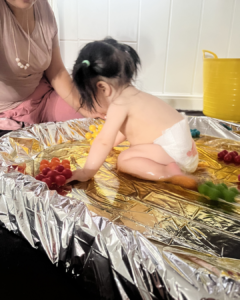
Somewhere along the way, many parents have absorbed the idea that learning only counts if it looks impressive.
If there is a worksheet.
A structured activity.
A developmental objective.
But babies have not read the parenting books.
They do not know they are supposed to be impressed by expensive toys.
They remain stubbornly fascinated by cardboard boxes, shadows, your face and the dog.
The truth is that babies learn best through relationships.
Through conversation.
Through exploration.
Through feeling safe enough to be curious.
The research consistently points in the same direction: responsive, loving interactions are some of the most powerful building blocks for healthy development.
Which is wonderful news.
Because it means many of the things you are already doing matter enormously.
Your Baby Doesn’t Need a Perfect Childhood
Perhaps the most reassuring thing about understanding how babies learn is realising what they do not need.
They do not need every minute planned.
They do not need endless entertainment.
They do not need a parent who gets everything right.
What they need is connection.
A face that smiles back.
A voice that responds.
A cuddle when they are upset.
A story shared together.
A walk in the fresh air.
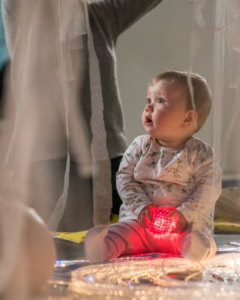
A chance to explore.
At Adventure Babies, everything we do is built around those simple principles. Sensory storytelling, play, books, movement and community all work because they tap into the way babies naturally learn best.
Not through pressure.
Not through performance.
Through connection.
So the next time you catch your baby staring at you while you unload the dishwasher, remember this:
They are not waiting for something more interesting to happen.
To them, it already is.