Do Babies Who Hear More Stories Learn to Talk Earlier?
You’re reading Dear Zoo for approximately the 147th time.
Your baby has eaten the corner, skipped three pages, grabbed your face and wandered off mentally halfway through the elephant.
It may not feel like a particularly sophisticated literacy session.
But something much more interesting is happening.
Your baby is listening to the rhythm of your voice, watching your face, hearing the same words return and beginning to notice that sounds, pictures, objects and people somehow belong together.
So, does reading to babies help them talk?
Research suggests that sharing books during infancy can support the foundations of language development, and studies have found links between early shared reading and later vocabulary and language skills.
That doesn’t mean reading three books a day will make your baby say their first word three weeks earlier.
The really interesting part isn’t how many stories you get through.
It’s what happens between you and your baby while you’re sharing them.
Your baby doesn’t need to understand the story yet
This is perhaps the biggest misconception about reading to babies.
Parents sometimes feel slightly ridiculous reading a story to a four-month-old who clearly has absolutely no idea why a tiger has come to tea.
But understanding the plot isn’t the point.
Long before babies can say words, they’re gathering information about language. They hear its rhythm and repetition, notice changes in your tone and gradually begin to recognise familiar sounds.
The NHS recommends talking, singing and responding to babies’ sounds from birth. From around 6–12 months, it also encourages parents to look at books together, point to things and talk about the pictures rather than worrying about reading every word.
That’s important because reading with a baby isn’t really a performance.
It’s an interaction.
The clever bit happens when you stop reading
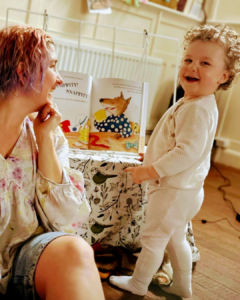
Imagine you’re looking at a book with a picture of a dog.
You say, “Dog!”
Your baby stares at it.
Then they look at you.
You make a ridiculous barking noise.
They grin.
You do it again.
Your baby squeals, kicks their legs or makes a noise back.
At this point, you’ve completely abandoned whatever the author wrote.
Developmentally, however, something rather lovely has happened.
You noticed what interested your baby, responded to it and then gave them space to respond to you.
That’s the beginning of conversation.
Babies don’t suddenly start learning communication on the day they say their first word. Long before speech appears, they’re learning that communication moves backwards and forwards between people.
You do something.
They respond.
You notice.
They do it again.
A book gives that interaction somewhere to happen.
Does reading to babies help them talk? Yes — but probably not in the way you think
A fascinating 2024 study looked at shared book reading between parents and nine-month-old babies and then examined the children’s language skills at 18 months. The researchers weren’t simply interested in whether a book had been opened; they looked at both the frequency and quality of shared reading and at babies’ attention during it.
Another large study involving 1,442 children aged 12 and 24 months found a positive association between shared book reading and vocabulary at both ages. Because this was observational research, it can’t prove that books alone caused those vocabulary differences.
That’s an important distinction.
Babies who hear lots of stories may also experience lots of conversation, songs, responsive interaction and language throughout their day. Families differ in countless other ways too.
So we shouldn’t turn reading into another parental competition.
Instead, the research gives us a much more useful message.
Books create brilliant opportunities for language.
A book contains words you might not use over breakfast
Think about the conversations you naturally have with a baby.
“Here’s your sock.”
“Where’s your spoon?”
“Shall we change your nappy?”
“No, please don’t lick the trolley.”
All excellent language, obviously.
Stories take you somewhere else.
Suddenly you’re talking about tigers, rockets, enormous turnips, bears, forests, dinosaurs, moons and creatures that definitely don’t live anywhere near your kitchen.
Books introduce babies to language beyond the practical vocabulary of everyday life.
They also give words a visual anchor. When you point at the duck and say “duck”, your baby can begin making connections between the sound they hear and the picture you’re both looking at.
BookTrust explains that sharing books can help children learn words and express themselves, while also creating opportunities for closeness, connection and learning about the wider world.
For a baby, that’s a lot happening on one cardboard page.
Repetition isn’t boring to your baby
Adults tend to crave novelty.
Babies are rather less concerned.
If your baby wants the same story again and again, you may find yourself wondering whether hiding it behind the sofa would make you a terrible parent.
Try to hang on.
Repetition gives babies another chance to hear the same sounds, rhythms and words. Familiarity can also create anticipation.
Eventually, your baby may recognise what’s coming before you’ve turned the page.
Perhaps their eyes widen at a familiar picture, their body starts bouncing before your silly voice appears or they make a sound at exactly the same point every time.
Those reactions matter.
Your baby isn’t just passively hearing a book. They’re beginning to participate in something familiar.
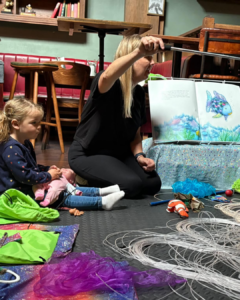
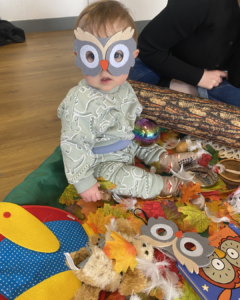
At Adventure Babies, we see this beautifully when stories, characters, sounds and actions become part of the sensory experience. A baby may not understand every word, but they can recognise a repeated sound, anticipate an action or respond when a familiar character appears.
Storytelling becomes something they experience rather than simply hear.
Your baby does not need to sit still
This deserves its own section because it causes so much unnecessary parental worry.
A baby who grabs the pages, turns backwards, chews the book, looks away or crawls off has not failed reading.
They’re a baby.
BookTrust specifically reassures parents that you don’t need to read a book from beginning to end, get every word right or even read the written words at all. Talking about the pictures counts too.
For younger babies, reading might mean lying beside them with a high-contrast book and talking about one picture.
At six months, the book may mainly be an exciting object to grab.
By ten months, your baby might enthusiastically turn four pages at once.
None of this needs correcting.
Follow their attention rather than trying to complete the story.
If they’re staring at the duck, stay with the duck.
The goal isn’t finishing the book. It’s sharing the moment.
Your voice changes when you tell a story
Here’s another reason books are interesting for babies.
Most of us don’t read a children’s book in exactly the same voice we use to ask somebody to unload the dishwasher.
We slow down, exaggerate certain sounds, change our pitch, repeat phrases and use ridiculous voices we’d deny ever making if another adult walked into the room.
That expressive language catches babies’ attention.
BookTrust’s overview of research into reading with babies describes how the rhythm of child-directed language can support babies as they detect patterns in speech. It also highlights something Adventure Babies has always felt strongly about: face-to-face shared reading allows adults to notice a child’s attention and adapt what they’re doing in response.
In other words, you aren’t broadcasting a story at your baby.
You’re constantly adjusting it with them.
That’s a very different experience.
This is why we put stories at the heart of Adventure Babies
When we created Adventure Babies, books weren’t added as a nice little extra before the sensory play.
The story is the structure.
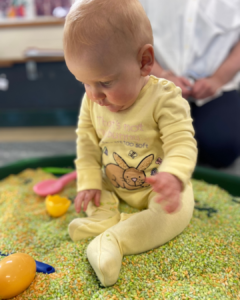
Sensory experiences, puppets, movement, sounds, messy play and characters bring different parts of that story to life, giving babies something meaningful to look at, reach towards, listen to and respond to.
A character appearing from a book might prompt a baby to stare.
You notice.
Your baby looks towards you.
You name the character, make a sound or repeat a phrase.
Suddenly there’s a tiny interaction happening around the story.
That’s why we think sensory storytelling is so powerful. Sensory play gives babies something to explore, while stories give adults and babies something to share.
If you’d like to experience it together, you can find your nearest Adventure Babies class and discover how we use stories throughout our baby classes.
You don’t need to turn storytime into a lesson
Once parents discover that reading can support language development, it’s very easy for another thought to creep in.
Am I doing enough?
Please don’t turn The Very Hungry Caterpillar into an assessment.
You don’t need to test whether your baby knows where the apple is, repeatedly ask them to point at the dog or worry because somebody else’s baby appears to be saying “duck” while yours is licking it.
Language develops at different rates.
Instead, make reading enjoyable.
Point things out when it feels natural. Copy your baby’s sounds, pause occasionally and see whether they respond. Make the silly noise again when they clearly love it.
Sometimes read the actual story.
Sometimes completely abandon it.
If your baby only wants to look at one page, enjoy that page together.
The NHS advice on helping babies learn to talk repeatedly comes back to interaction: looking at your baby, talking about everyday life, copying their sounds, singing, naming things and sharing books.
No flashcards required.
The number of books isn’t the most interesting number
So, do babies who hear more stories learn to talk earlier?
We can’t confidently say that reading a certain number of books will make an individual baby talk sooner. First words depend on many aspects of development, and babies follow their own timelines.
What we can say is much more useful.
Research links shared reading in infancy with language development and vocabulary, while organisations including the NHS and BookTrust encourage parents to share books, talk, sing and respond to babies from the earliest months.
BookTrust has also found that children whose families started sharing books during the first year were more likely to still experience daily shared reading at ages five to seven than children whose families began later. That’s an association rather than proof that starting earlier caused the later habit, but it suggests that the tiny routines we begin with babies can grow with them.
Perhaps that’s the loveliest reason to start.
Your three-month-old doesn’t need to understand the ending.
Your seven-month-old doesn’t need to stop eating the book.
Your ten-month-old doesn’t need to point at the right picture.
Just open one together.
Talk, look, laugh, pause and respond.
Because before your baby ever says a word to you, they’re already learning what it feels like to have a conversation.
And a story is a rather lovely place for that conversation to begin.