More Than Eating: How Weaning Builds Your Baby’s Skills
There comes a point during weaning when you look at your baby, then at the floor, then at the food you were fairly sure was supposed to go inside them.
Somehow, a carefully prepared lunch has become an experiment involving a piece of broccoli, one sock and the underside of the highchair. Your baby, meanwhile, looks extremely pleased with how things are progressing.
It can be tempting to judge a meal by how much your baby actually eats, particularly in those early weeks when weaning already comes with so many questions. Yet when we ask how does weaning help baby development, eating turns out to be only part of the story.
Reaching, grasping, coordinating hands and eyes, exploring textures, copying you, communicating preferences and discovering cause and effect can all happen during an ordinary lunch.
Your baby’s highchair is surprisingly busy.
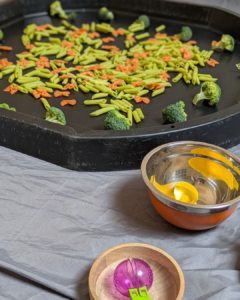
Eating is actually quite a complicated physical skill
Picking up a piece of banana doesn’t feel impressive when you’re an adult, but watch a baby learning to do it and you begin to appreciate just how much coordination it requires.
They need to see the food, judge where it is, move their arm towards it and close their hand around something that may be inconveniently slippery. Then comes the rather ambitious task of getting it to their mouth.
Sometimes it reaches the mouth.
Sometimes the forehead gets involved.
Both attempts require practice.
The NHS guidance on introducing solid foods explains that babies are generally ready to start solid foods from around six months. Signs of readiness include being able to stay sitting with a steady head, coordinating their eyes, hands and mouth so they can look at food, pick it up and bring it to their mouth, and swallowing food rather than pushing it back out.
When you read those skills together, something becomes very clear: eating involves far more of your baby’s developing body than their mouth.
How does weaning help baby development physically?
Those early attempts to pick up food give babies lots of opportunities to practise using their hands.
At first, they may scoop food towards themselves or grasp it with their whole hand. As their control develops, their fingers become increasingly useful and precise.
These aren’t skills that belong only at the dinner table. Your baby uses the same developing hand-eye coordination when reaching for a toy, exploring objects, turning the pages of a board book or investigating the sensory resources at an Adventure Babies class.
That’s one of the fascinating things about baby development: the different areas don’t sit neatly apart from one another.
A simple piece of toast can involve vision, balance, reaching, grasping, sensory processing and coordination before your baby even takes a bite.
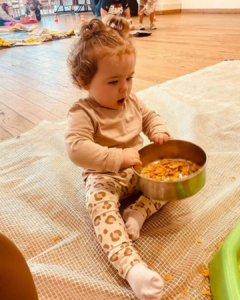
Weaning introduces a completely new sensory world
Your baby has spent their first months gathering information through touch, sight, sound, smell and movement. Then weaning arrives and suddenly there’s an extraordinary collection of new experiences sitting on the tray in front of them.
Cold yoghurt feels completely different from warm porridge. Toast behaves nothing like avocado, while a strawberry brings colour, smell, texture and taste together in one slightly slippery package.
This is one reason weaning can be such a rich sensory experience.
However, sensory development doesn’t mean exposing babies to as much stimulation as possible.
Some babies enthusiastically reach for anything new. Others prefer to watch first, cautiously touch something with one finger or experience a food several times before they feel comfortable investigating further.
Neither response is wrong.
We talk about this a lot in our Adventure Babies sensory classes because meaningful sensory exploration happens when babies have time to notice and investigate rather than feeling pushed towards a particular response.
The same idea can help at mealtimes too.
That squashed raspberry isn’t necessarily going to waste
Adults tend to measure the success of food by whether somebody eats it.
Babies haven’t agreed to these terms.
When your baby presses a finger into a raspberry, squeezes a piece of banana or turns something over repeatedly, they are finding out what that object does.
How does it feel when I press it? Does it change shape? Can I pick it up? What happens when I squeeze harder?
Of course, weaning exists to help babies move towards eating a varied diet, so we don’t need to pretend every abandoned carrot represents an advanced scientific investigation.
However, exploration really does matter.
The NHS recommends gradually introducing babies to a range of tastes and textures, while allowing plenty of time for them to get used to new foods. NHS Start for Life weaning advice also reminds parents that babies don’t need three meals a day immediately when they first start solids.
That takes some pressure off everyone.
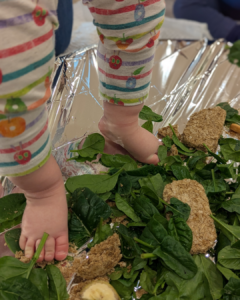
And then they discover gravity
At some point during weaning, many babies make an extremely important discovery.
Things fall down.
Unfortunately for you, this experiment has excellent repeatability.
Your baby releases the spoon, watches it disappear and waits. You pick it up, which makes the whole sequence even more interesting because they’ve now discovered that their own action can produce a reaction from you.
Suddenly the experiment isn’t simply about gravity. It has become social.
Babies spend much of their first year exploring cause and effect. They shake things to create sounds, push objects to make them move and repeat actions because repetition helps them understand what will happen next.
We see exactly this sort of fascination during Adventure Babies classes. Something an adult might dismiss as “doing the same thing again” can be a baby carefully exploring an interesting result.
Knowing that doesn’t mean you have to retrieve a spoon 84 times over lunch.
It does make the 17th time marginally more interesting.
Your baby is communicating before they can ask for more
Perhaps one of the most overlooked answers to how does weaning help baby development involves communication.
A baby doesn’t need words to tell you quite a lot about dinner.
They might lean towards something that interests them, reach for more, look between you and the food or turn away when they’ve had enough. Facial expressions, movements, sounds and gestures all become part of the exchange.
When you notice and respond, your baby gets another tiny lesson in how communication works.
They reach towards the banana and you say, “You’d like some more banana.”
A sound gets your attention, so you respond.
They look towards something and you follow their gaze.
These moments might seem insignificant, but they’re part of the enormous amount of communication practice happening before first words appear.
The NHS advice on helping babies learn to talk encourages parents to respond to babies’ sounds and talk naturally about what’s happening around them.
Mealtimes give you plenty to talk about without inventing a special language activity.
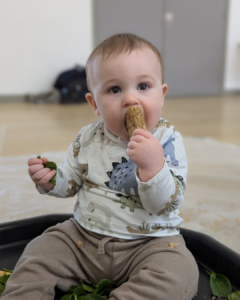
Food gives words something to mean
Think about how much useful language naturally appears during one meal.
You might talk about something being cold, soft, sticky or crunchy. Perhaps you’ll name the banana as your baby reaches towards it, or say “more?” when they look hopefully at the bowl.
Suddenly words aren’t abstract sounds.
Your baby can see the banana while hearing its name. They can experience something cold while hearing you describe it as cold, or watch an object disappear while you say “all gone”.
This connection between language and real experiences is something we use throughout Adventure Babies too.
Stories give us a structure, while sensory experiences, movement, puppets and objects give babies something meaningful to notice and respond to. If you’re interested in this side of development, our Does Reading to Babies Help Them Talk? article explores how shared stories can create some of those very early back-and-forth conversations.
Babies don’t divide their day into “language development”, “physical development” and “sensory development”.
Everything overlaps.
Babies also learn by watching you eat
We spend an enormous amount of time watching babies, but babies are equally busy watching us.
During meals, they see you pick things up, bring food towards your mouth, chew, drink and react to different tastes. As they grow, they’re also beginning to experience the social rhythm of eating with other people.
You don’t need to stage a perfect family dinner to make this valuable.
If you’re eating toast beside the highchair while wondering how it can possibly only be 8.07am, your baby still has someone to observe.
Ordinary family life provides a huge amount of learning without us deliberately turning it into a developmental activity.
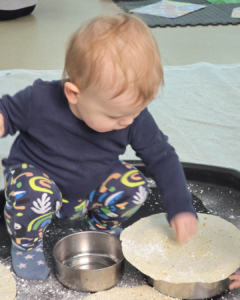
Messy play and weaning have something interesting in common
There is a connection here with the sensory and messy play we use at Adventure Babies, although food exploration and sensory play aren’t exactly the same thing.
Both allow babies to learn through direct experience.
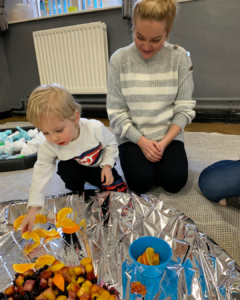
At one of our classes, one baby might immediately plunge both hands into a sensory experience while the baby beside them watches intently before eventually reaching out with one finger.
We don’t consider one response better than the other.
Babies have different temperaments and different responses to unfamiliar sensations, which is why we give them space to approach sensory experiences in their own way.
Food can work similarly. A baby may need time to look, smell, touch and become familiar with something before they’re ready to eat it.
That doesn’t mean every meal needs to become messy play. It simply means we can sometimes look beyond the amount eaten and notice the exploration happening around it.
What about baby-led weaning versus spoon-feeding?
Weaning can become strangely tribal online.
Baby-led weaning can appear to be on one side, purées on the other, with exhausted parents somewhere in the middle wondering whether they’re doing any of it correctly.
Families choose different approaches, and plenty combine finger foods with spoon-feeding.
The NHS recommends offering a variety of tastes and textures and letting babies feed themselves with their fingers as soon as they show an interest. It also suggests gradually moving towards mashed, lumpy and finger foods as babies develop.
From a developmental point of view, the useful part is participation.
Babies gradually get opportunities to handle appropriate foods, experience different textures and become increasingly involved in eating.
You don’t need to win weaning.
You just need to find an approach that works safely for your baby and family.
A quick word about safety
Weaning is exciting from a developmental perspective, but safety comes first.
Babies need appropriate foods and textures for their developmental stage, and an adult should always supervise them while they eat. Parents also need to understand the difference between gagging and choking and know which foods present a choking risk.
The NHS guidance on food safety and hygiene during weaning is worth bookmarking rather than relying on conflicting social-media advice.
Developmental opportunities only matter when babies can explore safely.
Please don’t make lunch another thing you have to optimise
Once you realise how much learning can happen during a meal, there’s a danger of turning lunchtime into another task parents feel they should be doing “better”.
That’s really not the point.
You don’t need educational placemats, colour-coded vegetables or an elaborate Montessori weaning set-up.
Nor does every spoonful need a developmental commentary.
Offer appropriate food safely, involve your baby and talk naturally when you feel like it. Give them opportunities to practise, notice what they’re interested in and accept that some meals will go considerably better than others.
Maternity leave doesn’t need another performance target.
Baby development is already happening in ordinary life
Perhaps this is the most reassuring answer to how does weaning help baby development.
Development isn’t something you have to fit into the gaps between feeding, changing, naps, washing and getting out of the house.
It’s already happening within those ordinary moments.
While reaching for toast, your baby practises movement and coordination. Exploring a new texture gives them sensory information, while watching something fall introduces cause and effect. Looking towards you for more creates an opportunity for communication.
None of it needs to look particularly educational.
At Adventure Babies, we create more opportunities for babies to explore through sensory storytelling, movement, books, messy play and responsive interaction, but we also want parents to understand just how much their babies are already learning outside class.
If you’d like to explore more together — without having to plan or clear up another activity yourself — you can find your nearest Adventure Babies class and come and join us.
Weaning may begin because your baby is ready to discover food.
Somewhere between the first taste and the food-covered floor, however, they’re also discovering what their hands can do, how their actions affect the world and how wonderfully interesting everyday life can be.