Tiny Fingers, Big Job: Learning to Turn the Pages of a Book
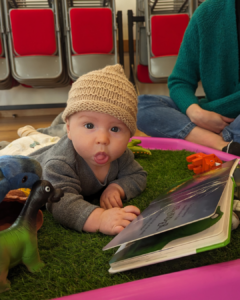
Have you ever watched your baby try to turn the page of a book?
Perhaps they grab three pages at once, accidentally close the whole thing or spend five minutes trying to lift one stubborn corner. Meanwhile, you’re patiently waiting to discover whether the bear ever finds his way home.
It looks like such a simple thing. After all, turning a page takes us less than a second.
But for your baby, it’s actually a rather complicated achievement.
Those tiny fingers are learning to work together, their eyes are guiding their movements, and their brain is figuring out how to make something happen.
If you’ve been wondering how to teach a baby to turn book pages, there’s some fascinating science behind this little milestone.
And the best part? You don’t need to teach it in the traditional sense. Your baby can discover these skills through everyday play, exploration and plenty of lovely stories together.
Why turning a page is a surprisingly big developmental achievement
Think about everything your baby needs to do to turn a page.
First, they must notice the page and decide to reach for it. Then their brain needs to coordinate their arm, hand and fingers.
Next comes the tricky bit.
They need to grip the page, lift it and move it across the book. Eventually, they’ll learn to release it at just the right moment.
All of this requires several developing skills to work together.
And that’s before we consider the enormous temptation to abandon the book halfway through because something far more interesting has appeared on the carpet.
According to BookTrust’s guidance on books and fine motor development, turning pages gives young children opportunities to practise hand-eye coordination and increasingly precise finger movements.
So, while you might see a baby enthusiastically wrestling with a board book, there’s actually some important physical learning taking place.
Your baby’s hands are changing faster than you might realise
One of the most fascinating things about babies is how quickly their ability to use their hands develops during the first year.
A newborn’s grasp is largely reflexive. Place your finger against their palm and those tiny fingers may curl around it automatically.
Over the following months, that changes.
Your baby gradually begins reaching towards objects intentionally. They start opening their hands, exploring different shapes and learning how to hold things.
By around six months, many babies can grasp toys using their whole hand.
A little later, they become more skilled at transferring objects between their hands.
Towards the end of their first year, many begin developing a more precise grip using their thumb and index finger.
This is called the pincer grip, and it’s a particularly important development.
The NHS Healthier Together guidance on hand skills explains how these abilities typically develop throughout infancy.
Of course, babies don’t all follow exactly the same timetable.
But every time your baby reaches, grasps, releases or explores an object, they’re gaining experience with movements that will eventually help them handle books.
When do babies start turning book pages?
This is one of those milestones that can look very different from one baby to another.
During the first few months, your baby may enjoy watching you turn pages while listening to your voice.
As their reaching and grasping improve, they might begin patting the pictures, grabbing the edge of a book or attempting to move a page.
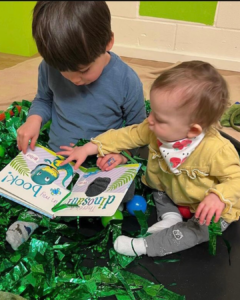
By around nine to twelve months, some babies start helping adults turn the pages of sturdy books.
However, turning one page at a time is a more demanding skill that often develops well into toddlerhood.
The NHS describes helping to turn book pages as a skill that can emerge towards the end of the first year.
So, if your ten-month-old enthusiastically turns five pages at once, there’s no reason to worry.
They’re still exploring how books work.
And if your baby would rather hold the book upside down and examine the back cover, that’s fine too.
The clever connection between your baby’s eyes and fingers
Here’s something particularly interesting.
Turning a page isn’t simply about finger strength.
Your baby’s brain must also coordinate what their eyes see with what their hands do.
This is called hand-eye coordination.
Imagine your baby spotting the corner of a page.
Their eyes help them locate it, while their brain guides their hand towards the right place.
Once they touch the page, sensory information from their fingers helps them adjust their grip.
If the page slips, they might try again using a slightly different movement.
Over time, these repeated experiences help babies become more accurate and confident with their hands.
It’s the same broad process that supports many other everyday activities, from reaching for toys to picking up finger foods.
And it explains why something as ordinary as exploring a board book can offer so many opportunities for physical development.
Why your baby keeps turning backwards
If you’ve ever tried reading a book with a determined nine-month-old, you’ll know that the story rarely progresses in the intended direction.
You turn to page three.
Your baby turns back to page one.
You try again.
They close the book.
You reopen it.
They immediately return to page one.
At some point, you accept that the main character is never going to reach the end of their adventure.
But there’s an interesting reason why babies enjoy repeating actions.
During the first year, babies become increasingly interested in how their actions affect the world.
They shake objects to produce sounds, drop toys to watch them fall and push things to see what moves.
Turning a page offers another opportunity to explore cause and effect.
When your baby moves the page, the picture changes.
Something they did has created a visible result.
We can’t know exactly what an individual baby understands from that experience. However, repeated actions give them opportunities to explore relationships between movement and what happens next.
And sometimes, the process is simply more interesting than the story.
How to teach a baby to turn book pages without making it a lesson
The easiest way to help your baby learn is to make books available and allow them to explore.
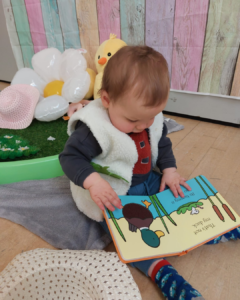
Start with sturdy board books that can withstand enthusiastic handling.
For younger babies, hold the book where they can see the pictures and watch you turn the pages.
As your baby becomes more interested in reaching, let them touch the book and explore its edges.
You might notice them placing their whole hand across a page before gradually becoming more interested in the corners.
When they’re ready, try lifting the edge of a thick page slightly and allowing them to complete the movement.
There’s no need to guide their fingers through every step.
Give them time to experiment.
They may miss the page completely, grab several at once or decide that closing the book is much more satisfying.
That’s all part of learning.
The NHS guidance on early hand development recommends offering babies age-appropriate objects, including books, that encourage reaching, grasping and exploration.
Most importantly, keep the experience enjoyable.
Your baby doesn’t need to master page-turning by a particular birthday.
Why board books are brilliant for little hands
There’s a good reason why board books are so popular with babies.
Their thick pages are easier for developing hands to grasp than ordinary paper pages.
They also provide resistance, which can make the movement easier to control.
For a baby still learning to coordinate their fingers, a thin paper page can be surprisingly difficult to separate.
Board books offer a more manageable starting point.
Books with different textures, flaps or moving parts can introduce additional opportunities for exploration.
However, babies don’t need elaborate features to enjoy books.
A simple picture book with clear images and sturdy pages can be just as engaging.
You might find that your baby spends far longer exploring how the book opens and closes than looking at the pictures.
And that’s absolutely fine.
They’re discovering that books are physical objects they can interact with.
There’s another skill hiding inside this milestone
When babies begin handling books, they’re also starting to discover something about how books work.
Adults understand that books have a front and back, that pages follow an order and that turning them reveals new information.
Babies don’t arrive knowing any of this.
Instead, they gradually become familiar with books through repeated experiences.
They watch adults open them, notice pictures appearing and begin recognising that pages can move.
Over time, they may start anticipating familiar pictures or reaching towards favourite pages.
These experiences contribute to their growing familiarity with books, an early part of developing literacy.
Of course, a baby turning a page isn’t demonstrating that they understand reading.
But they’re beginning to explore an object that will eventually become central to their learning.
And that makes those early experiences rather special.
The connection between page-turning and learning to write
This is one of my favourite things about early development.
The skills babies practise today often become useful for completely different activities later on.
When your baby reaches for a book, adjusts their grip or lifts a page, they’re gaining experience controlling their hands and fingers.
These are known as fine motor skills.
As children grow, fine motor development supports everyday tasks such as fastening clothes, using drawing tools and eventually writing.
BookTrust also highlights how handling books can support physical skills, including movements involving the hands, wrists and fingers.
That doesn’t mean turning pages directly teaches a baby to write.
Writing is a much more complex skill that develops over several years.
However, the coordination involved in exploring books belongs to the same broad area of physical development.
It’s lovely to think that such an ordinary activity can form part of a much bigger journey.
Why we love books at Adventure Babies
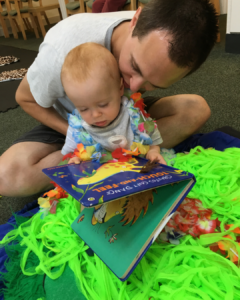
At Adventure Babies, books have always been at the heart of what we do.
Since 2013, we’ve been bringing stories to life through sensory experiences, movement, puppets and interactive play.
As early-years specialists, we’re passionate about helping parents understand the development happening during these experiences.
And sometimes, the smallest moments are the most interesting.
A baby reaching towards a puppet is practising coordination.
Another baby exploring a sensory texture is discovering how something feels.
Meanwhile, a little adventurer might be fascinated by the pages of the storybook itself.
All these experiences provide opportunities for babies to explore using their developing senses and movements.
Our Adventure Babies sensory storytelling classes are designed to welcome babies at different developmental stages.
We don’t expect babies to sit still or interact with resources in exactly the same way.
Instead, we create opportunities for them to explore, respond and enjoy stories alongside their grown-ups.
And for parents, there’s the added bonus of meeting other families who understand just how exciting a successful page turn can be!
Your baby’s first experiences with books matter
It’s easy to focus on reading as something children will learn when they’re older.
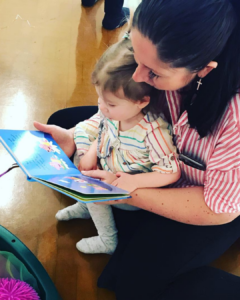
But a positive relationship with books can begin long before a child understands written words.
Your baby might enjoy hearing your voice, watching your expressions or exploring the pictures.
As they grow, they may begin recognising familiar characters and showing excitement when a favourite book appears.
Eventually, they might insist on turning every page themselves.
These shared experiences help make books familiar and enjoyable.
The UK children’s reading charity BookTrust encourages families to introduce books from infancy. Its Bookstart Baby programme also provides free book packs for eligible families with babies under one in England, Wales and Northern Ireland.
You don’t need an enormous collection of books to get started.
A few favourites, enjoyed regularly, can provide plenty of opportunities for exploration and interaction.
So, should you help your baby turn the pages?
Absolutely, if they’re interested.
But there’s no need to turn it into a developmental exercise.
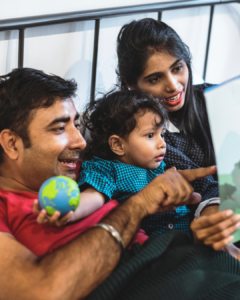
Offer your baby a sturdy book, give them opportunities to explore and follow their lead.
Some days, they’ll enjoy looking at the pictures. Other days, they’ll want to open and close the cover repeatedly.
They might turn every page at once or become fascinated by one particular illustration.
Whatever happens, enjoy the moment.
Because learning how to turn a page isn’t simply about mastering a movement.
It’s part of your baby’s growing ability to explore, coordinate their body and discover how the world works.
And one day, probably sooner than you expect, those tiny fingers will confidently turn a page without any help at all.
You might even miss the days when it took five minutes to get past the front cover.
Come and discover the wonderful world of stories with Adventure Babies
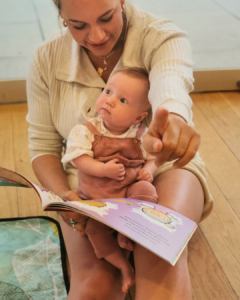
At Adventure Babies, we believe stories should be experienced, explored and enjoyed from the very beginning.
Our award-winning sensory storytelling classes bring books to life through movement, sensory play, puppets and plenty of opportunities for babies to explore at their own pace.
Whether your baby is just beginning to reach for objects or has already developed a determined little grip, there’s an adventure waiting for them.
And there’s a lovely community of other parents waiting for you, too.
Find your nearest Adventure Babies class and join us for a storytelling adventure.