
The Tiny Grip That Changes Everything: Your Baby’s Pincer Grasp
There’s a rather funny stage of baby development when your child suddenly becomes obsessed with things you would rather they didn’t pick up.
The tiniest piece of fluff on the carpet. A crumb you somehow missed after breakfast. Something so small that you have to get down on your hands and knees to work out what they’ve found.
Meanwhile, the lovely toy you’ve put right in front of them is apparently of absolutely no interest.
If you’ve reached this stage, you’ll know exactly what I mean.
But that determined little inspection of the carpet is actually a sign of something rather clever happening.
Your baby is learning to use their thumb and fingertip together to pick up tiny objects. It’s called the pincer grasp, and it’s one of those developmental achievements that looks completely ordinary until you understand just how much work has gone into it.
At Adventure Babies, we spend a lot of time thinking about the skills babies develop through everyday play. And this is one of my favourites, partly because it’s so easy to miss and partly because it explains some of the wonderfully strange things babies do.
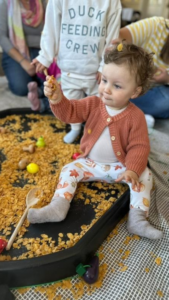
When do babies develop the pincer grasp?
Most babies begin developing a pincer grasp during the second half of their first year, with a more precise thumb-and-fingertip grip often emerging around nine to twelve months.
But it doesn’t appear overnight.
Think back to your baby’s first attempts at picking something up. They probably reached with their whole arm, opened their hand and hoped for the best. Sometimes they grabbed the toy. Other times they enthusiastically whacked it across the room.
Over the following months, their movements become more controlled.
At first, babies tend to use their whole hand to grasp objects. Later, they become better at using their fingers and thumb together, eventually managing smaller and more precise movements.
This is a gradual process, and there’s plenty of variation between babies.
The NHS Start for Life guidance provides useful information about development during your baby’s first year, while your health visitor can offer advice if you’re concerned about your baby’s hand skills.
One thing I always remind parents is that developmental milestones aren’t deadlines. Your baby doesn’t know what the milestone charts say, and they certainly aren’t trying to keep up with the baby next to them.
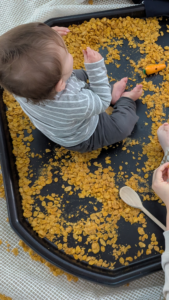
Why is the pincer grasp such a big deal?
Try picking up a tiny piece of paper using only the palm of your hand.
It’s surprisingly difficult.
Now use your thumb and index finger.
Easy, isn’t it?
That simple movement gives us an enormous amount of control over the objects we handle. But your baby has spent months developing the coordination needed to do it.
The pincer grasp is part of fine motor development, which involves increasingly precise movements of the hands and fingers.
Your baby needs to see the object, judge where it is, move their hand towards it and adjust their fingers to grasp it.
They also need to apply enough pressure to hold it without losing control.
And once they’ve picked it up, they have another challenge: learning how to let go.
It’s a complicated sequence for someone who, just a few months earlier, was still getting to grips with the fact that their hands belonged to them.
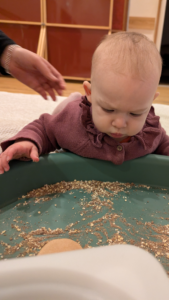
Why babies suddenly notice every tiny thing
This is the part I find particularly interesting.
Parents often notice their baby’s new ability to pick up tiny objects at roughly the same time that those objects become absolutely fascinating.
It’s tempting to think your baby has suddenly developed a special interest in carpet debris.
In reality, several developing abilities are coming together.
Your baby’s vision has been improving throughout their first year. They’re becoming better at directing their attention towards objects and coordinating what they see with what their hands do.
At the same time, their fingers are becoming more capable of manipulating smaller things.
So an object that was previously difficult to investigate may suddenly offer a new challenge.
Your baby sees it, reaches towards it and discovers that they can actually pick it up.
And once they’ve worked that out, naturally they want to try again.
It’s worth remembering that babies also explore objects with their mouths, so anything small enough to pose a choking risk needs to stay well out of reach.
The NHS advice on keeping babies and young children safe is a useful reminder of how quickly new physical abilities can change what babies can access.
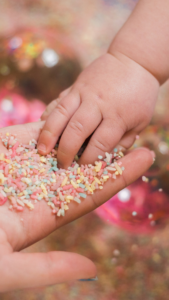
Your baby’s brain and fingers are working together
We often talk about fine motor development as though it’s simply about strengthening little hands.
But the brain has an enormous role to play.
Every time your baby reaches for an object, their nervous system has to coordinate information from several sources.
Their eyes help them locate the object. Sensory receptors in their skin provide information about touch and pressure. Signals from muscles and joints help the brain monitor the position and movement of the hand.
The brain uses this information to guide and adjust the movement.
This is one reason babies often make several attempts before successfully picking something up.
They might reach slightly too far, miss the object or struggle to position their fingers.
Then they try again.
Those attempts provide experience that helps them refine their movements over time.
It’s not a case of one successful grasp suddenly creating a new brain connection that changes everything. Motor learning is much more gradual and complex than that.
But repeated opportunities to explore objects do help babies practise coordinating their movements.
And the lovely thing is that they don’t need to know they’re practising.
They’re simply interested in what they’ve found.
The surprising connection between the pincer grasp and eating
One of the most noticeable places you’ll see this new skill emerging is at mealtimes.
Early on, babies often use their whole hand to grab food, which can result in a rather impressive amount of squashing.
As their finger control improves, they may begin picking up smaller pieces more precisely.
It’s a useful skill for self-feeding, although babies also need to develop sitting balance, hand-to-mouth coordination and the ability to manage food safely.
The pincer grasp alone doesn’t mean a baby is ready for every type of finger food.
Food still needs to be prepared in a way that suits their developmental stage and reduces choking risks.
The NHS guidance on introducing solid foods explains how to offer suitable textures and finger foods safely.
And if your baby spends more time examining a piece of food than actually eating it, that exploration can still be part of learning how to handle objects.
Of course, it doesn’t make cleaning the highchair any more enjoyable.
What does the pincer grasp have to do with reading books?
Quite a lot, actually.
At Adventure Babies, books are at the centre of everything we do, and I love watching how differently babies interact with them as they grow.
A younger baby might watch the pictures or reach towards a page with their whole hand.
An older baby may become determined to lift the corner, pull at a flap or turn the page themselves.
These actions involve hand-eye coordination and increasingly controlled finger movements.
A precise pincer grasp can help with manipulating smaller parts of a book, although babies don’t need a fully developed pincer grasp to turn thick board-book pages.
And there’s another interesting connection.
When your baby opens a book, moves a page or lifts a flap, they can see the effect of their actions.
They move something, and the picture changes.
That gives them an opportunity to explore cause and effect alongside their developing hand skills.
It’s one of the reasons I love books that babies can physically investigate, rather than expecting them to sit and listen while an adult does everything.
Our Adventure Babies sensory storytelling classes take that idea further by giving babies opportunities to explore stories through movement, textures, sounds and objects.
The aim isn’t to make every baby demonstrate a particular skill. It’s to provide interesting experiences that suit different stages of development.
How to help your baby develop their pincer grasp
The good news is that you don’t need to buy a special toy or create an elaborate activity.
In fact, some of the most useful opportunities come from ordinary play.
For younger babies, offer toys they can comfortably reach for and grasp. Soft blocks, lightweight rattles and easy-to-hold objects allow them to practise controlling their hands.
As their coordination develops, they may enjoy exploring larger objects with different shapes and textures.
Once your baby is ready for finger foods, mealtimes provide natural opportunities to practise picking things up. Always choose food that is safe for their age and stage, and supervise them closely.
Board books are another lovely option. Let your baby investigate the pages, explore the cover and try lifting the edges themselves.
You can also offer larger fabric pieces or textured toys that encourage them to adjust their grip.
There’s no need to correct their fingers or insist that they use a particular technique.
Babies develop these movements through exploration and repeated opportunities to practise.
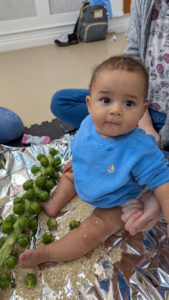
And please don’t scatter tiny beads, dried beans or other small objects around for your baby to pick up. You may see activities like this suggested online, but they can create serious choking risks.
The goal is to offer safe opportunities for exploration, not to rush a milestone.
Why sensory play can be so interesting for little hands
One of the things I’ve always loved about sensory play is how differently babies respond to the same experience.
You can offer a lovely collection of textures, and one baby will immediately reach towards the softest object while another spends ages investigating something that makes a gentle rustling sound.
A third baby might prefer to watch for a while.
There’s no single correct response.
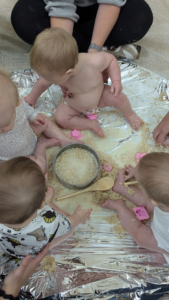
When babies explore safe sensory resources, they have opportunities to experience different textures, shapes and movements.
They might grasp something soft, release it, transfer it between their hands or adjust their fingers to hold it differently.
These experiences can provide opportunities to practise hand control alongside sensory exploration.
But it’s important to be clear about the evidence. We can’t say that a particular sensory tray will accelerate the development of the pincer grasp.
What we can do is create safe, interesting opportunities for babies to use their developing skills.
At Adventure Babies, we’ve been combining sensory exploration with storytelling since 2013, and we’re always keeping up with research into how babies learn.
Understanding the development behind these little moments helps us think carefully about the experiences we offer.
It also gives parents a chance to see just how much their babies are discovering during ordinary play.
The skills your baby is building for later life
The pincer grasp is an important step towards greater independence.
As children grow, they use increasingly precise hand movements for all sorts of everyday tasks.
Picking up food, turning pages, manipulating toys, drawing and eventually fastening buttons all involve fine motor control.
Later, children develop the coordination needed to use pencils and other writing tools.
That doesn’t mean babies who develop an early pincer grasp will become better writers, or that practising it now guarantees stronger handwriting later.
Development doesn’t work like that.
But the pincer grasp is one of the many physical skills that contribute to a child’s growing ability to handle and explore objects independently.
And that’s a lovely thing to watch.
What if your baby isn’t using their thumb and finger yet?
This is worth mentioning because developmental articles can sometimes make parents feel that everyone else’s baby is racing ahead.
There’s a wide range of typical development during the first year.
Some babies begin using a precise pincer grasp earlier than others, while many are still refining it around their first birthday.
If your baby was born prematurely, health professionals may also consider their corrected age when discussing milestones.
Rather than focusing on one movement, look at how your baby’s hand skills are developing more generally.
Are they reaching for objects? Exploring toys? Using their hands in increasingly varied ways?
If you’re concerned about your baby’s progress, notice that they consistently avoid using one hand, or see a loss of skills they’ve already developed, speak to your health visitor or GP.
You don’t need to wait for a particular birthday to ask for advice.
And please don’t feel that you need to turn every playtime into a fine motor development session.
Babies benefit from having time to explore without adults constantly directing what they should do next.
Sometimes the smallest milestones are the most fascinating
After years of working with babies and families, I still find it amazing how much development happens in the first twelve months.
We naturally celebrate the big milestones.
The first smile, the first roll, the first time a baby sits independently.
But there are so many smaller achievements happening in between.
The first time your baby deliberately reaches for something.
The moment they manage to transfer a toy between their hands.
And that determined little thumb and finger finally working together to pick something up.
These moments might not make it into the baby book, but they’re part of an extraordinary period of development.
So the next time your baby becomes completely fascinated by a microscopic crumb on the carpet, you’ll know there’s something rather clever going on.
Although I’d still recommend removing the crumb before they decide to eat it.
Want to discover more about how your baby learns through everyday experiences?
At Adventure Babies, we bring stories to life through sensory play, puppets, movement and plenty of opportunities for babies to explore at their own pace.
Our classes are designed around the different stages of baby development, but they’re also a lovely chance to spend time together, meet other parents and enjoy watching your little one discover the world.
Find your nearest Adventure Babies class and come along for an adventure.
Because sometimes the smallest discoveries are the ones worth celebrating most.