Why Does My Baby Copy My Face? The Beginnings of Social Learning
You open your mouth wide. Your baby watches carefully, then opens theirs.
Naturally, you do it again. Within minutes, you’re pulling increasingly ridiculous faces while someone who can’t yet sit up studies you with the seriousness of a job interview.
These small exchanges can feel wonderfully personal. Suddenly, there’s a little back-and-forth happening between you.
If you’ve wondered, “Why does my baby copy my facial expressions?”, the answer involves developing communication, discovering how faces work and learning through other people. However, the science holds a few surprises—including why an apparent copy doesn’t always mean deliberate imitation.
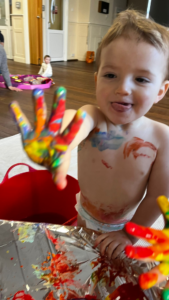
Why does my baby copy my facial expressions?
As babies develop, they learn from watching and interacting with the people around them. Copying expressions can become one part of that learning, alongside responding to voices, sharing smiles and experimenting with sounds.
Your face gives them plenty to explore. Eyebrows move, lips change shape and smiles often arrive alongside a warm voice.
During these exchanges, your baby gets opportunities to connect what they see and hear with movements they can make themselves. They also experience the rhythm of communication: someone does something, someone responds, then the interaction continues.
The NHS encourages parents to spend time face-to-face with their baby, copying sounds and talking about everyday experiences to support early communication.
Do newborn babies really copy faces?
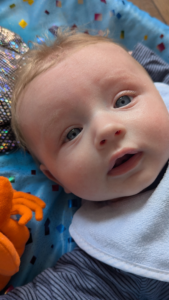
Here’s a detail that often disappears from parenting posts: scientists still debate whether newborns reliably imitate facial expressions.
Some studies have found evidence of newborn imitation. Others haven’t, including a large study that followed babies through their early weeks.
A baby sticking out their tongue after you do it might look like a perfect copy. Yet researchers need to establish whether babies match that particular action consistently, rather than making a movement they would have made anyway.
A 2024 review of research on facial imitation discusses these conflicting findings.
You can still enjoy the moment. Equally, your newborn doesn’t need to perform a matching expression to show that your time together matters.
The surprisingly tricky task of copying a face
Imagine trying to copy a dance move without seeing your own body.
Facial imitation presents babies with a similar challenge. They can see your mouth move and feel their own mouth moving, but they usually can’t see both at once.
That makes matching an expression a more complicated task than it first appears.
Researchers have proposed that sound may help babies make those connections. In their 2024 review, scientists explored how hearing the sounds that accompany mouth movements could help infants link what they hear, see and feel.
This remains a proposed explanation, rather than a settled account of how all babies learn to imitate. Still, it offers a fascinating perspective on your everyday face-to-face chats. Your baby may have several sources of information to explore at once.
What recent research tells us about mirrors
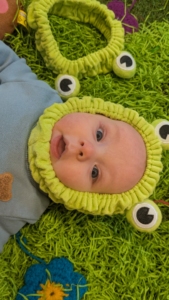
A 2026 study involving four-month-old babies explored whether seeing their own facial movements in a toy mirror affected how they responded to other babies’ facial actions.
After two weeks, the mirror group showed a greater increase in activity in a brain region involved in sensing and movement than the comparison group.
However, they didn’t show a greater increase in facial copying.
The University of Essex research offers an interesting distinction: changes in how babies process facial actions don’t necessarily produce a visible matching expression. It also doesn’t establish that mirror play improves communication or that babies need daily mirror practice.
A baby-safe mirror can simply become something enjoyable to explore together. Sit beside your baby, smile and chat, then follow their interest.
Try letting your baby lead the conversation
When we wonder, “Why does my baby copy my facial expressions?”, it’s easy to focus on getting them to copy us.
Try reversing the game.
Notice a relaxed expression or little coo, then gently copy it back. Pause and give your baby space to respond. Perhaps they repeat the sound, move their mouth or watch you closely.
The NHS Ready to Relate guidance suggests copying babies’ expressions and enjoying simple face-to-face games together.
There’s no need to turn this into a lesson. A brief exchange while you’re sitting together can fit into an ordinary day.
If your baby becomes upset, offer comfort rather than continuing the copying game.
Three easy ways to enjoy face-to-face play
Share a smile, then wait
Choose a moment when your baby seems comfortable and interested. Bring your face into their view, smile naturally and pause.
A smile back is lovely, but a quiet look or small movement can also give you something to respond to. Avoid repeating the expression faster and faster to get a reaction.
Give a story a face
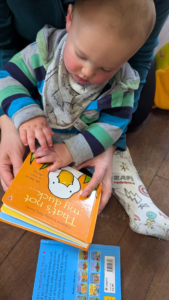
While sharing a book, let your expression join in. Raise your eyebrows when an animal appears or make a gentle sleepy face when a character settles down.
Keep the book low enough for your baby to see you as well as the pictures. Their attention may move between the page, your mouth and something across the room.
You can explore more about these overlapping experiences in our guide to how babies learn.
Enjoy a sound-and-face exchange
Make a soft “oooh”, then wait. Alternatively, copy a sound your baby has already offered.
Let the exchange unfold slowly, without expecting an exact match. Your baby might answer with a different sound, an excited kick or an interested stare.
How Adventure Babies classes support these early exchanges
At Adventure Babies sensory storytelling classes, we bring stories to life through expressive storytelling, puppets, sensory props and shared play.
Character voices and animated expressions give babies faces and sounds to watch together. During a story, you can join in with a gentle expression of surprise or copy your baby’s delighted response.
Puppets and props offer something interesting to share. As you explore together, you can comment on what your baby notices and leave room for their response.
Songs and repeated story moments create opportunities to pause, listen and join in. Younger babies may watch or move; older babies might experiment with a sound or action.
These activities give families enjoyable opportunities to interact. Each baby can take part in their own way, without having to demonstrate a particular skill.
What if my baby watches but doesn’t copy?
A baby who studies your face without producing a matching expression can still enjoy the interaction.
Interest also changes throughout the day. Hunger, tiredness or a fascinating nearby object can make your best performance much less appealing.
The NHS guide to understanding your baby suggests watching for cues such as turning away, yawning or closing their eyes. Pause when your baby needs a break and try again another time.
One unsuccessful copying game tells you very little on its own. If you have concerns about your baby’s wider communication, responses to people or loss of skills, speak with your health visitor or GP.
You don’t have to be entertaining all day
Some days, pulling a funny face feels easy. On others, you’re tired, touched out and trying to remember whether you’ve eaten lunch.
You can enjoy small moments of connection without making every waking minute an activity. Chat during a nappy change, share a smile after a feed or sit quietly together.
For mums navigating the first year, these tiny exchanges can feel especially moving. Someone who recently seemed so new is beginning to answer you in their own way.
Dads, grandparents and other familiar grown-ups can enjoy those conversations too.
Within our Adventure Babies community, there’s room for the delighted giggles, the serious observers and the babies who spend half the story looking at their neighbour. You’re welcome with the baby you have that day.
A little face, a growing conversation
So, why does my baby copy my facial expressions? As imitation develops, it becomes one way babies explore actions and connect with other people. Scientists continue to investigate exactly how that process begins.
Meanwhile, your everyday exchanges offer plenty to enjoy. Watch, respond and leave a little space for whatever your baby does next.
If you’d like to share more of those moments with other families, find your nearest Adventure Babies class.
Come for the stories and sensory discoveries. Stay for the familiar faces—and the people who understand why one tiny smile can become the highlight of your week.