Your Baby’s First Halloween: Playful, Gentle and Not Too Spooky
Somewhere between choosing a tiny pumpkin outfit and wondering whether you can leave the house before the next nap, your baby’s first Halloween arrives.
Suddenly, everyone seems to have a themed photoshoot planned. Meanwhile, you’re hoping the costume survives one nappy change.
Here’s the reassuring bit: your baby needs very little to enjoy this occasion. A friendly face, something interesting to explore and a few playful moments together can make a lovely first Halloween.
Your Baby’s First Halloween: Playful, Gentle and Not Too Spooky starts with following their lead. Think gentle peekaboo, cosy stories and pumpkin discoveries, with plenty of room for feeds, cuddles and an early exit.
What does Halloween mean to a baby?
For you, Halloween might mean childhood memories, dressing up or an excuse to buy miniature bat wings.
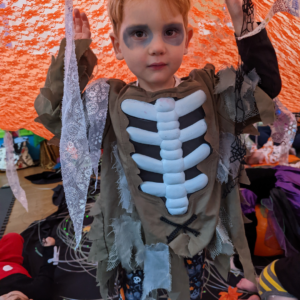
For your baby, it brings new sights, sounds and textures. They can watch your expression, hear a different rhythm in your voice or reach towards an unfamiliar object.
The seasonal theme gives you something fresh to explore together. Your response makes that exploration feel welcoming.
A sudden noise or unfamiliar mask can still upset a baby, even when adults find it funny. Keep your face visible, introduce new things slowly and let their reaction guide what happens next.
A surprising fact: pretending starts earlier than you might think
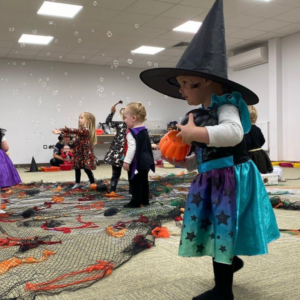
Your baby may begin experimenting with simple pretend play around their first birthday.
In a 2024 University of Bristol study, parents reported that around half of 12-month-olds already pretended regularly. Early examples included pretending to sleep or drinking from an empty cup.
The research involved a survey of 900 parents, so these findings describe reported patterns rather than a milestone every baby must reach. They certainly don’t mean a younger baby understands that a frightening costume is “only pretend”. Read the University of Bristol’s research on early pretending.
For an older baby, try making a soft toy fall asleep with a gentle snore. Pause to see what they do. A curious stare, a giggle or an attempt to copy you can all become part of the game.
Try peekaboo with a very gentle “boo”
Halloween offers an excellent excuse to play the game babies never seem to get bored of.
Cover your own face with your hands, pause briefly, then reveal a smile. A quiet “boo” gives the game a seasonal twist without a sudden shout.
Keep your baby’s face uncovered and watch their response. Some will beam before you even finish. Others prefer a slower reveal or a familiar “hello!”
There’s something wonderfully funny about becoming someone’s favourite entertainment simply by disappearing behind your own fingers.
The NHS suggests peekaboo as an activity to enjoy with your baby, alongside talking, singing and playing together.
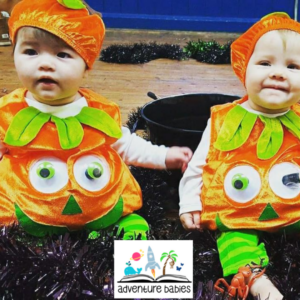
Let a pumpkin become a small discovery
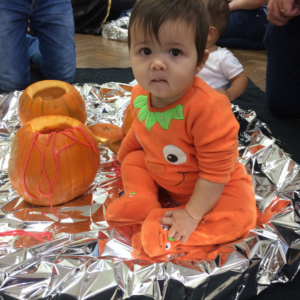
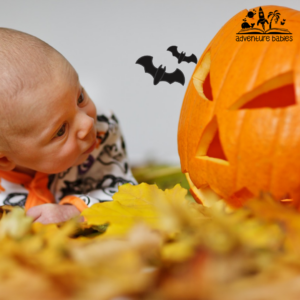
A pumpkin offers plenty to investigate before anyone carves a face into it.
Hold a clean, intact pumpkin securely while your baby looks at its shape or touches the ridged surface. Keep it steady, with any sharp or loose stem away from their hands and mouth.
Describe what catches their attention: “You’re touching the pumpkin. It feels bumpy.”
Young babies can enjoy looking while you hold them comfortably. Babies who already reach and grasp may want to explore with their hands. Leave loose seeds, carving tools and broken pieces out of reach.
One object can give you quite a lot to talk about. There’s no need to assemble an entire sensory tray to make the moment worthwhile.
Their favourite activity might be the one you’ve already done
Parents often feel pressure to keep introducing something new. Babies can take a different approach.
A 2024 Lancaster University study used eye-tracking to let babies choose which unfamiliar images to explore. Researchers found that babies often returned to one source of information before switching to another, with considerable differences between individuals. Explore Lancaster’s research on infant curiosity.
This wasn’t a study of Halloween play. However, it offers a useful reminder that curiosity doesn’t always look like constantly moving on.
At home, give your baby time to revisit the pumpkin, hear the same little rhyme or watch your face appear again. Their interest can help you decide when to repeat something and when to change it.
Make story time a little autumn adventure
You don’t need a spooky book to enjoy a Halloween story together.
A familiar board book featuring an owl, a cat or the night sky can give you plenty to explore. Add a gentle hoot, point to a picture and wait for your baby’s response.
Perhaps they look towards you. Maybe they kick, reach or answer with a squeal. Leave a little space for that contribution before carrying on.
BookTrust’s guidance on sharing books with babies encourages parents to talk about the pictures and choose a quiet place to read. Sharing stories can support closeness and early language development from the start.
Our Adventure Babies sensory storytelling classes bring books to life through shared stories and sensory exploration. You can borrow that approach at home with a book, your voice and one simple prop.
Watch for the quiet “I’ve had enough”
A baby doesn’t have to cry to need a break.
Turning away, closing their eyes or yawning can signal that it’s time to pause. Look at the whole picture: one yawn alone won’t tell you everything, but several changes in their behaviour may help you spot what they need.
The NHS guide to understanding your baby explains these cues and suggests slowing down, stopping the activity or moving somewhere quieter. Babies may only manage a few minutes of interaction at a time.
During a Halloween visit or class, a cuddle, feed or quiet corner can become part of the experience. Going home early is also perfectly reasonable.
There’s no prize for keeping a tired pumpkin at the party.
Keep the costume comfortable and the decorations out of reach
A soft outfit that allows easy movement makes dressing up much simpler. Check for loose pieces, trailing cords or anything that could cover your baby’s face. Remove costume accessories before sleep.
Keep sweets, loose decorations and toys with small parts away from babies. Battery-powered decorations also deserve attention: button batteries can cause severe internal burns if swallowed.
The NHS baby and toddler safety guide explains these everyday risks. For Halloween, keep decorative lights and their batteries out of reach, and choose a flame-free display.
A quick photo in ordinary clothes counts too. Your baby has no opinion on whether the outfit matches the pumpkin.
Enjoy a first Halloween together
The first year brings so many occasions you want to remember. That can make even a small celebration feel surprisingly loaded.
Perhaps you want a lovely photograph. Maybe you’re looking for somewhere friendly to go with your baby. You might simply want to enjoy an autumn morning that feels different from yesterday.
Our Halloween sensory storytelling adventures combine themed stories and sensory activities for babies and toddlers. Check the Adventure Babies classes page for your local leader’s sessions and age groups.
Whether you join a class or stay at home, Your Baby’s First Halloween: Playful, Gentle and Not Too Spooky can be wonderfully simple.
A little peekaboo. A story on your lap. A pumpkin they examine with great seriousness.
And perhaps one photograph taken just before they decide they’ve had enough.