When Do Babies Start Playing With Other Babies? The Social Development You Might Be Missing
You take your baby to a class hoping they’ll enjoy being around other babies.
They sit next to another tiny human for 45 minutes.
Neither appears remotely interested in the other.
Then, just as you’re putting their coat on, your baby becomes absolutely fascinated by somebody else’s sock.
Welcome to early friendship.
If you’ve been wondering when do babies play with other babies, you might be looking for something that doesn’t happen quite as early as you expect.
Babies don’t usually go from ignoring everyone to happily sharing toys and inventing games together. Social play develops much more gradually.
Long before children properly play together, they watch each other. They listen to one another, copy movements, smile, crawl closer, play alongside each other and become increasingly fascinated by what other small people are doing.
From the outside, some of this barely looks like playing at all.
Inside your baby’s developing social world, however, there’s plenty going on.
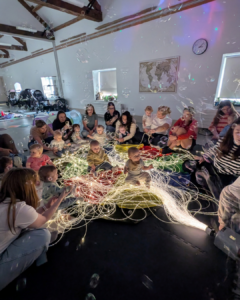
Babies are social long before they can play together
A tiny baby doesn’t need another baby to play with in the way an older child might.
Their most important social relationships are with the adults who care for them.
Your face is fascinating. Your voice gets a response. When your baby smiles and you smile back, they begin experiencing the wonderful discovery that their actions can affect another person.
The American Academy of Pediatrics describes smiling and vocal back-and-forth interactions as some of the earliest forms of social play.
So social development begins much earlier than toddler playdates.
During the first months, babies are learning something fundamental:
Other people respond to me.
That understanding becomes an important foundation for everything that follows.
When do babies play with other babies?
There isn’t one age when babies suddenly begin playing socially.
During the first year, babies become increasingly aware of other babies. They may stare, smile, reach towards them, vocalise, watch what they’re doing or become fascinated by another baby’s movements.
As mobility develops, babies can actively investigate one another too.
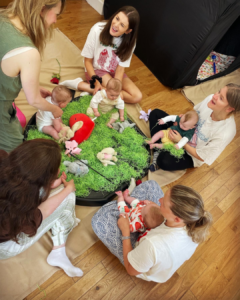
Anyone who has attended an Adventure Babies class will know what this can look like.
One baby crawls towards another.
Everyone briefly thinks we’re witnessing the beginning of a beautiful friendship.
Then it becomes apparent they were actually heading for the other baby’s sensory scarf.
Still social development.
As babies move towards toddlerhood, playing alongside other children becomes increasingly common. More genuinely cooperative play develops gradually after that.
The important thing is not to treat those stages like appointments in the diary.
Recent ZERO TO THREE guidance emphasises that stages of play overlap and shouldn’t be viewed as rigid developmental deadlines.
Your child isn’t late to the party because they haven’t started organising group activities at 14 months.
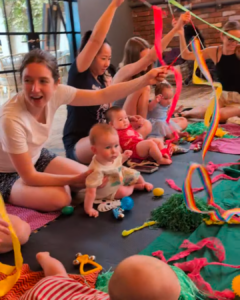
“They just ignore each other”
This is something parents notice all the time.
Put two toddlers beside each other with some toys and they may each get on with their own activity.
No conversation.
No obvious game.
No adorable sharing moment for Instagram.
It can look as though they’re completely ignoring one another.
They probably aren’t.
This is often called parallel play.
Parallel play happens when young children play near one another while remaining focused mainly on their own activity. They don’t need to share a game or coordinate what they’re doing for the experience to have social value.
ZERO TO THREE’s 2026 guidance describes parallel play as involving both proximity and awareness of peers. Children can observe movements, facial expressions, gestures and play ideas while they remain busy with their own activity.
An NHS children’s health service similarly explains that young children may play alongside one another rather than directly together, and that this forms a normal part of developing social interaction.
So your toddler playing with a cup while another toddler plays with a cup beside them isn’t necessarily two separate activities.
They’re sharing a social space.
That’s a bigger deal than it looks.
Your baby is watching the other babies
This is perhaps the loveliest part.
Babies are extraordinary observers.
At Adventure Babies, we often see one baby watching another baby doing something before trying it themselves.
Someone bangs an object.
Another baby watches.
A baby starts crawling towards the sensory tray.
Someone else notices.
One child discovers that shaking something creates a noise and suddenly the baby next to them becomes extremely interested in conducting the same experiment.
Recent guidance on parallel play highlights observation and imitation as important parts of the experience. A child watching another stack, roll or manipulate an object can gather ideas for their own play, even if they don’t immediately copy what they saw.
Learning from other children doesn’t always require them to interact directly.
Sometimes watching is enough.
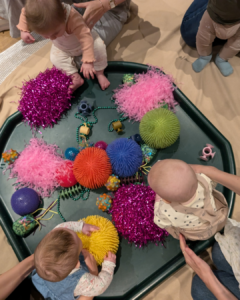
The toy stealing isn’t quite as sinister as it looks
Then comes one of the great social moments of babyhood.
Another baby has something.
Therefore your baby needs it immediately.
This can feel slightly embarrassing when you’re the parent retrieving the object for the fifth time.
“Sorry! Sorry again. Apparently yours is much better than the identical one directly in front of him.”
Young babies and toddlers aren’t miniature adults with mature concepts of ownership, sharing and turn-taking.
They’re still learning.
Another child holding something can make that object especially interesting because it moves, creates a reaction and has suddenly become socially relevant.
This doesn’t mean grabbing should simply be ignored. Adults can gently guide what happens.
“You want that one. Freya’s using it at the moment. Here’s another.”
There’s no need for a lecture on generosity.
Your 13-month-old probably isn’t ready for the PowerPoint.
Watching counts as joining in
Some babies arrive at a busy environment and launch themselves straight into everything.
Others watch.
They may sit on their parent’s lap and take in the room before moving anywhere.
One baby crawls straight towards the other children. Another spends ten minutes studying them from a comfortable distance.
Neither response is wrong.
We talk about this a lot at Adventure Babies because it’s easy for parents to look around a class and compare.
Everyone else’s baby is joining in.
Mine is just watching.
But watching is a form of participation.
A baby who watches another child may be processing movement, sounds, expressions and what happens when that child interacts with an object.
That’s one reason we don’t expect every baby in an Adventure Babies class to respond to an activity in exactly the same way.
We create the invitation.
Babies decide how they’re going to investigate it.
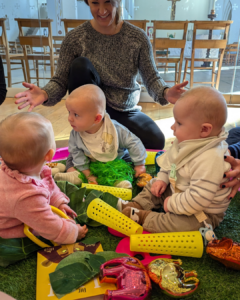
Other babies are surprisingly interesting sensory experiences
Think about another baby from your baby’s perspective.
They move unpredictably.
They make strange noises.
Their face changes.
They laugh.
They crawl.
They bang things.
Occasionally they shriek with absolutely no warning.
Frankly, they’re fascinating.
This is where the sensory and social sides of development overlap.
A baby isn’t experiencing the other children in class as a lesson in “social development”. They’re hearing them, watching them and noticing what happens around them.
The sensory experience creates something interesting to pay attention to.
The social environment adds another layer.
That’s why we think baby classes can offer something genuinely different from creating another activity at home.
Your baby’s favourite playmate is still likely to be you. The NHS describes parents and carers as central to babies’ play and learning.
But a room containing other babies gives them something else to observe.
Playing beside someone can be a big social step
Parallel play can look underwhelming if you’re expecting friendship.
Two toddlers.
Two toys.
Approximately zero cooperation.
Yet they are learning how it feels to occupy a play space with another child.
They can watch what someone else does.
Notice reactions.
Copy ideas.
Experience another child moving close to them.
Begin dealing with the difficult reality that another person occasionally possesses the object they desperately want.
These experiences create foundations for increasingly social play.
By around two, many toddlers are happy playing alone or alongside others, while simple turn-taking begins to appear too. Again, individual development varies considerably.
Playing with other children develops over time.
It doesn’t arrive fully formed.
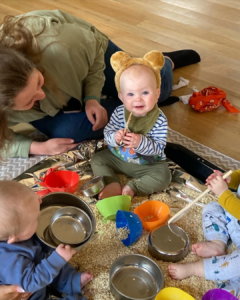
Your toddler doesn’t have to be brilliant at sharing
This may come as a relief.
Toddlers aren’t famous for their sophisticated negotiation skills.
Sharing requires a lot.
A child has to understand that somebody else wants the object, manage their own desire to keep it, tolerate waiting and understand that giving something away doesn’t necessarily mean losing it forever.
That’s a considerable emotional task when you’ve only been on the planet for 18 months.
So if your toddler is delighted to see other children but considerably less delighted when those children touch their things, you haven’t failed to teach kindness.
They’re learning.
Warm adult guidance helps, but so does time.
Books and stories can create shared attention too
This is one of the reasons stories work so beautifully in a group.
A character appears and several babies look towards it.
A funny sound makes them pause.
A puppet moves across the room and multiple little faces follow it.
Something has briefly captured everyone’s attention.
Babies aren’t discussing the plot afterwards, obviously.
But they can experience being part of something alongside other people.
Stories give our Adventure Babies classes structure, while puppets, sensory play, movement and sound give babies plenty to notice.
One baby might reach.
Another might laugh.
Someone else may stare with enormous concentration.
A fourth baby has decided that today’s main developmental priority is attempting to escape from the mat.
All perfectly valid.
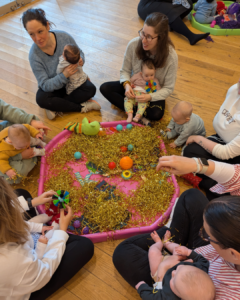
Baby classes aren’t about forcing babies to socialise
This matters.
Taking your baby to a class doesn’t mean they need to “make friends”.
Your four-month-old does not require a networking strategy.
The value lies in giving babies opportunities to experience other people while they still have the security of their grown-up nearby.
They can watch.
Listen.
Move closer.
Move away.
Join in.
Sit back.
Become fascinated by another child.
Then return to you.
That combination of a secure grown-up and an interesting environment gives babies space to explore socially at their own pace.
It’s very much part of the Adventure Babies ethos.
We don’t need babies to perform.
We give them interesting things to experience and allow development to unfold through play, stories, movement, sensory exploration and responsive interaction.
Baby classes can be social for parents too
There is another person in this story who deserves mentioning.
You.
Parents often arrive at baby groups thinking primarily about what their baby will get from the experience.
Then something unexpected happens.
You recognise the same people the following week.
Someone remembers your baby’s name.
You chat about sleep.
Then weaning.
Then the completely ridiculous thing your baby did at 5am.
A few weeks later, the class feels familiar.
That matters too.
Your baby’s social world develops alongside your own changing world as a parent.
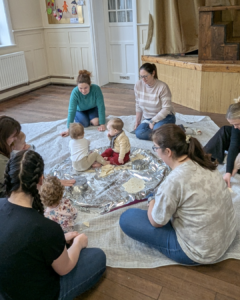
A regular baby class gives babies familiar faces to notice while giving parents a chance to find their own people as well.
Sometimes the babies play alongside one another while their mums become the actual friends.
We think that’s a pretty good outcome.
How can I help my baby become more social?
You don’t need to teach social skills through a carefully planned programme.
Start with interaction.
Smile back.
Copy their noises.
Respond when they try to get your attention.
Play simple back-and-forth games.
Let them watch other children without immediately trying to make them join in.
As they get older, give them opportunities to play near other children and step in gently when they need help navigating grabbing, waiting or taking turns.
The NHS recommends everyday play, songs, books, movement and interaction as valuable ways babies and toddlers learn. It also emphasises that play doesn’t need to be difficult or expensive.
Social development grows through ordinary experiences.
You don’t need to manufacture it.
When do babies play with other babies? Earlier than it might look
So, when do babies play with other babies?
The answer depends partly on what we mean by play.
If we mean two children cooperating over a shared game, you’ll usually be waiting until toddlerhood and beyond for that to develop properly.
But if we include noticing, watching, smiling, copying, moving towards one another and eventually playing side by side, the social story begins much earlier.
Your baby staring at another baby counts for something.
So does the smile.
The fascinated watching.
The crawling closer.
The copying.
Even the determined attempt to acquire the other baby’s toy is evidence that another person has become interesting.
Social development isn’t a switch that suddenly turns on.
It grows through hundreds of tiny encounters.
At Adventure Babies, our baby and toddler classes create plenty of opportunities for those encounters through sensory storytelling, movement, books, puppets and shared play. Babies can join in as much or as little as they want, while parents get the rather lovely bonus of spending time with other grown-ups who understand exactly what life with a baby or toddler currently looks like.
So if your baby spends their next class apparently ignoring every other child in the room, don’t worry.
They may be taking in far more than you think.
And if they crawl across the mat and steal somebody’s sensory scarf?
Well.
Perhaps friendship is simply progressing slightly faster than expected.