Your Baby Is Talking to You Before They Can Talk: The Communication Most Parents Miss
There is a moment most parents are waiting for.
The first word.
Will it be Mama? Dada? Dog? Something completely random that nobody remembers teaching them?
Because first words feel like such an enormous milestone, it is easy to think that everything before them is simply preparation.
But your baby hasn’t been waiting quietly for speech to arrive.
They’ve been communicating with you for months.
The look towards something interesting. The arm stretched towards the object they want. The noise made specifically to get your attention. The wave, the point, the glance back at you when something surprising happens.
If you’ve ever wondered how babies communicate before talking, some fascinating new research suggests we should pay much more attention to these tiny moments.
Because communication doesn’t begin with words.
It begins with two people noticing each other.
Your baby’s look back at you means more than you might realise
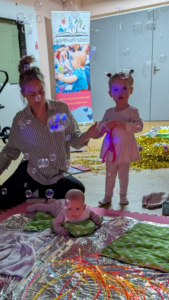
Imagine you’re holding your baby when a dog suddenly runs past.
Your baby looks at the dog.
Then they look at you.
Then back at the dog.
It seems like almost nothing.
Yet something surprisingly sophisticated is happening.
Your baby isn’t simply interested in the dog. They’re beginning to understand that you can be interested in it too.
In developmental research, this is known as joint attention: two people sharing their attention around the same thing.
It is one of those pieces of baby development that sounds terribly academic until you notice your own baby doing it.
A puppet appears.
Your baby looks at it.
Then at you.
Their expression seems to say:
“Are you seeing this?”
And suddenly you’re not simply watching your baby experience something.
You’re experiencing it together.
New research has captured these tiny conversations
A fascinating 2026 study looked at how young children communicate during shared book reading.
Researchers followed 52 children between six months and three years old and analysed 557 videos of families sharing different types of books at home.
Rather than concentrating only on the words children used, the researchers recorded all their communicative acts.
What they found is particularly interesting.
More than half of the children’s communication during shared reading involved gestures used to initiate joint attention.
In other words, a huge amount of communication wasn’t simply about requesting something.
It was about sharing something.
“Look.”
“Did you see that?”
“Look at this with me.”
The researchers also found differences according to the books being shared. Narrative and concept books were associated with longer reading sessions and frequent communication, while more complex narrative books were associated with a greater proportion of word combinations in older children.
That doesn’t mean buying a particular book will make your baby talk sooner.
The study was observational, so it can’t prove that a type of book caused those differences.
What it does show beautifully is just how communicative shared reading can become.
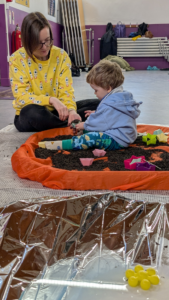
There is a big difference between “I want that” and “look at that”
Babies begin communicating intentionally in increasingly sophisticated ways.
Sometimes the message is practical.
They reach towards something because they want it.
They lift their arms because they want to be picked up.
They push something away because they’ve had enough.
Those communications matter enormously.
But eventually something particularly interesting starts happening.
Your baby begins drawing your attention towards things simply because they want to share the experience with you.
They may point towards the cat and then look at your face.
They might hear an unexpected sound and immediately turn towards you.
Perhaps something funny happens and they look at you before smiling.
They aren’t necessarily asking you to do anything.
They’re checking that you’re there with them.
That little shift from “I want that” towards “I want you to notice that with me” is a fascinating part of social communication.
So how do babies communicate before talking?
Long before clear words arrive, babies have an increasingly impressive communication toolkit.
They use their eyes.
Their faces change.
Their bodies move.
They reach.
They vocalise.
They turn towards things and away from them.
Later, gestures such as waving and pointing become increasingly important.
The NHS encourages parents of babies aged 6–12 months to name and point towards things they can both see. It also recommends games involving turn-taking and looking at books together, talking about what catches the baby’s attention rather than feeling you must read every word.
That advice matters because early communication isn’t a one-way stream of adults talking at babies.
Your baby contributes too.
You say something.
They look.
You respond to their look.
They make a sound.
You copy it.
They react.
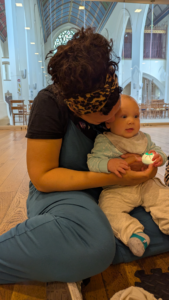
Suddenly you’ve had a conversation.
There wasn’t a single word in it.
The pause might be more important than you think
Adults are remarkably good at filling silence.
With babies, we can become even better at it.
“Look at the bear! Can you see the bear? There’s the bear! He’s brown! What noise does a bear make? Shall we find another bear?”
Meanwhile, the baby is still processing bear number one.
Sometimes one of the most powerful things we can do is stop.
Say something.
Then wait.
Your baby’s response might not arrive in the form you’re expecting.
They might widen their eyes.
Kick their legs.
Look towards the object.
Turn back towards you.
Make a tiny sound.
Reach.
Smile.
Those are responses.
The NHS guidance on helping your baby learn to talk encourages parents to name and point towards things they can both see, respond to their baby’s sounds and enjoy simple turn-taking interactions together.
That gives us a useful way of thinking about early communication:
Notice. Respond. Pause. Repeat.
You don’t need to make your baby answer.
Give them enough space to join in.
This is where books become much more interesting
It’s easy to think the developmental benefit of reading comes from babies hearing lots of words.
That’s part of the picture.
But a book does something else that’s incredibly useful.
It gives you and your baby something to look at together.
You see the same picture.
Your baby notices something.
You notice that they’ve noticed it.
You respond.
They respond to you.
The story has quietly created a three-way interaction between baby, grown-up and book.
BookTrust describes face-to-face book sharing as active and child-led because adults naturally monitor children’s attention and adapt what they’re doing in response.
You might linger on one picture because your baby loves it.
Repeat a funny sound because they reacted.
Go backwards.
Skip three pages.
Stop reading completely because they’ve become fascinated by one character.
None of this ruins storytime.
Quite the opposite.
The goal isn’t finishing the book. It’s sharing the moment.
Your baby looking at you during a story isn’t getting distracted
This is one we would love more parents to know.
You open the book.
Your baby looks at the picture.
Then they turn and stare at you.
It can look as though they’ve lost interest in the story.
They may actually be doing something far more interesting.
Your face gives them information that the page can’t.
Was that exciting?
Funny?
Surprising?
Should I keep watching?
BookTrust’s research into reading with babies highlights the responsive nature of face-to-face reading. Adults continuously adjust their pace, voice and behaviour according to the baby’s attention and reactions.
So don’t feel you need to keep redirecting your baby towards the page.
Sometimes you are part of the story they’re watching.
This is why we use stories at Adventure Babies
Stories have been at the heart of Adventure Babies since we began.
Not because we expect a six-month-old to sit silently through a plot.
Anyone who has met a six-month-old will appreciate the optimism involved there.
We use stories because they give babies, parents and class leaders something to experience together.
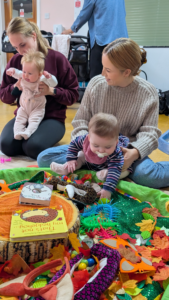
A puppet appears and suddenly several babies look towards it.
A character makes an unexpected sound.
The lights change.
Something moves across the room.
A sensory experience connects with what’s happening in the story.
Babies watch.
They reach.
They move.
They make sounds.
They look towards their grown-ups.
Sometimes they look at another baby who is also looking.
That’s why sensory storytelling can offer so much more than simply providing babies with lots of stimulation.
The sensory experience creates something worth noticing.
The interaction around it is where things become really interesting.
Babies can communicate with each other too
One of the loveliest things about watching babies together is seeing when they begin to notice one another.
A baby makes a sound.
Another turns.
One crawls towards something and another watches.
Someone laughs and suddenly three babies are looking in the same direction.
These aren’t adult-style conversations, of course.
But babies are learning that other people are interesting, responsive and worth watching.
A baby class creates something that is difficult to reproduce in the living room: shared experiences involving other babies as well as adults.
At Adventure Babies, the puppet, book, parachute or sensory experience can become a common point of attention.
Nobody needs to instruct a baby to “practise joint attention”.
That would be a fairly joyless baby class.
Instead, we create something interesting and give babies space to respond.
You don’t need to teach your baby to communicate
Once parents learn about an area of development, it’s incredibly tempting to turn it into another thing to practise.
Please don’t spend tomorrow repeatedly pointing at household objects while silently assessing whether your baby is displaying sufficient joint attention.
You don’t need to test them.
Communication grows through ordinary interactions.
When your baby notices the dog, notice it too.
When they make a sound, answer them.
When they point, tell them what they’ve found.
When something surprises them and they look towards you, respond.
When you’re sharing a story and they become fascinated by one picture, stay there for a while.
You don’t need to manufacture these moments.
They’re already happening.
What if my baby isn’t pointing yet?
Babies don’t all communicate in exactly the same way or reach milestones on precisely the same timetable.
Pointing is only one part of a much bigger communication picture.
Look at how your baby interacts more broadly.
Do they make sounds?
Look towards you?
React to your voice?
Use facial expressions?
Reach?
Move their body to show excitement or displeasure?
Try to attract your attention?
As your baby grows, these signals become increasingly intentional and recognisable.
If you’re worried about your baby’s communication or development, speak to your health visitor or GP rather than comparing one individual milestone with another baby at class.
Before the first word comes hundreds of tiny conversations
We make an enormous fuss about first words.
Quite rightly.
Hearing your baby deliberately say something you recognise is extraordinary.
But perhaps we should make a little more fuss about everything that came first.
The look across the room.
The hand reaching towards something interesting.
The noise designed specifically to make you turn around.
The first wave.
The point.
The delighted glance back at you when something unexpected happens.
The moment during a story when your baby looks from the picture to your face as though checking that you saw it too.
If you’ve been wondering how babies communicate before talking, start looking for those moments.
Your baby isn’t waiting for language to begin communicating with you.
The conversation has already started.
At Adventure Babies, our sensory storytelling classes give babies plenty to notice, share and respond to through books, characters, movement, sensory play and interaction. You can find your nearest Adventure Babies class and come and discover just how much your baby may already have to say.