How Do Babies Learn to Communicate? The Tiny Conversations We’ve Loved Watching This Summer
If you’ve joined us for one of our Adventure Babies Summer Specials this year, you’ve probably gone home with sensory rice in your shoes, bubbles clinging to your clothes and at least one photo of your baby making a determined dash for something they definitely weren’t supposed to have. Summer classes always have their own kind of magic. Families arrive in sandals instead of wellies, older siblings often come along too, and the room buzzes with that relaxed excitement that only the school holidays seem to bring.
It’s been one of our favourite summers yet. We’ve celebrated first crawls, watched babies discover messy play for the first time and laughed as parents admitted they’d enjoyed squelching through the sensory trays just as much as their little ones. Every week has reminded us why we love creating these experiences, not just because they’re fun, but because they give babies and parents the chance to explore, play and discover together.
As class leaders, though, we’ve found ourselves smiling at something that many parents don’t even realise is happening. While everyone has been busy chasing bubbles or helping tiny hands scoop coloured rice, another story has been unfolding quietly around the room. It’s easy to miss if you aren’t looking for it, but once you notice it, you’ll begin to see it everywhere.
One baby spots another shaking a bell and stops what they’re doing to watch. A little girl crawls across the mat with a feather in her hand, then pauses to see whether anyone else has noticed her discovery. Two babies catch each other’s eye across the parachute before bursting into identical smiles. Nobody has taught them to do it. Nobody has organised a game. Yet somehow they’re already communicating.
Parents often tell us, “They’re making little friends already.”
Sometimes they are.
But something even more fascinating is happening beneath the surface.
They’re learning how to communicate, long before they have the words to do it.
Communication Starts Long Before First Words
When people ask us how babies learn to communicate, they’re usually thinking about talking. It’s completely understandable. Parents spend months waiting for those magical first words, wondering whether “ba” means ball, banana or simply that your baby has discovered a sound they quite enjoy making. We celebrate “mummy”, cheer for “daddy” and proudly translate strings of babble that probably make perfect sense to us and absolutely nobody else.
The truth is that communication begins months before speech ever appears. Long before babies can ask for a cuddle or tell us they want another story, they’re learning something much more fundamental. They’re discovering that other people notice things, feel things and share experiences. Once babies begin to understand that, language has somewhere to grow.
Developmental psychologists call one of these early skills joint attention, although the name makes it sound far more complicated than it really is. Imagine you’re watching fireworks with a friend. The display is spectacular, but one of the nicest moments is turning to them with a huge grin that says, “Did you see that?” Babies do exactly the same thing every day. They spot something exciting, whether it’s a bubble, a puppet, another baby laughing or even a pigeon outside the window, and then they look back to see whether someone else has noticed it too.
Those little glances are incredibly important. Every time your baby looks between an object and another person, they’re beginning to understand that experiences can be shared. That simple idea sits right at the heart of communication.
The NHS Start for Life explains that talking, responding and playing with your baby from birth helps build the foundations for speech, language and social development. Those everyday moments might feel ordinary to us, but they’re exactly how babies begin making sense of the world around them.
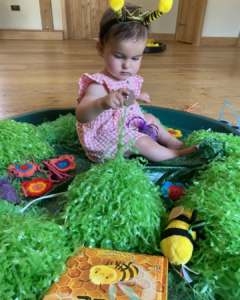
The Tiny Conversations We Keep Seeing in Class
Once you know what these early conversations look like, you realise they’re happening all the time.
A few weeks ago, one little boy became completely fascinated by the bubbles drifting across the room. He reached up to pop one, missed completely, then turned to look at his mum with the biggest grin. Before she’d even had chance to respond, another baby nearby noticed his excitement and shuffled across the mat to investigate. Within moments, four babies had gathered underneath the bubbles, each watching the others just as much as they watched the bubbles themselves.
Not one of them spoke.
None of them needed to.
They were sharing an experience.
We’ve seen the same thing happen around our sensory trays, our giant parachute and even during story time. One baby gasps when a puppet suddenly appears. Another baby hears the excitement and immediately turns to look. A third crawls over because everyone else seems interested in something fascinating. It looks wonderfully simple, but beneath those smiles and curious glances, thousands of new neural connections are forming.
This is one of the reasons we often reassure parents whose babies spend an entire class watching everyone else. Almost every week, someone apologises and says, “They didn’t really do much today.”
From our perspective, they did an enormous amount.
Watching isn’t a sign that your baby has missed out. Watching is one of the most powerful ways babies learn.
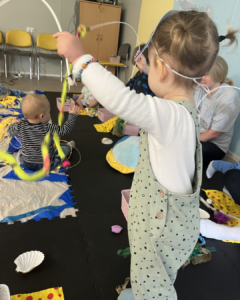
Why Watching Other Babies Is Such Powerful Learning
Adults tend to think learning happens when children are actively doing something. Babies teach us something different. Before they copy a wave, clap their hands or crawl confidently into the middle of the room, they usually spend weeks watching somebody else do it first.
You can almost see the cogs turning.
They watch another baby shake a maraca.
They notice everyone laughing.
They see a parent clap.
Then they quietly file that information away until they’re ready to have a go themselves.
Scientists believe babies are born with brains that are designed to learn through observation. Every smile they see, every facial expression they copy and every interaction they experience helps build the networks that support communication later on. That’s one of the reasons babies often seem fascinated by other babies, even when they aren’t quite ready to play alongside them.
It’s also why comparing babies can be so misleading. The little one who sits quietly observing everyone else may simply be gathering information before trying things in their own time. If you’ve ever worried because your baby seems happier watching than joining in, our blog Is My Baby Developing Normally? explores why development rarely follows the neat timelines we imagine.
The charity Speech and Language UK also highlights how responsive interactions, shared attention and everyday play all contribute to language development long before children begin talking.
Stories Create Conversations Before Babies Can Talk
This is one of the reasons we’ve always believed that sensory storytelling is about so much more than books.
Parents often arrive thinking their baby is too young to enjoy a story because they can’t follow the plot. In reality, the story itself is only one part of what’s happening.
When the lights dim inside our dark den, every baby looks in the same direction.
When a puppet suddenly appears, dozens of tiny faces light up together.
When bubbles float across the room, babies don’t just watch the bubbles. They watch each other watching the bubbles.
Those shared experiences create hundreds of opportunities for babies to practise the earliest stages of communication without anyone needing to teach them.
That’s why we choose stories that encourage interaction rather than simply listening. Babies point, smile, reach, copy expressions and gradually learn that books aren’t just something you read. They’re something you experience together.
Research from BookTrust supports exactly this idea. Reading together from birth doesn’t simply introduce books; it strengthens bonding, supports early language development and encourages the back-and-forth interactions that help babies become confident communicators.
If you’d like to continue those shared story experiences at home, many of the Adventure Babies books we use in class are available in our online shop, giving you simple ways to revisit favourite adventures together during the week.
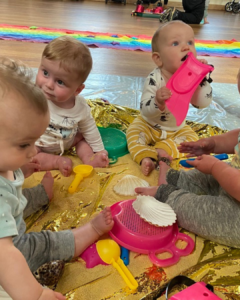
Why Repetition Helps Babies Become Better Communicators
One of the things we love most about running weekly classes is that we get to see changes parents don’t always notice at home. When you’re with your baby every day, development can feel almost invisible. Then someone comments on how much they’ve changed, or you look back at a photograph from a month ago, and suddenly you realise just how far they’ve come.
The same thing happens in class. A baby who spent the first session quietly tucked into Mum’s arms will often return the following week just a little more curious. By week three they’re reaching for the sensory props before the story has even begun, and by the end of the term they’re confidently crawling towards another baby to investigate whatever has captured their attention. It’s rarely one dramatic leap forward. Instead, it’s hundreds of tiny moments building on one another until parents suddenly find themselves saying, “When did they start doing that?”
Repetition plays a huge part in that process. Adults often think babies need constant novelty, but their brains actually thrive on familiar experiences. Every time your baby hears the same song, sees the same puppet or recognises the opening lines of a favourite story, their brain frees up a little more space to notice everything else that’s happening around them. Instead of concentrating on what’s coming next, they begin paying attention to the expressions on another baby’s face, the sound of someone laughing behind them or the way a friend shakes a maraca differently to them.
That’s one of the reasons we don’t worry about repeating stories or activities throughout a term. Familiarity creates confidence, and confidence creates curiosity. Once babies know what to expect, they become much more willing to explore, communicate and join in. Research from BookTrust has found that families who begin sharing books and stories early are more likely to develop lasting reading habits, with benefits for language, communication and family wellbeing that continue as children grow.
If you’ve ever wondered why your baby wants to hear the same story over and over again, you might enjoy reading our article on How Babies Learn Best, where we explore why repetition is one of the brain’s favourite ways to learn. You can find it here:
.
What We’ve Loved Watching This Summer
As wonderful as the sensory play has been, it’s the quieter moments that we’ll remember most from this summer.
We’ll remember the little girl who spent her first class clinging tightly to her dad before gradually becoming brave enough to crawl over and offer another baby a ribbon. We’ll remember the baby who couldn’t take his eyes off the older children dancing beneath the parachute and, by the final week, had become the one everyone else was watching. We’ll remember parents laughing together because their babies seemed to have developed an entire friendship based on smiling every time they spotted each other across the room.
Those moments remind us that communication isn’t something babies suddenly switch on when they say their first word. It grows slowly through thousands of shared experiences. A smile returned. A look copied. A noise echoed back. A favourite story enjoyed together. Every one of those interactions teaches babies that communication is rewarding because it helps them connect with the people around them.
Perhaps that’s why parents often tell us they leave class feeling as though they’ve had something special too. Of course babies enjoy the stories and sensory adventures, but adults find something just as valuable. They spend time with people who understand this stage of life, celebrate the same tiny victories and reassure one another that they’re doing better than they think. Those conversations matter every bit as much as the ones happening on the play mats.
Looking Ahead to an Autumn Full of New Discoveries
Although we’ll miss our Summer Specials, there’s something about September that always feels exciting. Babies return from holidays looking taller, stronger and somehow just that little bit older. Some arrive with brand-new crawling skills. Others have discovered clapping, waving or enthusiastic babbling over the summer. A few surprise everyone by suddenly deciding they’re ready to stand.
What never changes is the atmosphere when everyone comes back together. Familiar faces recognise one another. Parents catch up over everything that’s happened during the holidays, while babies settle back into stories, songs and sensory experiences that now feel wonderfully familiar. For many little ones, that sense of recognition gives them the confidence to notice even more about the people around them.
Our autumn classes are designed around exactly those opportunities. New seasonal stories, exciting sensory invitations and immersive play experiences all create reasons for babies to look, listen, share and communicate together. While parents often come because they’re looking for a lovely baby class, what they discover is something much bigger: a community where both they and their baby can grow in confidence week after week.
If you’re joining us for the first time this autumn, we can’t wait to welcome you. If you’ve been with us before, we can’t wait to see just how much your little one has changed over the summer.
You can find your nearest Adventure Babies class here:
The Conversations That Matter Most
When people ask us, “How do babies learn to communicate?”, they’re often expecting an answer about vocabulary, first words or speech milestones.
Those things matter, of course, but they’re only part of the story.
Communication begins the first time your baby smiles because you’ve smiled. It grows when they notice another baby laughing and decide to laugh too. It develops every time they point at something exciting, wait for your reaction and realise you’ve shared the same moment together. Long before they can tell you about their day, they’re already learning that other people make life richer, more interesting and much more fun.
Looking back over our Summer Specials, that’s what we’ll remember most. Not just the bubbles, the parachutes or the messy play, but the hundreds of tiny conversations that happened without a single word being spoken. Those fleeting glances, shared smiles and moments of curiosity may only last a few seconds, yet they’re quietly laying the foundations for language, friendships and confidence that will continue to grow for years to come.
At Adventure Babies, that’s why we’ll always believe stories matter. They don’t just introduce babies to books. They give families opportunities to laugh together, wonder together and discover the world together. In the end, those shared experiences become the conversations that shape childhood.
If you’re looking for a baby class this autumn, we’d love you to come and be part of our community. Together, we’ll read stories, explore sensory play, make wonderful memories and, without even realising it, help your baby take another small step on their remarkable journey towards communication.