How to Help My Baby Learn to Talk: The Secret Isn’t More Talking
One of the biggest worries new parents share with us isn’t about nappies or sleep.
It’s communication.
“Am I talking to my baby enough?”
“Should I be reading already?”
“They’re seven months old and only squeal… is that normal?”
If you’ve ever caught yourself wondering how to help your baby learn to talk, you’re in very good company.
We hear these questions every week in our Adventure Babies classes, usually while a baby is happily chewing a board book or becoming completely fascinated by a puppet instead of the story. Parents often laugh and apologise.
“They’re not really listening today.”
The funny thing is…
From a baby development point of view, they probably are.
Just not in the way most adults imagine.
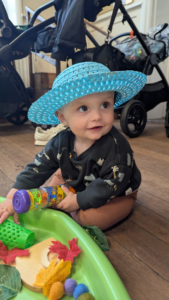
Before babies learn words, they learn conversations
Most of us think learning to talk starts with first words.
“Mama.”
“Dada.”
“Dog.”
In reality, your baby has been practising for months before that magical moment arrives.
Every smile they send your way.
Every excited kick when they hear your voice.
Every squeal when you copy their noises.
They’re all early conversations.
Researchers call these responsive interactions, but the idea is beautifully simple. Instead of constantly leading the conversation yourself, you notice what your baby is interested in and respond to it. That back-and-forth teaches babies one of the most important lessons they’ll ever learn:
“When I communicate, somebody responds.”
The Harverd Developing Child research describes these little moments as serve and return interactions. Just like a game of tennis, one person “serves” and the other “returns”. Those repeated exchanges help build the brain architecture that supports communication, learning and relationships throughout childhood.
It sounds wonderfully scientific.
In reality, it often looks like two people smiling at each other over a soggy board book.
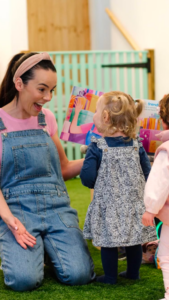
You don’t need to entertain your baby all day
Modern parenting can feel exhausting.
Social media is full of activities claiming to boost intelligence, stimulate the brain or accelerate development. It’s easy to come away feeling as though every waking minute should be educational.
Thankfully, babies don’t need a full-time entertainer.
They need someone who notices them.
Imagine your baby notices a duck in a book.
You could turn the page and carry on reading.
Or you could pause.
“Yes! That’s a duck.”
“Quack, quack!”
You wait for a second.
Your baby smiles.
You smile back.
Without even thinking about it, you’ve just had a conversation.
That tiny exchange has probably done more for your baby’s communication than reading three extra pages ever could.
It’s something we see every week in our classes. Babies rarely experience stories by sitting perfectly still. They point, reach, wriggle, babble, laugh and sometimes crawl away entirely before coming back again.
They’re still communicating.
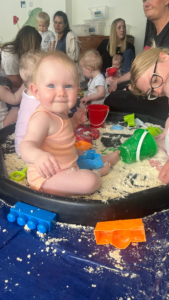
Reading isn’t about finishing the book
One of the biggest myths we come across is that babies should sit and listen while an adult reads from beginning to end.
Babies didn’t get that memo.
They’d much rather spend five minutes looking at the same picture of a bear.
Or stroke the fluffy page.
Or repeatedly open the same flap.
Parents often worry they’re doing story time “wrong.”
Actually, those moments are exactly where the learning happens.
When your baby points, you respond.
When they laugh, you laugh.
When they babble, you answer as though they’re telling you something fascinating.
Because they are.
They’re learning that communication isn’t a lesson.
It’s a relationship.
That’s why sensory storytelling has always been at the heart of Adventure Babies. We don’t simply read books—we help babies experience them through movement, songs, sensory play, puppets and exploration. Those experiences make language meaningful because babies connect words with real experiences. You can even recreate some of that magic at home with our <a href=”https://adventurebabies.co.uk/shop/”>Adventure Babies books and sensory resources</a>.
The simplest trick costs absolutely nothing
If you take one idea away from this article, let it be this.
Slow down.
We naturally fill silences when we’re talking to babies.
Try leaving one instead.
Pause after you’ve spoken.
Pause after singing a song.
Pause after reading a sentence.
Those tiny gaps invite your baby into the conversation.
Today they might answer with a smile.
Next month it could be a babble.
Before long it might become a recognisable word.
According to speech and language experts, responsive interactions during the first years of life are some of the strongest foundations for later speech and language development.
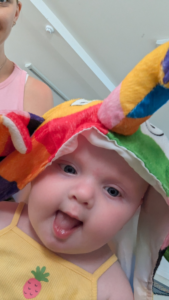
What this looks like at Adventure Babies
Walk into one of our classes and you’ll quickly notice something.
Nobody expects babies to sit quietly.
Instead, you’ll see babies reaching for props, watching bubbles drift across the room, giggling at puppets, splashing in sensory play and cuddling into their grown-up while a familiar story unfolds.
Some babies join in loudly.
Others spend weeks quietly watching before suddenly becoming the most enthusiastic participant in the room.
Both are learning.
Both are communicating.
Every activity is carefully designed to encourage those precious moments of connection between baby and adult because that’s where communication grows.
If you’d like to understand more about why babies learn this way, you’ll enjoy our guide to How Babies Learn which explores the fascinating science behind early development.
Try this today
You don’t need any special equipment.
The next time your baby notices something interesting:
✔ Wait.
✔ Name what they’re looking at.
✔ Smile.
✔ Pause.
✔ See what happens next.
Congratulations.
You’ve just helped your baby practise one of the most important skills they’ll ever learn.
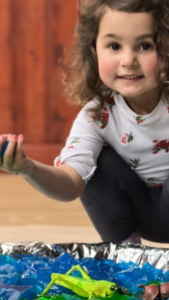
The best conversations begin long before first words
If you’ve been searching for how to help my baby learn to talk, we hope you feel reassured.
Language doesn’t begin with “mama.”
It begins with shared smiles, funny voices, repeated stories and the comforting feeling that someone is listening.
Those tiny moments might not seem remarkable today.
One day, you’ll realise they were the beginning of every conversation you’ve ever had together.