Why Doesn’t My Baby Play With Toys? The Surprising Truth About How Babies Really Learn
If you’ve ever wondered why doesn’t my baby play with toys, you’re in very good company. Every week at Adventure Babies, we meet parents who worry because their baby seems far more interested in chewing a book, watching a ribbon dance through the air or dropping a spoon onto the café floor than playing with the expensive toy they spent ages choosing.
Those moments can leave you questioning whether your baby is developing as they should. Perhaps another baby at your playgroup happily presses buttons on a musical toy or stacks blocks while yours seems fascinated by the washing label instead. It’s easy to compare, especially during those first months when every new milestone feels important.
The reassuring truth is that your baby isn’t playing the wrong way. In fact, they’re learning exactly as nature intended. What looks like random behaviour to us is actually a series of carefully repeated experiments that help your baby’s brain make sense of the world.
Your Baby Isn’t Trying to Play – They’re Trying to Learn
Adults understand what toys are for. We know that rattles should be shaken, puzzles completed and books read from front to back. Babies don’t arrive with those expectations. Instead, they approach every object with complete curiosity because they have no idea what it does yet.
When your baby picks something up, they aren’t thinking about whether it’s a toy or whether they’re using it correctly. They’re gathering information. They want to know how it feels, whether it makes a noise, how heavy it is, what happens if they squeeze it or whether it tastes different from everything else they’ve explored.
Each of those discoveries helps build new neural connections. Scientists often describe the first years of life as a period of extraordinary brain growth because babies create millions of connections through everyday experiences. Every shake, squeeze, drop and chew gives the brain another piece of information to store and connect with everything it already knows.
That’s why there really isn’t a “right” way for a young baby to play. Exploration comes first. Purpose comes much later.
Every Toy Is a Scientific Experiment
Imagine seeing an everyday object for the very first time. You wouldn’t know whether it made a sound, rolled across the floor or bounced when you dropped it. Your baby feels like that about almost everything they encounter.
Instead of asking themselves how to play with a toy, they’re asking questions such as:
“What does this feel like?”
“Can I hold it with both hands?”
“What happens if I let go?”
“Does Mum react when I do that again?”
“Will it make a different sound on the carpet?”
Although those questions never appear in words, they drive almost everything your baby does during play. Repetition isn’t boredom. Repetition is how babies test whether the world behaves in predictable ways.
That curiosity forms the foundation for later problem-solving, language, memory and even confidence. Every time your baby repeats an action, they strengthen the brain pathways that help them understand cause and effect.
The NHS explains that babies learn best through exploration, movement and responsive interactions with the adults around them rather than formal teaching. You can read more about early development on the NHS Start for Life website
Why Comparing Babies Can Be Misleading
One of the hardest parts of becoming a parent is watching other babies develop alongside your own. One child appears fascinated by toys, another loves looking at faces and someone else’s baby seems determined to chew absolutely everything.
The truth is that babies don’t all explore in the same way.
Some spend longer watching before they join in. Others learn by moving constantly, while another baby might carefully study a toy before touching it. None of those approaches is better than another. They’re simply different ways of collecting information about the world.
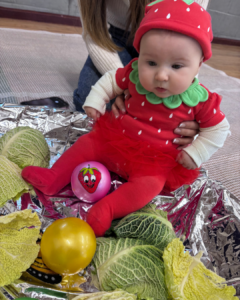
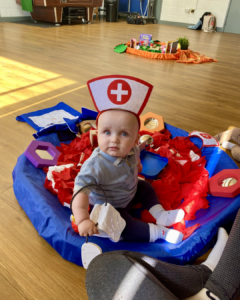
We see this every week at Adventure Babies. Some babies head straight for the sensory trays, while others spend several minutes watching the lights or following a puppet with their eyes before joining in. Both babies are learning. They’re simply following different paths to reach the same destination.
That’s one reason we encourage parents to stop comparing milestones quite so closely. When you understand how babies learn, you begin to appreciate that curiosity matters far more than using a toy in the way adults expect.
Why Does My Baby Chew Everything?
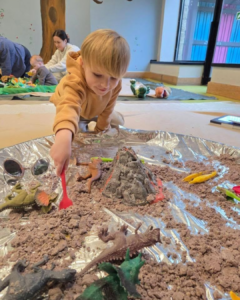
If your baby chews books, toys, spoons, muslins and even your shoulder, there’s no need to panic. Although it might not feel like it when you’re rescuing another soggy board book, this is one of the most important ways young babies learn about their world.
Adults rely mainly on their eyes to explore new objects. Babies haven’t reached that stage yet. Their mouths contain thousands of highly sensitive nerve endings, making them one of the richest sources of sensory information in the body. Long before your baby can describe something as smooth, rough, cold or soft, they’re discovering those differences through mouthing.
Every chew gives the brain new information. Your baby learns about texture, shape, weight, temperature and firmness, all while strengthening the muscles they’ll later use for eating and speaking.
That’s why we never expect babies to keep our books looking pristine at Adventure Babies. We choose durable board books because we know babies explore with their whole bodies. Reading isn’t simply about looking at pictures during the first year of life. It’s a wonderfully rich sensory experience that combines touch, sound, movement, language and connection.
If you’d like to understand more about the science behind this, read our guide on How Babies Learn, where we explore why sensory experiences play such an important role in early brain development:
Why Does My Baby Throw Toys?
Few things test a parent’s patience quite like picking the same toy up over and over again. It often happens at the worst possible moment too, usually in a café or restaurant where everyone seems to notice.
As frustrating as it feels, your baby isn’t throwing things to wind you up.
They’re investigating one of the biggest discoveries of early childhood: cause and effect.
Every time they release an object, they learn something new. They discover that gravity works every single time. They notice different sounds on different surfaces. They begin to predict what will happen next. They also watch your reaction with enormous interest because you’re part of the experiment too.
Repeatedly dropping objects strengthens far more than curiosity. It develops memory, prediction, attention and problem-solving as babies test whether the same action always produces the same result.
That’s why repetition matters so much during the first years of life. Every repeated action strengthens the neural pathways that help babies understand how their world works.
The twentieth throw isn’t pointless.
It’s another lesson.
Why Does My Baby Bang Toys Together?
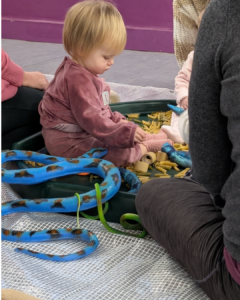
Banging toys can sound noisy and chaotic, but your baby has a very different goal in mind.
They’re comparing objects.
A wooden block makes a different sound from a spoon. Soft fabric behaves differently from hard plastic. Metal feels different from silicone. Every comparison teaches the brain something new.
As babies bang, tap and knock objects together, they also strengthen the muscles in their shoulders, arms and hands. Those movements improve coordination, encourage both sides of the body to work together and lay the foundations for later fine motor skills like drawing, cutting with scissors and eventually writing.
What sounds like endless noise to us is actually carefully repeated practice for a rapidly developing brain.
Why Does My Baby Love Ribbons More Than Expensive Toys?
This surprises almost every parent.
You spend ages researching the perfect developmental toy, only to discover your baby would much rather watch a ribbon floating through the air or stare at the tags on a soft toy.
There’s a good reason for that.
Unlike many electronic toys, ribbons never move in exactly the same way twice. They twist, float, spin and drift unpredictably. That constantly changing movement captures your baby’s attention because their brain loves novelty.
Following a moving ribbon also develops visual tracking, one of the building blocks for later reading, hand-eye coordination and movement. As your baby’s eyes smoothly follow an object across their field of vision, they’re strengthening skills they’ll continue using throughout childhood.
That’s exactly why ribbons, scarves, bubbles and flowing fabrics appear so often in Adventure Babies classes.
We don’t use them because they look pretty.
We use them because they encourage babies to reach, track, concentrate and connect with the adult beside them. Every activity has a developmental purpose, even when it simply feels like fun.
What Toys Does My Baby Really Need?
Modern parenting can make it feel as though babies need endless shelves of developmental toys.
The truth is much simpler.
Your baby needs opportunities to explore.
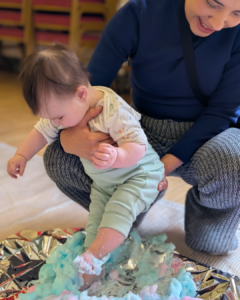
Books. Interesting textures. Songs. Open-ended objects. Faces. Conversation. Time on the floor. Space to move. Most importantly, they need someone who joins in with their discoveries.
Research repeatedly shows that responsive interaction between parent and baby supports development far more effectively than expensive toys alone. Your voice, facial expressions and shared attention help build language, emotional security and social understanding from the very beginning.
BookTrust has some wonderful ideas for reading and playing with babies of different ages
Why Adventure Babies Looks Different
Parents often leave their first Adventure Babies class saying the same thing.
“I finally understand why my baby does that.”
That’s because everything you see during a session has a purpose.
We choose books that encourage interaction rather than passive listening. Puppets support joint attention and communication. Ribbons strengthen visual tracking. Sensory trays invite babies to investigate texture, temperature and movement. Songs and repeated stories help babies recognise patterns that support language and memory.
To a baby, it feels like joyful play.
To us, every activity supports an area of development.
Our classes don’t entertain babies while parents watch from the sidelines. Instead, they help parents understand how their baby learns and how simple everyday moments shape their child’s development.
Once you understand the “why” behind your baby’s behaviour, everyday life suddenly feels much less worrying.
Instead of wondering whether they’re behind, you begin to notice just how much learning happens during ordinary moments at home.
You’re Not Doing Anything Wrong
One of the loveliest moments in every Adventure Babies class comes when a parent smiles and says,
“Oh… that’s why they’ve been doing that!”
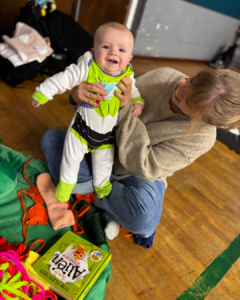
Around the room, other parents laugh because they’ve experienced exactly the same thing. One baby chews every book. Another throws every toy. Someone else’s spends the whole session watching ribbons instead of touching anything.
Nobody judges.
Everyone understands.
That’s what makes our community so special.
Adventure Babies isn’t simply somewhere to spend an hour with your baby. It’s a place where developmental science meets real life, where questions are always welcome and where parents leave feeling more confident than when they arrived.
So the next time your baby ignores the flashing toy and becomes completely fascinated by a ribbon dancing through the air, don’t worry.
They’re not wasting time.
They aren’t playing the wrong way.
They’re building their brain, one tiny experiment at a time.
If you’d like to experience the difference for yourself, we’d love to welcome you to an Adventure Babies class. You’ll discover that every story, every sensory activity and every shared smile has a purpose. More importantly, you’ll leave with a deeper understanding of your baby’s incredible development and a community of parents who are discovering it alongside you.
Find your nearest Adventure Babies class
Explore our books, sensory resources and mini parachutes