
Screen Time for Babies: What the Research Really Says Without the Parent Guilt
There is a particular kind of guilt that arrives when you realise your baby has been staring at the television.
Perhaps you switched it on because you needed ten minutes to make lunch. An older sibling might have been watching something, or your baby may have become completely mesmerised by a video call while you tried to answer a message.
Then you notice their eyes fixed on the screen and wonder whether you have done something terrible.
Parents searching for advice about screen time for babies often meet two extreme messages. One suggests that every screen damages a baby’s brain. The other claims that screens are simply part of modern life, so there is little point thinking about them.
The reality sits somewhere more useful in the middle.
Babies learn particularly well through responsive relationships, physical movement, real objects and back-and-forth communication. Screens become more concerning when they regularly replace those experiences, not because one accidental episode of television has somehow undone all your loving interaction.
What does the latest UK screen-time guidance say?
In March 2026, the Government introduced new screen-time guidance for families with children under five.
For children under two, the guidance recommends avoiding screen use apart from shared activities that encourage bonding, interaction and conversation. Video calls with relatives are an obvious example. Parents of children aged two to five are advised to aim for no more than one hour of screen time each day. Screens should also stay away from mealtimes and the hour before bed.
The Royal College of Paediatrics and Child Health welcomed the new guidance, while stressing the need for practical advice that reflects real family life.
That point matters.
Parents use phones to work, navigate, communicate, take photographs, book appointments and stay connected with people they love. Simply telling families to remove every device ignores how modern life actually works.
What does the screen-time research tell us?
The Government commissioned an independent expert group to review evidence about screen use during the early years. Its report informed the new guidance and concluded that the effects of screens depend on several factors, including the child’s age, the type of content, how the screen is used and what it replaces.
Research often finds links between heavier or less appropriate screen use and differences in language, attention, sleep, behaviour and social development. However, the word links is important.
Many studies are observational. Researchers can see that two things occur together, but they cannot always prove that one directly caused the other.
Families with higher screen use may also be managing poor sleep, parental stress, limited childcare, financial pressure, illness or reduced access to community support. Those factors can influence both screen habits and child development.
“Screen time” also covers very different experiences. A responsive video call with Grandma is not the same as background television or an endless stream of fast-moving videos.
Babies learn through real responses
Babies are not simply smaller adults watching information.
During the first two years, they learn through their bodies and their relationships. A real person can notice where a baby is looking, change their voice, pause, repeat an action and answer a squeal or gesture.
A recorded video cannot reliably do that.
It may show a baby a puppet, but it cannot notice that the baby has turned away. The programme might say “ball”, yet it cannot see which object has actually captured the baby’s attention.
Live interaction changes in response to the baby.
The Harvard Center on the Developing Child describes this as “serve and return” interaction. A baby “serves” through a look, sound, movement or gesture. A caring adult “returns” that communication by noticing and responding. These exchanges support early language, social development and developing brain architecture.
What screens can crowd out
A short programme while somebody prepares dinner differs greatly from a baby spending long periods in front of a device instead of moving, playing or interacting with people.
Screens take up time. The most useful question is often: what would otherwise have happened during that time?
Babies particularly benefit from moving freely on the floor, looking at real faces, hearing responsive speech, handling physical objects, exploring outdoors, sharing books and getting enough sleep.
The Government’s expert report identifies sleep, physical activity, face-to-face interaction and play as experiences that screen use can displace. It also emphasises the quality of the content and the involvement of an adult.
A screen does not become harmful simply because it exists in the room.
Concern grows when passive viewing repeatedly takes the place of the real-world experiences babies need to practise movement, communication and regulation.
Screen time and baby language development
Language development involves much more than hearing words.
Imagine that your baby spots a dog.
You follow their gaze and say, “You saw the dog.”
Your baby makes a noise, and you answer.
That exchange connects the word with the animal, your face, your tone and the baby’s own interest. It also teaches them that communication travels in both directions.
Passive content cannot follow a baby’s attention in the same way.
An “educational” video may include colours, numbers and vocabulary, but placing information in front of a baby does not guarantee meaningful learning. Babies need context, repetition and responsive interaction.
Our own guide to supporting your baby’s language development explores how talking, pausing, reading and responding can help language grow naturally.
The adult’s response remains one of the most useful parts of any experience.
Background television can interrupt interaction
Parents often focus on the screen placed directly in front of the baby. Background television is easier to overlook.
A baby may not appear to be watching, yet changing sounds and images can repeatedly pull their attention away from play. The television can also distract adults, leading to shorter or more fragmented conversations.
This does not mean families need to sit in silence.
Music, radio, conversation and ordinary household noise all belong in family life. However, a television running for hours when nobody is actively watching it can add unnecessary competing stimulation.
Turning off unused screens creates an easy place to begin. You are not committing to an elaborate digital detox; you are simply making more room for the interaction that already happens naturally.
The sound of your voice, the clatter of lunch being made and an occasional conversation about the missing muslin are all perfectly valid parts of a baby’s world.
Are video calls bad for babies?
Video calls differ from passive viewing because they can involve genuine, live interaction.
Grandma says your baby’s name.
The baby smiles.
Grandma notices and answers.
You point to the person on the screen and say, “There’s Grandma!”
The technology carries a real relationship rather than replacing one.
Video calls work best when an adult stays nearby and helps the baby connect the screen with their physical world. You might show the caller a favourite toy, repeat what they say or play a familiar game together.
Context changes the experience.
A baby watching an endless sequence of videos alone is not having the same developmental experience as a baby exchanging smiles and sounds with someone who knows them.
Parents do not need to feel guilty about using technology to maintain loving family relationships.
What about baby apps and “sensory” videos?
Words such as “educational”, “sensory” and “brain development” can make online content sound automatically beneficial.
Marketing labels do not always reflect strong evidence.
Rapid editing, constant sound and high-contrast movement may capture a baby’s gaze, but being difficult to look away from is not the same as creating deep learning.
The UK guidance advises families to avoid fast-paced, short-form content for young children and to choose slower, age-appropriate material when screens are used. It also recommends watching together and talking about what is happening.
One short song shared with an adult may offer more than twenty minutes of autoplay content.
You can connect the song to movement, pause for your baby’s response and stop when they have lost interest. Those choices keep the adult, rather than an algorithm, in charge of the experience.
Screens and baby sleep
Screens around bedtime can cause difficulties for several reasons.
Stimulating content may make it harder for babies to wind down. A device can also delay the bedtime routine, while bright light and changing sounds compete with the quieter signals that tell a baby sleep is approaching.
The latest UK advice recommends avoiding screens during the hour before bed for children under five.
A simple routine might involve a feed, dimmer light, a cuddle, a familiar phrase and a short book.
No bedtime routine guarantees perfect sleep. Babies remain babies and may reject even the most carefully planned evening with impressive determination.
However, a physical book adapts to the moment in a way a programme cannot. You can pause on one page, lower your voice, allow your baby to touch the picture and stop whenever they have had enough.
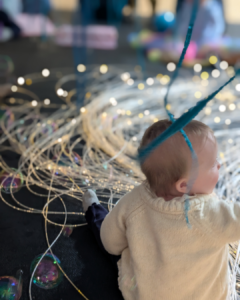
Why real sensory play is different
A “sensory” video usually offers visual movement and sound.
Real sensory play involves far more.
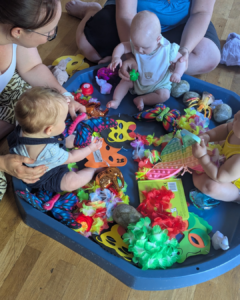
When your baby explores a scarf, they notice colour, texture, weight and movement. Pulling it produces a physical result. Grasping it gives information about pressure and body position.
A shaker offers sound, touch, movement and cause and effect. Your baby acts, and the object responds.
Live sensory storytelling adds another layer. A puppet can pause when a baby looks away, move closer when they reach and reappear when their expression shows renewed interest.
The baby does not simply receive stimulation. They help shape the experience.
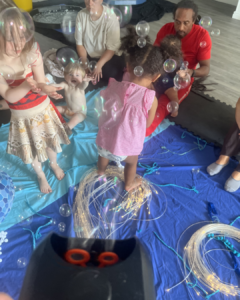
At Adventure Babies sensory storytelling classes, books, puppets, movement, textures, lights and shared play create meaningful opportunities for babies to explore.
We never judge quality by how much stimulation we can fit into 45 minutes.
Good sensory play is not sensory overload
A richer environment is not automatically a better one.
Babies are still learning to organise sights, sounds, movement, touch and social information. An activity that delights one baby may feel like enough after a few seconds for another.
High-quality sensory play includes contrast.
There can be moments of excitement, followed by time to watch and recover. A puppet might appear dramatically, then remain still while babies study it. Music can become lively before the class returns to a calmer story moment.
Looking away does not mean a baby has failed to participate. They may need a pause while their brain processes what has happened.
We do not need to win their attention back by becoming louder or faster.
Slowing down protects babies from feeling bombarded and gives their responses room to become part of the story.
Why baby classes matter in a screen-filled world
Baby classes have always provided more than an activity to fill an hour. Their role feels especially important when so much of family life now happens through screens.
Adventure Babies does not pretend that families can or should live without technology.
Instead, our classes protect a small part of the week for a real, shared experience.
Babies meet actual faces rather than flat images. Voices respond to their sounds. Puppets pause when they look away and move again when they become interested.
Physical props also behave according to the baby’s actions. Fabric changes shape in their hands. A shaker makes a noise when they move it. A ball rolls through real space rather than disappearing at the edge of a screen.
These experiences help babies connect sight, sound, touch, movement and communication.
A butterfly on screen is not the same butterfly
A video can show your baby a butterfly.
During an Adventure Babies class, the butterfly can flutter slowly into view, pause while your baby watches and move towards their reaching hand.
The class leader can notice your baby’s expression. You might name what they have seen, copy their sound or give them time to respond.
Now the butterfly has become part of a conversation.
That responsiveness is where much of the developmental value sits.
Babies need experiences that adjust to them rather than continuing at a pace chosen in advance. They should be able to look, reach, turn away, cuddle into a parent and return when they feel ready.
We are not trying to hold a baby’s attention at all costs. Our role involves making attention worth sharing.
Baby classes also support the parent
Screen-time discussions often treat babies as though they exist separately from the adults caring for them.
They do not.
A tired, isolated or overwhelmed parent may rely on screens because they need to cook, work, care for another child or simply gather themselves for ten minutes.
Community support can change what feels possible.
At Adventure Babies, parents arrive to find the story, puppets, sensory activities and play environment already prepared. They do not need to invent an enriching activity from nothing.
Instead, they can sit with their baby, notice what interests them and enjoy watching the experience unfold.
A screen may occupy a baby, but it cannot introduce a tired mum to somebody else who understands the broken nights. Technology cannot reassure a parent that their quiet, watchful baby is still joining in.
Real communities notice people.
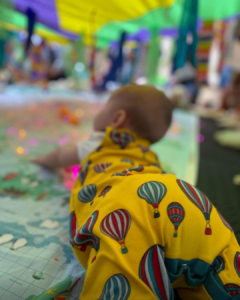
Books provide the thread
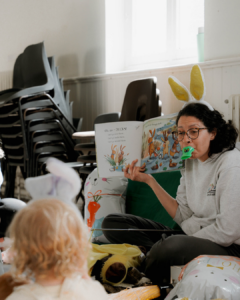
Every Adventure Babies session begins with a book because a story gives the sensory experience meaning.
The props are not a random collection of colourful objects. They connect with the characters, language and ideas in the story.
A repeated sound supports anticipation. Moving fabric may represent a character or setting. A puppet introduces shared attention, while a sensory tray allows babies to explore an idea physically.
Our Adventure Babies books and sensory storytelling resources help families continue these experiences at home. Parents do not need to reproduce a complete class.
One familiar story, a playful voice and a slowly moving scarf can create a rich interaction.
The Adventure Babies mini parachute can also support tracking, reaching and anticipation through simple shared play.
Books help us slow the experience down and return the focus to connection.
Why shared stories still matter
A story offers something screens often struggle to provide: complete flexibility.
Your baby can stay on the same page for several minutes. You may repeat one sound because it made them smile or skip ahead because they have begun wriggling away.
The story can become louder, quieter, faster or slower according to the baby in front of you.
Reading also creates shared attention. You look at the same picture, notice your baby’s reaction and respond.
Adventure Babies has always placed this relationship at the centre of sensory storytelling. Since 2013, our classes have helped families discover that books can be moved, sung, whispered, explored and enjoyed long before a child can read independently.
In a screen-filled world, helping babies fall in love with physical books feels more important than ever.
Adventure Babies offers active participation
In a world full of passive content, Adventure Babies offers active participation.
Where digital experiences keep moving, our stories can pause.
While attention is constantly pulled elsewhere, classes create space to notice one thing together.
Parents are often expected to manage everything alone. Our community brings them into a room with other adults living through the same stage.
The value does not come from declaring that every screen is bad.
It comes from protecting the experiences screens cannot reproduce: live voices, physical movement, touch, responsive communication, shared attention and human connection.
That is what every Adventure Babies session aims to offer.
For one part of the week, babies can explore the real world, parents can feel supported and a brilliant book can become something they experience together.
Why Adventure Babies does not use fear
A baby-development business could easily use screen-time research to frighten parents.
We could imply that every programme causes harm and suggest that responsible parents must book more classes.
That would be neither honest nor helpful.
Adventure Babies parents are real people. They are feeding babies at 5am, caring for older children, working, managing illness, attempting to make dinner and occasionally needing a few quiet minutes.
A screen may help a parent complete an essential task or regain enough calm to continue the day.
That choice does not erase the cuddling, reading, chatting, walking and playing that happens throughout the rest of family life.
Our role is to explain what babies particularly benefit from and help families create more of those experiences where possible.
Support works better than shame.
A more useful way to think about screen time for babies
Rather than watching the clock with rising panic, begin by thinking about context.
Consider what your baby is watching. Slower, simpler content provides a different experience from rapidly changing videos.
Next, notice whether anyone shares the experience with them. An adult can add language, respond to the baby and connect what appears on screen with a real object.
Think about what the screen is replacing too. Ten minutes while you make lunch differs from losing regular opportunities for sleep, movement and conversation.
Finally, watch your baby’s response. Some babies become unsettled, absorbed or distressed when a screen stops. Others glance briefly and return to their play.
These questions support thoughtful decisions without demanding perfection.
Simple changes that do not require a digital detox
You do not need to redesign family life overnight.
Start by switching off background television when nobody is using it. Choose one or two naturally screen-free parts of the day, such as mealtimes or the period before bed.
Place your phone out of reach during one short story or a few minutes of floor play.
When your baby needs a distraction, try a safe household object, board book, scarf or wooden spoon. Babies often find ordinary objects more interesting than adults expect.
Sit nearby when screens are used and talk about what is happening whenever that feels manageable.
None of these habits needs to happen perfectly.
The aim is not to remove technology completely. You are simply protecting enough responsive, physical and social experiences for your baby to keep learning from the real world.
What if your baby has already had lots of screen time?
Start from where you are.
Do not panic or assume that you have permanently affected your baby’s development.
Population-level research describes patterns across groups of children. It cannot predict one individual baby’s future from a family’s past screen habits.
Small changes still matter.
Turn the television off for part of the morning. Put a few safe objects on the floor. Share one short book or sit beside your baby and copy their sounds.
A walk outside can offer movement, changing light, conversation and new things to notice.
None of these experiences needs to be elaborate.
Baby development grows through repeated patterns over time rather than one perfect day—or one difficult week.
Parent wellbeing belongs in the conversation
Advice about screen time for babies must include the wellbeing of the person caring for them.
Parents with practical help, social contact and places to go may find it easier to create screen-free periods. Families coping with exhaustion, isolation or poor mental health may need screens more often because they have fewer alternatives.
Judging individual choices without understanding the wider situation helps nobody.
This is why our baby and toddler classes focus on the parent community as well as developmental play.
Parents can meet other families, ask questions, share the reality of life with a baby and enjoy activities they did not need to prepare themselves.
Supporting the adult strengthens the environment around the baby.
Community is not an optional extra. It forms part of healthy family life.
What should parents remember?
Current UK guidance recommends avoiding screens for children under two, apart from shared activities that encourage bonding, interaction and conversation.
Context still matters.
A brief screen used while a parent manages family life is not the same as long periods of solitary viewing. A responsive video call differs from fast-paced autoplay content.
Most importantly, screen use represents only one part of a baby’s developmental world.
Your baby benefits from your face, voice and response. They learn through movement, physical objects, stories and the discovery that their actions affect what happens next.
Those experiences do not need to be complicated.
Talk to them. Read a short book. Sit on the floor. Go outside. Copy a sound and wait to see what comes back.
When the television stays on longer than you planned, turn it off when you can and begin again.
There is no need for guilt to occupy the space where connection could go.
Real babies, thoughtful development and no pressure to perform
Adventure Babies classes give babies real, responsive experiences through books, puppets, movement, light, textures and shared sensory play.
Babies can watch, feed, cuddle, sleep, roll, crawl or dive into the middle of the activity.
Nobody expects them to perform on cue.
Parents can learn more about what their baby is noticing, meet other adults and enjoy a class where development feels joyful rather than like another target to meet.
Our classes matter in this screen-filled world because they create something technology cannot reproduce: a room full of real people responding to one another around a shared story.
Find your nearest Adventure Babies class and join a welcoming community built around thoughtful baby development, human connection and books brought brilliantly to life.