How to Encourage a Love of Reading in Babies: Why Reading for Pleasure Begins at Birth
The Government has been warned that children’s enjoyment of reading is falling—and that reversing the decline cannot begin only when children arrive at school.
In July 2026, the House of Commons Education Committee published its major Reading for Pleasure report. It called for a National Reading Guarantee, giving every child frequent opportunities to enjoy books, stories and shared reading from birth to the age of 18.
The words from birth matter.
Babies cannot decode letters, follow a complicated plot or discuss a character’s motivation. They may not even let you reach the second page before trying to eat the book.
But they can begin building a relationship with reading.
They can learn that a book means a familiar voice, closeness, rhythm, surprise and shared attention. They can discover that stories are something people enjoy together rather than a task they will eventually be expected to complete correctly.
At Adventure Babies, this has been at the heart of what we do since 2013. We do not wait until children are considered “old enough” to make books meaningful. Our sensory storytelling classes for babies and toddlers bring brilliant books to life through puppets, movement, texture, light, sound and shared play.
Because a love of literacy does not suddenly appear when a child begins learning phonics.
It starts much earlier, in someone’s arms.
Why is reading for pleasure now a national concern?
The Education Committee launched its Reading for Pleasure inquiry in response to a serious decline in the number of children and young people choosing to read in their free time.
Its final report argues that this is not only an educational issue. Reading for pleasure is associated with wider benefits for wellbeing, empathy and attainment, and the Committee says children need regular access to enjoyable reading experiences throughout childhood.
The report also recognises that reading habits are shaped by far more than what happens in a classroom. Families, early-years settings, libraries, community organisations and access to books all have a role to play.
Time, money, working patterns, confidence around reading and access to local services can all affect how easily books become part of family life. The answer cannot simply be to tell parents to read more and leave them feeling that they have failed at yet another area of parenting.
Families need practical, welcoming ways to discover that reading with a baby can be enjoyable, flexible and surprisingly simple.
This is where baby classes, libraries, health visitors, family hubs and community programmes can make a real difference. They can introduce books without judgement, show parents how babies engage with stories and make shared reading feel like part of everyday family life.
Adventure Babies already works in this space. Our classes combine our knowledge of infant development with sensory storytelling, helping parents understand that babies do not need to sit still, concentrate for long periods or demonstrate what they have learned.
This is not about teaching newborn babies to read.
It is about creating the conditions in which reading becomes familiar, joyful and emotionally meaningful long before formal teaching begins.
When should I start reading to my baby?
You can start from birth.
A newborn will not understand the plot in the way an older child does, but understanding every word is not the only reason to share a story.
Your baby is listening to the rhythm of your voice. They are noticing changes in pitch, pace and expression. They may study your face, become alert when you repeat a sound or relax against you as they hear your familiar voice.
BookTrust’s research into shared reading during a baby’s first year highlights benefits for babies’ speech, communication and language, alongside greater warmth and positivity in parent-baby interactions.
The important phrase is shared reading.
Reading with a baby is not about delivering every word while they sit politely and listen. It is an interaction between the book, the baby and the adult.
You may spend most of the time looking at one page. Your baby may grab the book, turn it upside down, study your mouth rather than the pictures or lose interest after thirty seconds.
That still counts.
A successful baby story is not measured by whether you reached the end. It is found in the looks, sounds, cuddles and moments of shared attention that happened around the book.
Babies do not need to sit still to become readers
One of the biggest misunderstandings about reading with babies is that they should sit quietly and pay attention from beginning to end.
That is an adult idea of reading.
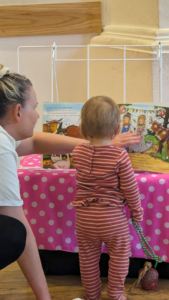
Babies learn with their whole bodies. They look, reach, kick, grab, mouth, turn, listen and move. Their attention may shift between the book, your face, a noise in the room and their own toes.
This does not mean they are uninterested.
A baby who reaches for a page is discovering that a book is a physical object. A baby watching your mouth is learning about speech and expression. A baby who kicks during a familiar phrase may be beginning to recognise and anticipate it.
Even handling a board book can support physical development. BookTrust notes that lifting, turning and manipulating books gives babies and young children opportunities to practise balance, upper-body movement and hand control.
The aim is not to train babies to behave like schoolchildren.
The aim is to help them associate books with pleasure, curiosity, safety and connection.
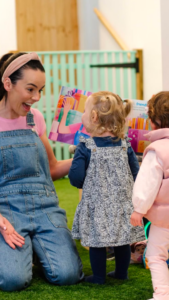
At Adventure Babies sensory storytelling classes, babies are welcome to watch, roll, crawl, cuddle, feed or explore while the story unfolds.
Some will watch a puppet intensely.
Some will reach straight into the sensory tray.
Some will listen quietly from a parent’s lap.
One may attempt to leave with the book.
All of them are participating.
Reading for pleasure is different from teaching reading
Reading for pleasure and learning to decode written words are connected, but they are not the same thing.
Formal reading instruction teaches children how letters and written symbols relate to sounds and language. Reading for pleasure is about developing the interest and motivation to return to books and stories voluntarily.
A child may technically be able to read without choosing to read.
That is why the Education Committee’s report is so significant. It argues that children need opportunities to experience books as enjoyable in their own right, not only as a route to assessment or academic success.
For babies, this distinction is particularly clear.
Nobody should be testing a six-month-old on vocabulary or expecting them to recognise letters. But we can help babies discover that books are interesting, funny, reassuring and full of possibilities.
When a baby repeatedly experiences books through warmth, interaction and enjoyment, reading begins as something shared with people they trust.
That emotional foundation matters.
How shared reading supports attachment and connection
Books can bring babies and adults physically and emotionally closer.
You may hold your baby against your body, slow your voice and respond to what they notice. For a few moments, your attention rests in the same place.
BookTrust explains that sharing stories can support bonding by creating closeness and shared attention, helping children feel safe, noticed and valued.
This does not mean every story will become a serene bonding experience.
Your baby may be overtired. You may be distracted. The book may be thrown onto the floor five times.
Connection is not ruined because the moment was imperfect.
It grows through repetition.
Your baby gradually begins to recognise the pattern: the book appears, your voice changes, you look together and something familiar happens.
The story becomes known, but so does the experience of being with you.
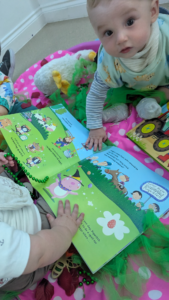
Why repetition is so important for babies
Adults often look for novelty. Babies benefit from new experiences too, but they also learn an enormous amount through repetition.
The first time your baby sees a particular page, they may notice only a bright patch of colour.
The next time, they may study the character’s face.
After several readings, they may recognise the sound you always make, kick before an exciting part or turn towards a favourite picture.
The story has not changed.
The baby has.
Repeated reading allows babies to recognise patterns, anticipate what comes next and notice details they missed before. It also gives them repeated opportunities to connect the same words with the same pictures, actions and emotional reactions.
This is why reading the same book again and again is not something parents need to apologise for.
You are not failing to offer variety.
You are allowing familiarity, anticipation and memory to do their developmental work.
How books support early speech and language
Books introduce babies to language that may not appear regularly in everyday family conversation.
Much of our daily talk is practical:
“Where is your sock?”
“Let’s change your nappy.”
“Please don’t grab the dog.”
Stories offer something different. They bring rhythm, rhyme, repeated refrains, unusual vocabulary, character voices and playful sound patterns.
BookTrust describes rhyme, repetition, humour and interactivity as valuable ways to introduce children to language in an enjoyable context.
For babies, the adult’s delivery is part of the experience.
When you slow down, repeat a phrase or change your expression, you help your baby notice the shape and rhythm of the language. When you name something they are already studying, the word becomes connected to their focus.
They do not need to repeat the word back.
Listening, watching, vocalising and moving are all part of early communication.
What sensory storytelling adds to a book
A book already offers sound, rhythm, pictures and connection.
Sensory storytelling adds carefully chosen experiences that help babies connect the language of the story with something they can see, hear, feel or do.
A butterfly might be represented by fabric moving slowly through the air.
A repeated word such as “shake” can be paired with an object the baby can hear and feel.
A character hiding might be explored through a puppet disappearing beneath a cloth.
The word is no longer only heard. It becomes attached to an experience.
This is why sensory storytelling can inspire a love of books in babies. The story remains at the centre, while movement, texture, sound and carefully chosen sensory experiences help make its language, characters and ideas meaningful.
This can be especially valuable during the first two years, when babies learn through their senses, their bodies and their relationships.
Sensory storytelling should not, however, mean bombarding babies with constant stimulation.
More props do not automatically create more learning. Louder sounds do not necessarily hold attention more effectively. Babies need time to notice what has happened, process it and offer a response.
At Adventure Babies, we use gentle sensory stimulation to support development while helping babies build positive relationships with books.
The story is the thread holding the experience together.
We are not presenting a random collection of exciting objects. We are helping the words and ideas in the book become meaningful.
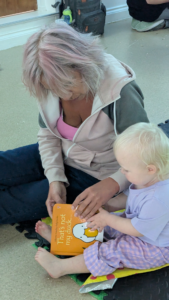
A good baby story is a conversation
The most valuable reading experiences are not entirely adult-led.
Your baby contributes too.
They may look, vocalise, reach, smile, kick or turn away. When you notice and respond, the story becomes a conversation.
You might say:
“You saw the bear.”
“You’re listening.”
“That surprised you.”
“You want to touch the page.”
This tells your baby that their response matters.
It also allows parents to slow down and observe rather than feeling that they must perform the entire story perfectly.
Sometimes the most useful thing you can do is pause.
Give your baby time to process the picture, movement or sound. Watch what captures their attention. Let their response influence what you do next.
This is one reason sensory storytelling can support far more than early literacy. It creates opportunities for shared attention, communication, emotional connection, memory and turn-taking.
The parent does not need to be a brilliant storyteller
Some parents love dramatic voices and happily perform an entire cast of characters.
Others feel self-conscious reading aloud to somebody who cannot answer.
Both can raise children who love books.
Your baby does not need a polished theatrical performance. They need a familiar person sharing the experience with genuine interest.
You can read the words exactly as written, describe the pictures or repeat one favourite sound. You can skip pages. You can stop when your baby has had enough.
There is no reading test for parents.
Adventure Babies classes are designed partly to remove that pressure. We provide the story, characters, sensory ideas and inviting environment. Parents can then concentrate on watching how their baby responds and discover techniques they may enjoy using at home.
You do not have to invent a developmental activity every afternoon.
Sometimes you simply need a good book and permission to enjoy it in your own way.
Why access and community matter
The Education Committee’s report makes clear that enthusiasm alone is not enough. Children need access to books, libraries and supportive shared-reading experiences.
Not every family begins with the same resources.
Some homes contain shelves full of books. Others have very few. Some parents were read to throughout childhood and feel confident choosing and sharing stories. Others had difficult experiences of reading at school or may not see themselves as “book people”.
A national commitment to reading for pleasure must therefore be welcoming rather than judgemental.
Libraries, early-years groups and community organisations can help families discover books without pressure or unnecessary expense.
Families may also receive support through Bookstart Baby, a universal early-years programme designed to help parents begin sharing books and stories with their children as early as possible.
Baby classes can contribute too.
They allow parents to see how different babies respond, borrow ideas from experienced class leaders and talk with other adults about the books and activities their children enjoy.
Most importantly, they make reading social.
Books become part of family and community life rather than an isolated educational task.
Reading supports the parent too
Shared reading is often discussed only in terms of what it gives the child.
It can help parents as well.
A book provides somewhere to place your attention during a long day. It offers words when you are unsure what to say and a simple activity when you are too tired to invent one.
It can create a small moment of predictability during a stage of family life that often feels anything but predictable.
Research shared by BookTrust suggests that shared reading can influence both babies’ and parents’ physical and cognitive states as their rhythms become more closely aligned during the interaction.
This does not mean a story will transform every unsettled afternoon into calm.
But it can offer a point of connection.
Even a few minutes spent sharing one page, sound or cuddle can shift the rhythm of the moment.
The National Year of Reading 2026
This work feels particularly urgent during the National Year of Reading 2026, a Department for Education campaign launched with the National Literacy Trust to encourage people of all ages to rediscover reading for pleasure.
Babies must be part of that conversation.
Reading culture does not begin when children enter a classroom. It begins at home, in libraries, at community groups and anywhere a baby experiences stories as warm, playful and meaningful.
At Adventure Babies, we have spent more than a decade helping families discover exactly that.
Our classes show parents that a book can be sung, whispered, moved, explored and brought gloriously to life.
Our Adventure Babies books and sensory storytelling resources have been created especially for early shared storytelling, with engaging characters, rhythmic language and plenty of opportunities to add voices, movement and sensory play.
They are designed to help families continue the Adventure Babies experience at home without needing complicated equipment or elaborate preparation.
Families can also use an Adventure Babies mini parachute to introduce gentle movement, visual tracking, anticipation and shared attention while bringing familiar stories to life.
A scarf can become part of a story.
A repeated sound can become a favourite game.
A familiar book can become part of the pattern of family life.
Before babies can read books, they can fall in love with them.
How to encourage a love of reading in babies
You do not need to run a formal literacy programme at home.
Begin by making books accessible. Keep a few where your baby can see and safely reach them rather than treating them as precious objects that must remain perfect.
Follow your baby’s attention. You do not need to read every word if they are fascinated by one particular picture.
Repeat favourites. Familiarity builds recognition, anticipation and confidence.
Use your natural voice. Add expression, sounds or a little movement when it feels comfortable, but do not feel that you must perform.
Let your baby handle sturdy books. Turning, holding, patting and exploring the pages are all part of becoming familiar with them.
Pause and watch. Give your baby time to show you what they have noticed.
Stop while the experience is still enjoyable. A two-minute shared story can be more valuable than struggling through ten minutes after your baby has lost interest.
Above all, separate reading from pressure.
Your baby does not need to demonstrate what they have learned.
The aim is to create the feeling that books are interesting, enjoyable and always worth returning to.
Adventure Babies and the future of reading for pleasure
The parliamentary report calls for children to have regular opportunities to enjoy books and shared reading from birth.
Adventure Babies has been creating those opportunities since 2013.
Our expertise sits at the meeting point between literacy, infant development and parent-child connection.
We understand that babies learn through their senses and relationships.
We understand that attention may look quiet.
We understand that repetition is valuable, that parents need encouragement rather than judgement and that books should feel joyful before they ever feel instructional.
Our sensory storytelling classes support early communication, shared attention, movement and curiosity while helping parents discover practical and playful ways to share books.
We do not claim that attending one class guarantees later academic success.
What we can do is create the kind of early experiences that make books familiar, meaningful and loved.
That is where a reading culture begins.
Not with a worksheet.
Not with a test.
Not even with a child reading their first independent sentence.
It begins when a baby hears a familiar voice open a book and discovers that something lovely is about to happen.
Find your nearest Adventure Babies class and join a community helping babies fall in love with brilliant books from the very beginning.