Why Does My Baby Copy Me? The Remarkable Development Hidden Inside Mirroring
You open your mouth and your baby opens theirs.
You make a soft “ooo” sound and, after a long and serious pause, they attempt something similar. Later, they begin clapping when you clap, waving when you wave or copying the expression you make when a spoonful of food lands on the floor.
It can feel as though your baby has suddenly decided to become your tiny impersonator.
But when parents ask, “Why does my baby copy me?”, the answer goes far beyond a cute party trick.
Copying, imitation and mirroring are among the ways babies begin to understand people. Through these simple back-and-forth exchanges, they explore how faces move, how sounds are made, how actions produce results and how communication travels between two people.
Mirroring can support early relationships, attention, communication, movement, memory and social learning. It also gives babies an important message long before they understand spoken reassurance:
What I do is noticed. What I express matters. I can affect another person.
That is an extraordinarily powerful discovery.
What is mirroring in babies?
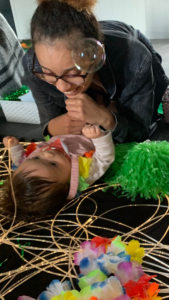
Mirroring is a broad term used to describe moments when one person reflects another person’s expression, sound, movement or emotional tone.
Sometimes the baby copies the adult. They may imitate a smile, clap, wave, sound or simple action.
Sometimes the adult mirrors the baby. A baby raises their eyebrows and their parent responds with a similar expression. The baby says “ba-ba”, and the adult repeats it. The baby bangs a cup on the floor and the adult copies the rhythm.
Often, the interaction becomes mutual. Neither person is simply demonstrating while the other follows. They are influencing one another.
Your baby vocalises.
You copy the sound.
Your baby notices.
They make it again, perhaps louder this time.
You respond with a smile and another sound.
A tiny conversation has begun.
This kind of responsive back-and-forth interaction is closely related to what the Harvard Center on the Developing Child calls serve and return. A baby “serves” through a look, sound, movement or cry, and an adult “returns” by noticing and responding. These exchanges help strengthen developing connections involved in communication, emotional wellbeing and social understanding.
Mirroring is therefore not just a baby copying an isolated action. At its richest, it is a shared experience in which both people are watching, responding and adjusting.
When do babies start copying you?
There is no single age at which every baby begins to imitate.
Very young babies are fascinated by faces and may appear to match simple expressions or mouth movements. Great Ormond Street Hospital notes that babies in the early months may copy facial expressions, such as an adult sticking out their tongue, while also beginning to smile and wait for a response.
However, the science around newborn imitation is more complicated than many milestone articles suggest.
Researchers have debated for decades whether newborn babies are deliberately copying particular facial gestures, whether some early responses are reflexive, or whether reliable imitation develops through repeated social experience. Reviews of the evidence have reached different conclusions, and there is still no complete scientific consensus about how much imitation is present from birth.
That uncertainty does not mean early face-to-face interaction is unimportant. It simply means parents should not feel they need to make a newborn copy a tongue movement to prove that development is on track.
As babies grow, their imitation usually becomes easier to recognise. They may begin copying:
- coos and playful noises;
- smiles and exaggerated facial expressions;
- clapping and waving;
- banging, shaking or dropping objects;
- actions used during songs and stories;
- simple words or parts of words;
- everyday activities such as brushing hair, stirring or using a phone.
A major 2023 longitudinal study found evidence that babies’ own imitation developed partly through being imitated by sensitive caregivers. In other words, babies may learn how imitation works because adults first reflect them.
This gives mirroring a beautifully relational quality. Babies do not necessarily arrive knowing exactly how to copy everything they see. They learn through experiencing the back-and-forth for themselves.
Why does my baby copy me?
Babies copy because other people are one of their most important sources of information.
An adult can demonstrate what an object does, how a sound is produced, what happens during a familiar routine and how people express excitement, surprise or caution.
Through imitation, babies can borrow an action before fully understanding it.
They may clap before they know why people clap. They may wave before they completely grasp the idea of departure. They may hold a toy phone to their ear because they have repeatedly watched an adult do something similar.
The copied action becomes a starting point. Through repetition and experience, the baby gradually adds meaning.
Imitation also creates closeness. Research reviews describe imitation as a deeply social process that can support affiliation—the sense that two people are connected or “like” one another. Babies and young children often respond positively when another person imitates them.
For a baby, being copied can feel like receiving a very clear reply:
I saw that. I am with you. Let’s do it again.
Being mirrored teaches your baby that they can affect the world
A young baby has very little direct control over daily life.
Adults decide where they go, what they wear and when the pushchair is apparently going to stop moving just as they have fallen asleep.
But during a mirrored interaction, the baby experiences cause and effect in a social form.
They make a sound, and you repeat it.
They smile, and your face changes.
They kick, and you respond with excitement.
Their action has produced a result.
This developing sense of agency—the feeling that “I can make something happen”—is important across many areas of development. It encourages babies to experiment, repeat actions and pay attention to the outcomes.
Mirroring gives them particularly immediate feedback because the result appears in another human being.
The Harvard Center on the Developing Child explains that responsive exchanges help babies connect what they see, hear and experience with language and social meaning. Naming or reflecting what a baby is doing can help make those experiences more understandable.
You do not need to mirror every movement for this to happen. A few responsive moments within everyday life can be enough to create a satisfying exchange.
Mirroring and the developing relationship
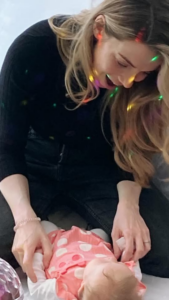
Mirroring is closely linked with emotional connection because it shows the baby that another person is paying attention to their internal state.
Imagine your baby sees something unexpected and widens their eyes. You respond with an interested, slightly surprised face and say, “Oh! You saw that.”
You have not simply copied their expression. You have acknowledged the experience behind it.
Babies cannot yet explain:
“That sound surprised me, but I am curious rather than frightened.”
They rely on their bodies, faces and voices to communicate. A responsive adult tries to interpret those signals and offers something back.
This does not mean copying every distressed expression literally. If a baby cries, they do not need an adult to cry dramatically in return. Emotional mirroring is more about showing that you have noticed the feeling while remaining regulated enough to help.
You might soften your face, lower your voice and say:
“That was a big surprise.”
“You didn’t like that.”
“You’re tired. I’m here.”
Your response reflects the baby’s experience without becoming overwhelmed by it.
A systematic review of infant social interaction and brain development found that sensitive, responsive social experiences—including forms of parental mirroring—are associated with processes involved in early social and neural development.
The key word is responsive. Healthy mirroring is not a performance technique. It is one part of an ongoing relationship in which adults notice, interpret and adapt.
Mirroring does not mean copying every emotion exactly
The word mirroring can be misunderstood.
Parents sometimes imagine they should reflect every feeling with the same intensity. But if a baby is frightened, furious or overwhelmed, an equally frightened or furious adult may add more intensity rather than helping.
Babies often benefit from a response that says:
“I understand that this feels big, and I am steady enough to stay with you.”
You can acknowledge a baby’s upset through your face, tone and words while offering calm rather than copying panic.
For example, a baby becomes startled by a loud noise.
You might widen your eyes briefly and say, “That was loud,” before relaxing your face and bringing them closer.
Your expression shows that you noticed the event. Your return to calm helps communicate that the situation is manageable.
Mirroring is therefore not robotic duplication. It involves matching enough of the baby’s experience to show understanding, then adjusting your response to what they need.
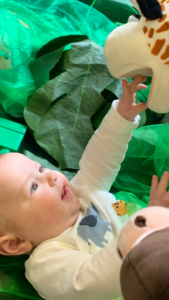
How mirroring supports early communication
Communication begins well before words.
Babies communicate through gaze, body movement, expressions, cries, gestures and vocalisations. When adults copy or respond to these signals, babies experience the basic rhythm of conversation.
I make a sound.
You answer.
I wait.
You pause.
I try again.
This turn-taking pattern becomes part of the foundation for later spoken conversation.
Harvard’s serve-and-return guidance emphasises that babies are active participants rather than passive recipients of adult language. Their babbles, gestures and expressions shape the interaction, and the adult’s response keeps it moving.
This is why copying your baby’s babble can be more useful than talking continuously over it.
If your baby says, “Da-da-da,” you might repeat, “Da-da-da,” then wait.
They may respond with the same sound, change it or look at you intently. Whatever happens, the exchange shows them that their voice has communicative power.
Great Ormond Street Hospital describes cooing as an important stage in which babies begin gaining control over the muscles needed for later speech. It also notes that early smiles and copied expressions form part of the developing social exchange.
You are not teaching a word in that moment. You are teaching something underneath words: conversation belongs to both of us.
Why copying sounds can help language development
Babies learn spoken language by listening to patterns and gradually experimenting with their own vocal system.
They hear pitch, rhythm, pauses, repeated syllables and emotional tone long before they understand every word. When adults respond to their sounds, vocal play becomes social rather than purely experimental.
A baby might discover they can make a long “aaaa” sound.
You copy it.
They try again, perhaps changing the volume.
You answer in a slightly different pitch.
Now they are exploring sound, attention, imitation and turn-taking at once.
The aim is not to turn every babble into a correct word. In fact, responding playfully can be more developmentally appropriate than continually correcting or testing.
If your baby says something resembling “ba” while looking at a ball, you might say:
“Ba! Ball. You found the ball.”
This reflects their sound while gently offering the full word.
Mirroring also helps adults slow down. Instead of filling the interaction with instructions and questions, you wait to see what the baby contributes.
That pause creates room for communication.
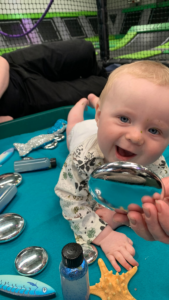
Mirroring and facial expressions
Faces are some of the most complex and interesting things babies encounter.
A face moves, changes shape, produces sound and communicates emotion. Babies learn to watch the eyes, mouth and overall expression for clues about what is happening.
When you reflect your baby’s smile or surprised expression, they can see something similar to their own experience represented on another face.
One study found that the degree to which mothers mirrored babies’ facial expressions at two months was associated with babies’ later motor-system responses when observing those same expressions at nine months. The researchers suggested that early mirroring may help strengthen links between seeing an expression and the motor experience of producing it.
This does not mean parents need to monitor themselves anxiously or deliberately reproduce every facial movement.
Natural interaction already contains plenty of mirroring.
Your baby grins.
You grin back.
They open their mouth in excitement.
You respond with an animated “Oh!”
They become serious.
You pause and watch.
The value lies in the responsiveness, not the accuracy of the imitation.
How babies begin connecting actions with feelings
Babies are not born with adult knowledge of emotions.
They experience bodily states—tension, tiredness, comfort, hunger, excitement—and gradually learn how these states fit into social life.
Adults help by responding to the signals they can see.
A baby squeals and kicks while watching a puppet. You smile and say, “You’re excited!”
A baby turns away and rubs their face. You soften the activity and say, “You need a little break.”
Your words do not instantly teach a precise emotional label. Over time, however, repeated experiences can help the child connect internal sensations, facial expressions, adult responses and language.
Mirroring plays a part because the adult’s face and voice reflect something recognisable about the baby’s experience.
The process is not always neat. The adult will sometimes guess incorrectly. That is normal.
You may say, “You’re tired,” when the baby is hungry. You may assume they are frightened when they are simply concentrating. Relationships develop through these imperfect attempts, adjustments and repairs.
Your baby does not need a parent who reads every expression perfectly. They need someone willing to keep noticing.
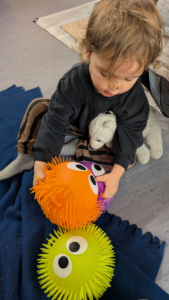
Mirroring and motor development
Imitation is also a powerful route into movement.
Babies watch adults clap, wave, reach, bang objects, turn pages and use everyday tools. They begin to connect the sight of an action with their own developing ability to produce something similar.
At first, the copied movement may be approximate.
A baby trying to clap may bring their hands together slowly and miss. A wave may involve the entire arm. Copying an action from a song might happen several seconds after everybody else has moved on.
The delay does not mean the baby was not paying attention.
To imitate an action, the baby must:
- notice it;
- hold some representation of it in mind;
- work out which parts of their own body are involved;
- organise the movement;
- compare the result with what they saw.
That is a significant piece of cognitive and physical work.
Research on infant imitation describes links between observing an action and organising the baby’s own motor response, although scientists are still exploring exactly how these “neural mirroring” processes develop.
Simple imitation games can therefore support movement without feeling like exercise.
Tap the floor gently and wait.
Roll a soft ball.
Shake a scarf.
Clap slowly.
Allow your baby time to respond in their own way.
Mirroring and memory
Imitation can reveal that babies remember more than they can explain.
An older baby may watch an adult press a button, bang two objects together or place something inside a container. They may reproduce the action immediately—or much later.
When a baby copies an action after a delay, researchers call this deferred imitation. It suggests the baby has stored some information about the event and can retrieve it later.
This is one reason parents sometimes see a new behaviour appear apparently from nowhere.
Your baby may have watched you wave for days without responding. Then one morning, they wave at the cat.
The learning was not necessarily absent during the quiet period. It may have been developing beneath the surface.
Repeated songs, gestures and story actions can support this memory process because they give babies several opportunities to observe, anticipate and eventually participate.
At Adventure Babies, we often see babies watch an action closely for several sessions before suddenly joining in. The baby who appears very serious and still may be processing an enormous amount.
Watching counts.
Why repetition helps babies imitate
Adults can become bored with repetition long before babies do.
A baby, however, benefits from seeing the same action enough times to recognise its pattern.
The first time you shake a scarf, they may notice only the colour.
The next time, they may notice your hand.
Later, they may connect the movement with a repeated word such as “shake”.
Eventually, they may attempt the action themselves.
Repetition reduces the amount of novelty the brain must process, leaving more capacity to notice detail and predict what happens next.
This is why repeated books, familiar songs and recurring class routines can be so valuable. The baby does not experience the same event in exactly the same way each time. They arrive with slightly more developed attention, movement, memory and understanding.
The experience may look repeated to the adult, but it is meeting a changed baby.
Mirroring and social confidence
Being imitated can be enjoyable because it creates a sense of connection.
Research with six-month-old babies has found that infants can recognise when another person imitates them and may show more positive, socially directed behaviour towards that person.
Imagine joining a group where somebody naturally matches your pace, responds to your expression and seems interested in what you contribute. You are likely to feel more included than if everyone continues without noticing you.
Babies cannot describe belonging, but responsive imitation can create a simple form of social alignment.
This is particularly useful for babies who prefer to observe before joining in.
A watchful baby may not immediately copy an adult-led action. An adult can instead copy something the baby is already doing—a gentle tap, a sound or a small movement.
The interaction begins from the baby’s idea rather than requiring them to follow ours.
That can make participation feel safer and more inviting.
Does mirroring support empathy?
It would be too strong to say that copying a baby directly “teaches empathy” in one simple step.
Empathy develops through many experiences over a long period, involving relationships, language, emotional understanding and growing cognitive abilities.
Mirroring may contribute to some of the foundations beneath it.
When babies experience another person responding to their expression or emotional state, they begin participating in a world where feelings are shared, noticed and communicated.
When they observe someone else’s expression and attempt something similar, they are exploring connections between another person’s body and their own.
Researchers have long been interested in imitation as a route through which infants begin relating self and other. The “like me” account of social development proposes that babies use correspondences between their own actions and other people’s actions to begin understanding that others are beings with bodies and experiences somewhat like their own.
That is an early foundation rather than full adult empathy.
A baby copying a sad face does not necessarily understand another person’s complex emotional experience. But the ability to notice, match and respond to people becomes part of later social understanding.
What are mirror neurons—and should parents worry about them?
Mirroring is often explained through “mirror neurons”.
These are cells or systems described as becoming active both when an action is performed and when a similar action is observed. Research into neural mirroring began in non-human primates, and scientists have since investigated related processes in adult and infant human brains.
The idea is fascinating, but it is often oversimplified online.
There is not one magical “copying centre” that explains bonding, language, empathy and every social skill. Infant brains are developing systems involving perception, movement, attention, memory and relationships, and researchers are still examining how these systems work together.
Reviews of infant neural mirroring suggest that observing and performing actions may involve linked brain processes, but they also emphasise that development and experience matter.
Parents do not need to understand neuroscience terminology to support mirroring.
The practical version is much simpler:
Your baby notices what you do.
They experiment with doing something similar.
Your response helps make the action social and meaningful.
Mirroring is not the same as using a mirror
The terms are easy to confuse.
Mirroring means reflecting another person’s action, sound, expression or emotional state.
A mirror is the reflective object babies enjoy studying.
Looking in a physical mirror can still provide fascinating developmental play. Babies may watch expressions, follow movement, touch the reflection or look between their parent’s real face and reflected face.
However, young babies do not immediately understand that the reflection represents themselves.
Self-recognition develops gradually. A baby may initially treat the reflected baby as something interesting in the environment rather than recognising “that is me”.
Mirror play can support attention, tracking, shared enjoyment and language, but it should not be presented as a test.
You can sit together and say:
“There’s your face.”
“You’re smiling.”
“There’s Mummy behind you.”
ZERO TO THREE recommends simple mirror peekaboo as a playful early turn-taking activity that can support the rhythms behind later conversation.
How to mirror your baby naturally
You do not need to schedule a daily mirroring lesson.
The best opportunities are usually brief and spontaneous.
Copy a sound
When your baby coos or babbles, repeat the sound once and pause.
Watch what they do next.
Do not worry about matching it perfectly. Your interested response is the important part.
Reflect an expression
If your baby smiles, smile back. If they look surprised, acknowledge it with your face and voice.
Avoid exaggerating so dramatically that the interaction becomes overwhelming.
Copy a simple movement
Your baby taps the tray. Tap it too.
They kick both legs. You can say, “Kick, kick,” and make a small matching movement with your hands.
Add one tiny variation
After repeating the baby’s sound or action, change it slightly.
They tap once; you tap twice.
They say “ba”; you answer “ba-ba”.
This keeps the exchange playful and introduces something new without taking over.
Wait
Babies often need much longer to respond than adults expect.
Count silently for a few seconds before repeating yourself. Your baby may be organising a movement, processing the sound or deciding whether they want another turn.
How mirroring can work during reading
Books create wonderful opportunities for mirroring because they bring together faces, sounds, gestures, rhythm and repetition.
You might copy a character’s expression and wait for your baby to study your face. You can repeat your baby’s sound and weave it into the story. If they bang the page, you might copy the rhythm gently and add a word.
Your baby does not need to sit still or imitate the “correct” story action.
Shared reading works best when the adult remains responsive to what the baby actually notices.
If they are fascinated by one picture, stay there.
If they make a sound, answer it.
If they turn the page early, let the story adapt.
Our Adventure Babies books are designed for expressive, playful shared reading. The characters, repeated language and sensory possibilities give parents plenty of ways to add movement and sound without making the experience feel like a lesson.
The goal is not to make your baby copy on demand. It is to create a story rich enough for them to watch, respond and eventually join in.
How mirroring fits into sensory storytelling
Sensory storytelling brings words and actions together.
A character shakes. A scarf moves. A sound repeats. A light appears. A baby watches the action and begins to connect what they hear with what they see and feel.
Mirroring adds a social layer.
The class leader performs an action.
A parent copies it.
The baby watches both.
The baby may attempt their own version.
The adult responds.
Now the experience is not simply sensory stimulation. It is a chain of attention, imitation and communication.
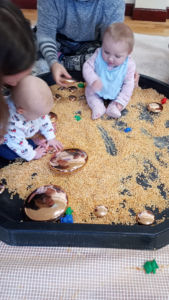
At Adventure Babies classes, we use stories, puppets, movement, voices, lights and sensory play to give babies meaningful ideas to explore. Some babies copy immediately. Others watch closely and repeat something later at home.
Neither response is more successful.
Our classes are designed around the understanding that development happens through relationships and repeated experiences—not through making babies perform on cue.
What if your baby does not copy you?
Babies vary enormously in when, how and how often they imitate.
Some are enthusiastic copiers. Others are more interested in objects, movement or observing the room. A baby may copy sounds but not gestures, or imitate familiar family members while remaining very still in a group.
Temperament, tiredness, familiarity, attention and developmental stage can all affect what you see in the moment.
A baby who does not copy your clap today may reproduce it next week.
A baby who watches silently in class may practise the action later when the environment is quieter.
Try not to turn imitation into a test.
Repeatedly saying “Can you clap? Do this. Copy Mummy,” can make the interaction feel pressured, particularly when the baby is tired or absorbed in something else.
Model the action, enjoy it yourself and leave space.
If your baby does not join in, the experience can still be valuable.
When should you ask for professional advice?
Imitation is only one part of development, and the absence of one particular copied action does not automatically suggest a problem.
However, it is sensible to speak to your health visitor or GP if you have broader concerns about your baby’s hearing, vision, movement, interaction or communication.
Seek advice if your baby:
- stops using skills they previously had;
- rarely seems to notice voices or sounds;
- appears not to respond to familiar people;
- has marked difficulty making eye contact or sharing attention alongside other concerns;
- consistently uses one side of their body differently;
- seems unusually stiff or floppy;
- is not developing gestures or communication in the way you expected.
Great Ormond Street Hospital’s guide to speech and language development from birth to twelve months provides an overview of early sounds, facial interaction and communication.
Parents do not need to wait until a child is expected to speak before mentioning a concern. Early communication includes attention, expression, gesture, response to sound and social interaction.
Asking for guidance is not overreacting. It is part of understanding your individual baby.
You do not need to mirror your baby all day
Once parents discover that responsive interaction supports development, it is easy for the information to become another source of pressure.
Should you be copying every sound?
Have you missed an important brain-building moment because you were washing bottles?
Is your baby losing something valuable while you answer a message?
No.
Babies do not need constant adult interaction.
Harvard’s discussion of serve and return makes clear that uninterrupted engagement is neither realistic nor necessary. Babies also need opportunities to rest, observe, play independently for short periods and experience the natural rhythm of people becoming available again.
What matters is the broader pattern of responsive relationships.
Sometimes you answer immediately.
Sometimes you finish making lunch first.
Sometimes your baby plays while you sit nearby.
Sometimes you share a wonderfully focused exchange, and sometimes neither of you is in the mood.
Development happens within ordinary family life, not inside a permanent one-to-one intervention.
The parent is not a developmental toy
Your value to your baby does not lie only in how effectively you stimulate their brain.
You are not required to remain animated, emotionally available and educational every waking minute.
Mirroring works because it comes from a real relationship.
You are interested in your baby. They become interested in you. You make one another smile. You misunderstand one another. You reconnect.
The imperfections are part of the exchange.
Your baby is not looking for a professionally delivered demonstration. They are gradually learning the unique patterns of your face, voice and response.
That familiarity is one reason a tiny copied sound can feel so powerful.
It is not merely evidence that your baby has acquired a skill.
It is evidence that they have been watching you.
Why mirroring matters so much during the first two years
Across the first two years, imitation becomes increasingly complex.
A young baby may match a sound or expression.
An older baby may copy clapping, waving or an action with an object.
A toddler may reproduce several linked actions, imitate household routines or use copying within pretend play.
These changes reflect growing abilities in attention, memory, movement, language and social understanding.
Imitation helps babies and toddlers learn not only what people do, but also how activities are organised.
They see that a spoon goes into a bowl before it reaches the mouth. A brush moves across the hair. A book opens before the story begins.
Over time, copied actions become personally understood and deliberately used.
This is one way culture travels into childhood. Babies join the habits, gestures, words and routines of the people around them.
They are not passive sponges absorbing everything without thought. They are active participants who watch, experiment, select and respond.
Why does my baby copy me? Because you are their first social world
Your baby copies you because you are familiar, fascinating and full of information.
Your face shows them how expressions move.
Your voice gives them patterns to explore.
Your actions reveal what objects can do.
Your responses teach them that communication has an effect.
When you mirror them in return, you show that this learning travels in both directions. They are not simply watching you. You are watching them too.
That is what makes mirroring so much more than mimicry.
It is a relationship becoming visible.
You make a sound.
They answer.
They clap.
You clap too.
They see their own excitement reflected in your face and discover, for a moment, that the two of you are sharing the same experience.
These exchanges may last only seconds, but they contain the beginnings of conversation, cooperation, emotional understanding and social connection.
You do not need special equipment.
You do not need to make your baby copy you.
Notice what they offer. Reflect it gently. Pause long enough for their reply.
And remember that the baby staring seriously at you may be doing far more than watching.
They may be learning how it feels to be seen.
At Adventure Babies, we create sensory storytelling experiences that invite babies to watch, imitate, move, communicate and connect through brilliant books and shared play. Every baby can participate in their own way—whether they copy every action, observe from a cuddle or surprise their parents by repeating it three days later.
Find your nearest Adventure Babies class and join a community where baby development is understood, stories are brought gloriously to life and no baby is expected to perform on demand.