Do I Need Lots of Toys for My Baby? (The Truth That Usually Makes Mums Breathe Out a Bit)
I used to think I was supposed to be constantly doing something for my baby.
Not just feeding, cuddling, keeping them safe… but actively entertaining them. Like it was my job to make every moment developmental and interesting.
So I bought the toys. The ones that “light up learning.” The ones that claimed to support brain development. The ones that looked like they belonged in a carefully curated Instagram playroom.
And still, most days looked nothing like that.
Most days looked like my baby ignoring everything except the same battered toy, or demanding the same book again and again, while I quietly wondered if I should be doing more.
That’s usually where the question creeps in: do I need lots of toys for my baby?
The pressure to keep babies constantly entertained
There’s a very modern kind of parenting pressure that doesn’t always get said out loud.
It’s the feeling that if your baby isn’t being actively stimulated every minute, you’re missing something important. So we rotate toys. We save activities. We feel guilty when we don’t have something “set up” for them.
But babies don’t experience the world like that.
They don’t need a constant stream of novelty. In fact, too much of it can make it harder for them to focus, settle, and really understand what they’re seeing.
What they actually come back to—again and again—is familiarity.
That one toy they keep reaching for.
That same book you’ve read so many times you don’t even need to look at the words.
That song they calm down to instantly.
It can feel repetitive to us. But for them, it’s how learning sticks.
Why repetition matters more than variety
One of the biggest shifts for me was realising that repetition isn’t “nothing happening.” It is the learning.
Every time your baby returns to the same experience, their brain is doing something really important with it. They’re not just seeing it again—they’re noticing something slightly different each time.
The Harvard Center on the Developing Child explains that repeated, responsive experiences strengthen neural connections in the brain. In simple terms, the more a baby experiences something familiar, the more solid and efficient those pathways become.
So when your baby insists on the same book every night, it’s not because they’re stuck. It’s because they’re building memory, pattern recognition, and confidence in what comes next.
That “again!” phase? That’s development.
Do babies get bored if they only have a few toys?
This is the bit that surprises most parents.
We assume boredom is the problem. That if we don’t keep offering new things, babies will get restless or under-stimulated.
But boredom in the adult sense doesn’t really exist in the same way for babies. Everything is still new. Their brains are still learning how the world works. Even the same object feels different depending on how it’s held, shaken, dropped, or chewed that day.
What looks like “the same toy” to us is actually a constantly changing experiment for them.
That’s why a simple object—a wooden spoon, a rattle, a fabric tag—can hold their attention far longer than a pile of complex toys.
It’s not about how much there is. It’s about how deeply they can explore it.
The National Literacy Trust also highlights how repetition in early shared experiences—like stories, songs, and language patterns—supports communication development long before children can speak.
So it’s not variety that drives learning at this stage. It’s repetition, rhythm, and connection.
Why “less” at home often feels like more
I think one of the hardest parts of early motherhood is the feeling that you should be doing more.
More activities. More stimulation. More structure.
So when you strip it back and realise your baby is happily playing with the same two or three things on rotation, it can feel almost like you’re not doing enough.
But what actually happens when you stop trying to constantly add more is quite the opposite.
Babies settle deeper into play. They return to things more confidently. They start to anticipate, recognise, and repeat patterns. And instead of flitting between toys, they begin to engage with them.
It looks quieter from the outside. But internally, there’s a lot more going on.
What this looks like in baby classes
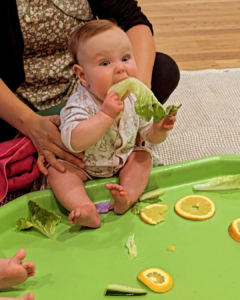
I see this play out constantly in classes at Adventure Babies.
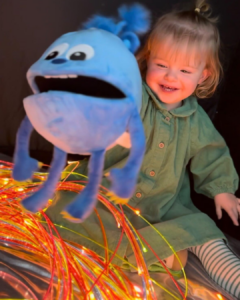
A baby who ignored a prop the first week suddenly reaches for it the second time they see it. Not because it’s new, but because it’s becoming familiar. Another baby starts smiling before a story moment even happens because they recognise the rhythm of it now.
That’s repetition doing its job.
We don’t rely on constant newness in class either. We build familiarity on purpose—songs that repeat, story structures that return each week, sensory experiences that babies begin to recognise over time.
And when that happens, something shifts for mums too.
You can physically see the moment it lands: oh… my baby is learning even when it looks simple.
The bit no one really tells you
You don’t need to turn your home into a toy shop or a constant activity centre for your baby to thrive.
You are already providing what matters most: repetition, connection, safety, and your voice in their world.
The toy they keep going back to isn’t a sign you need more things. It’s a sign they’re learning deeply from what they already have.
And if your days feel repetitive sometimes, that doesn’t mean they’re lacking stimulation. It often means your baby is exactly where they need to be.
A gentler way to think about it
So if you’re sitting there wondering do I need lots of toys for my baby, the honest answer is no.
You don’t need more.
You probably just need permission to stop measuring your baby’s development by how much variety they’re exposed to—and start noticing how much they’re getting from repetition instead.
Because that’s where so much of the real learning is happening.
If you want to see it in action
At Adventure Babies, everything we do is built around that idea—repetition, familiarity, and gentle sensory storytelling that helps babies build confidence over time.
And if this made you feel a bit more relaxed about the toys on your living room floor, it might be worth sending to another mum who needs the same reassurance.