What Do Babies Learn in Sensory Classes? (It Might Not Look How You Expect)
It doesn’t look how you think it will
I always think this, right at the start of a class.
If you walked in off the street, no context, no expectations… you’d probably take one look and think, is this it?
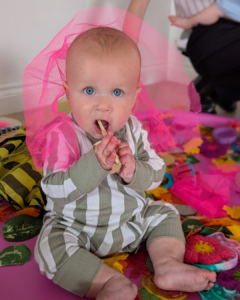
There’s a baby chewing a book.
Another one has made a determined break for the edge of the mat.
Someone’s halfway through a song but also trying to catch a rogue prop.
And a mum is doing that half-smile, half-“am I doing this right?” expression we’ve all done at some point.
It doesn’t look calm.
It definitely doesn’t look like the picture of “learning”.
It looks… a bit chaotic.
But if you stay a few minutes, you start to see it differently. And this is where the answer to what do babies learn in sensory classes becomes much clearer—because it’s not always obvious at first glance.
The moment you almost miss
Not in a big, dramatic way. No grand moment where all the babies suddenly sit still and clap. It’s quieter than that.
A baby who’s been wriggling the whole time suddenly pauses when the hello song starts. Just for a second—but it’s there. Recognition.
Another baby, who only ever engages with one thing at home, reaches out for something new. Not because it’s been pushed at them, but because it feels familiar enough to be safe.
And the mums… that’s the bit I notice most.
Shoulders drop.
Smiles soften.
There’s this almost invisible exhale that goes around the room when everyone realises—oh… it’s not just me.
Because underneath what looks like chaos, something much more important is happening.
So… what do babies actually learn in sensory classes?
Not in a sit-down, structured, “now we learn this” kind of way.
Babies learn through experience. Through repetition. Through feeling safe enough to explore.
In a sensory class, that looks like:
They begin to recognise patterns—the same song, the same rhythm, the same flow each week.
They start to build memory—pausing at familiar moments, anticipating what comes next.
They develop early communication skills—tuning into your voice, sounds, rhythm, and expression.
They grow in confidence—reaching out, exploring, engaging more over time.
And they learn how to learn—which is the most important bit of all.
The Harvard Center on the Developing Child explains that repeated, responsive experiences are what build strong neural connections in the early years. In simple terms: the more your baby experiences something meaningful, the more their brain strengthens around it.
So even if it looks like “just playing”… it isn’t.
Why repetition is where the magic happens
We often think babies need constant newness to learn.
New toys.
New activities.
More stimulation.
But actually, babies learn best when things are familiar.
That’s why sensory classes don’t throw endless new things at them. Instead, they use repetition as a foundation—and gently build on it.
The same hello song each week.
A familiar structure.
Stories with repeated moments.
That repetition is what allows babies to relax, recognise, and then engage more deeply each time.
If this is something you’ve been worrying about at home, you might like this: “My Baby Only Likes One Thing—Should I Be Worried?” (internal link)
Why it feels different to doing it at home
At home, repetition can feel a bit… never-ending.
The same book. Again.
The same song while you’re trying to drink a cup of tea.
The same toy that has somehow become the centre of your baby’s universe.
You know it’s good for them—but it doesn’t always feel inspiring.
In a sensory class, it’s not that we’re doing completely different things. It’s that we take what already works (repetition) and layer in just enough variation to bring it to life.
A new texture alongside a familiar song.
A prop that makes a story feel real.
A shared experience with other babies.
So your baby still feels safe—but also curious.
The National Literacy Trust highlights how shared, repeated experiences like storytelling and singing support early language development. And when you add sensory elements into that? It deepens the experience even more.
And then there’s the bit no one talks about enough
You.
Because while your baby is learning all of this, something else is happening quietly in the background.
You’re realising your baby doesn’t need to sit still to learn.
You’re seeing that other babies wriggle, grab, and explore too.
You’re feeling a bit less like you have to get everything “right”.
And then you start chatting to the mum next to you.
You laugh about the same book you’ve both read twenty times that morning.
You feel that small but powerful sense of… I’m not on my own here.
That sense of belonging? It matters.
So are sensory classes worth it?
If you’re asking what do babies learn in sensory classes, the answer isn’t something neat and obvious.
It’s not ABCs.
It’s not sitting still.
It’s not performing for an outcome.
It’s learning how the world works—through sound, touch, rhythm, repetition, and connection.
It’s confidence building in tiny, quiet ways.
It’s memory forming in those almost invisible pauses.
It’s curiosity growing, week by week.
And once you see it, you can’t unsee it.
Come and see it for yourself
At Adventure Babies, we create classes that work with how babies naturally learn—not against it.
No pressure. No perfect behaviour expected. Just real babies, real mums, and all those small moments that add up to something much bigger.
👉 Find your nearest class and experience it for yourself:
And if this helped you see your baby (and those chaotic moments) a little differently, send it to a mum who might need that reassurance too.