Emotional Regulation in Babies (0–2 Years)
How babies learn to manage big feelings — and how you can support their emotional development from the very beginning
If you’re parenting a baby or toddler, chances are you’ve had moments where you’ve thought:
Why does the smallest thing tip them over?
Are they supposed to be this emotional already?
Am I meant to be teaching them how to calm down?
Here’s the reassuring truth: babies aren’t born knowing how to regulate their emotions. Emotional regulation in babies develops gradually over time and is shaped by experience, connection and environment.
And yes — those experiences can absolutely be playful, sensory and joyful.
What is emotional regulation in babies?
Emotional regulation in babies refers to their developing ability to experience, express and gradually manage emotions — with support from the adults around them. Parents often search for emotional regulation in babies or baby emotional development 0–2 when they notice intense feelings or meltdowns.
If you’d like further reassurance from a trusted UK source, the NHS explains how babies develop emotionally and why responsive, consistent care supports their ability to feel safe and secure:
👉 https://www.nhs.uk/conditions/baby/babys-development/emotional-and-social-development/
This guidance mirrors what we see every day in class — babies thrive when experiences feel predictable, supportive and shared with a trusted adult.
Emotional regulation milestones in babies (0–2 years)
Rather than neat tick boxes, emotional regulation develops in layers.
0–6 months: Safety first
At this stage, emotional regulation looks like:
- Calming when held, rocked or spoken to
- Responding to familiar voices and faces
- Feeling secure through repeated routines
Babies learn that the world responds to them. This sense of safety is the foundation for everything that follows.
6–12 months: Awareness and attachment
Now babies begin to:
- Show preference for familiar people
- React more strongly to new environments
- Express frustration when they can’t reach or do something
This is often when parents notice increased clinginess or upset — especially in new situations. That’s not regression. It’s growing emotional awareness.
12–24 months: Big feelings, small bodies
Toddlers are bursting with:
- Opinions
- Determination
- Curiosity
…but they still don’t have the brain development needed to calm themselves independently.
This is where emotional regulation is practised, not perfected. With support, repetition and safe experiences, children begin to learn:
- What emotions feel like
- That emotions pass
- That they are supported, even when overwhelmed

Why emotional regulation in babies needs experience — not pressure
Babies don’t learn emotional skills by being told to “calm down”. They learn through:
- Predictable, safe environments
- Repeated experiences
- Gentle exposure to new situations
- Shared moments of joy, surprise and connection
This is where sensory experiences and storytelling play such an important role.
How sensory storytelling supports emotional regulation in babies
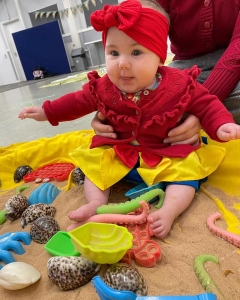
At Adventure Babies, emotional development is woven into every class — not as a lesson, but as an experience.
Our sessions are carefully designed to:
- Follow a predictable structure (helping babies feel secure)
- Introduce new sensory elements in a gentle, supported way
- Encourage shared attention between parent and baby
- Allow babies to observe before joining in
This balance of familiar + new helps babies practise emotional regulation in real time.
They learn:
- I can feel excited and still feel safe.
- I can try something new with my grown-up nearby.
- I can pause, watch, then join in when I’m ready.
Why parents love it
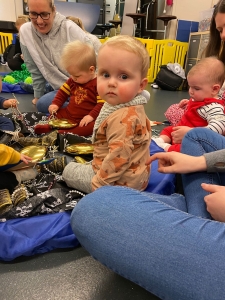
Many parents wonder whether their baby is “ready” for a class, especially if they’re emotional, shy, or easily overwhelmed. In reality, those babies often benefit most from gentle, supportive group experiences. Seeing other babies experience big feelings too can be incredibly reassuring — and parents often leave the class feeling calmer than when they arrived.
Emotional regulation grows through connection
One of the most powerful parts of emotional development is shared experience.
When babies:
- Sit on your lap during a story
- Watch your facial expressions
- Hear your voice alongside others
They are learning emotional cues, safety signals and social understanding.
And when parents see other babies experiencing the same big feelings? That reassurance matters too.
Supporting emotional regulation beyond the class
The skills babies practise in class carry over into everyday life:
- Coping with new places
- Managing transitions
- Exploring with confidence
- Building resilience through safe challenge
These aren’t quick wins. They’re quiet, powerful foundations — made easier when parents can witness and guide their baby in a supportive setting.
If your baby feels deeply, needs closeness, or takes time to warm up — they are not behind. They are developing exactly as they should. Emotional regulation isn’t about stopping feelings. It’s about learning how to move through them — supported, understood and secure.
If you’re looking for a baby class that supports emotional regulation gently — without pressure, comparison, or expectation — Adventure Babies classes are designed with exactly that in mind. Babies and parents alike can feel safe, supported and connected while exploring, playing, and learning together.
Curious about how sensory storytelling can support your baby’s emotional regulation and emotional development? Find your local Adventure Babies class and experience it together.