Why is Reading to Babies So Important
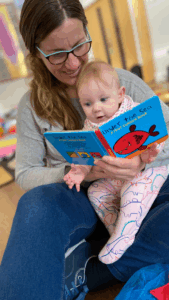
There’s something quietly magical about watching a baby experience a book for the first time.
Not “reading” it.
Not understanding the words.
Just being completely absorbed.
They trace the pictures with their fingers. They pause when your voice changes. They wait for what comes next. And in that moment, something important is happening — something far bigger than literacy.
They’re learning how it feels to learn.
Loving Books Comes Before Reading Ever Does
When we talk about why reading to babies is so important, it’s easy to picture school desks, phonics charts, and bedtime reading logs.
But none of that matters if a child doesn’t enjoy books.
A love of books doesn’t start with letters. It starts with emotion. With closeness. With safety. With the sense that stories are something you share, not something you’re tested on.
A child who has cuddled through stories, laughed at the same page over and over, and felt completely wrapped up in a moment of storytelling grows up believing that books are a place they belong. That belief changes everything.
Because when children feel comfortable with books, they approach learning with openness instead of pressure. Curiosity instead of fear.
What Books Are Really Teaching Young Brains
From the outside, reading to a baby can look deceptively simple. You’re just sitting there, turning pages, talking.
But inside that tiny brain, an extraordinary amount is happening.
They’re learning how language flows — the rise and fall of your voice, the rhythm of sentences, the pauses that signal something exciting is coming. They’re learning how to focus, how to listen, how to follow a sequence of events. They’re beginning to understand that symbols and sounds carry meaning.
Even more than that, they’re learning patience. Anticipation. The quiet thrill of waiting to see what happens next.
These early experiences show exactly why reading to babies is so important — they set up skills that will make all future learning easier and more enjoyable.
Why This Matters So Much in a World Full of Screens
We’re raising children in a world that moves fast.
Screens are bright, instant, and always competing for attention. They encourage short bursts of focus and constant novelty.
Books ask something different.
They ask them to slow down.
To stay.
To imagine.
When a baby listens to a story, there’s no algorithm deciding what comes next. There’s no rush. Just time, connection, and space for their imagination to grow.
This doesn’t mean screens are “bad” or that parents need to feel guilty. It simply means that books offer something increasingly rare: the chance to practise deep attention in a gentle, joyful way.
And that skill — the ability to focus, to wonder, to stay curious — is one of the most valuable skills a child can have.
Why Starting Early Makes Such a Difference
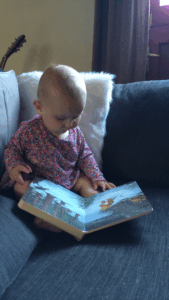
Babies don’t care if a story makes sense. They don’t mind if the same book is read every day for weeks. What they care about is how it feels.
They remember your voice.
Your expression.
The excitement.
The closeness.
When books are part of life from the very beginning, they become normal. Comforting. Expected. They’re not something introduced later with rules or pressure — they’re just there.
That early familiarity is exactly why reading from babyhood is so important: children don’t just learn to read, they learn that reading is fun, safe, and part of life.
How Adventure Babies Brings Stories to Life
At Adventure Babies, we don’t ask babies to sit still and listen quietly.
We invite them into the story.
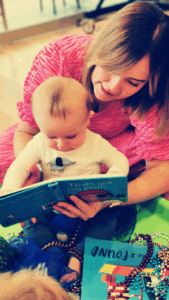
Through sensory play, movement, music, and immersive storytelling, books become experiences. Babies don’t just hear words — they feel the excitement, the drama, the emotion.
That kind of storytelling doesn’t just build language. It builds a relationship with books that is joyful, physical, and memorable.
It’s often the moment when parents say, “I didn’t realise my baby could be so engaged.” And that moment matters — because belief is contagious. When parents see how powerful stories can be, they read more at home too.
Because Loving Books Shapes More Than Just Learning
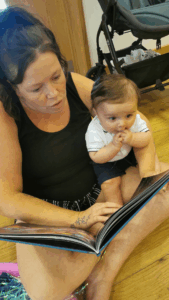
A child who loves books is a child who believes that learning can be enjoyable.
That belief stays with them.
It shapes how they approach school, challenges, and new experiences. It helps them find comfort in stories, escape into imagination, and see the world through different perspectives.
In a busy, noisy world, giving a child a love of books is one of the quietest — and most powerful — gifts we can give.
And it starts exactly where you are now.
With a baby.
A story.
And a moment shared.