Why Do Babies Stare at Pictures in Books? What’s Actually Going On in Their Little Brains
There’s a moment most parents have at some point during that first year where you’re sitting reading a book to your baby and suddenly realise they are absolutely transfixed by one single page. Not the story. Not even the whole book. Just one page.
Maybe it’s a smiling moon. A bright yellow duck. A baby’s face. Sometimes it’s not even the main part of the illustration. I’ve watched babies completely ignore an entire beautifully written story only to become emotionally attached to one tiny ladybird hidden in the corner of a page.
And it does make you wonder — why do babies stare at pictures in books so intensely?
Because as adults, we read for narrative. We want the plot. We’re trying to get from beginning to end. Babies couldn’t care less about any of that yet. They experience books in a completely different way and honestly, once you realise that, reading to your baby becomes so much more enjoyable and far less pressured.
At Adventure Babies we see this constantly in classes. Parents will often apologise because their baby “isn’t concentrating properly” or because they only want to look at one page over and over again. But the truth is, that repetitive staring, studying and focusing is often where the real learning is happening.
Why Do Babies Stare at Pictures in Books?
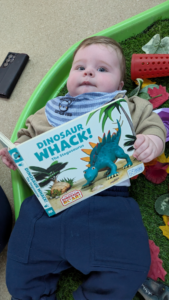
When babies are very small, the world is still brand new to them. Their brains are trying to work out what faces are, what expressions mean, how shapes differ from one another and what deserves attention. A book gives them a safe, still place to practise doing that. Unlike the real world, the pictures don’t move. They can stare for as long as they need to.
In those early months especially, babies are naturally drawn to strong contrast and clear images because their eyesight is still developing. The American Academy of Pediatrics explains that newborns see bold black-and-white patterns more clearly at first, which is why babies often seem fascinated by simple illustrations or high-contrast books.
But as they grow, something else starts happening too. They become fascinated by faces.
Why Babies Love Looking at Faces in Books
Honestly, babies are tiny people-watchers. They study expressions with an intensity most adults reserve for true crime documentaries. If a book has a big smiling face in it, chances are your baby is going to lock onto it immediately. And it makes sense really. Faces are communication. Faces tell babies whether something feels safe, familiar, funny or exciting.
Sometimes when I read with babies in class, I notice they spend as much time looking at their parent’s face as they do the actual book. They’re watching your reactions. Your smile. Your voice changing. The excitement in your face when you turn the page dramatically for the fifteenth time that day. Reading together is never just about the words on the page.
Research from Harvard University’s Center on the Developing Child talks about how responsive interactions help build babies’ brains, and you can really see that during shared reading moments. Even when it feels incredibly simple to us, your baby is taking in so much.
Why Babies Love the Same Book Again and Again
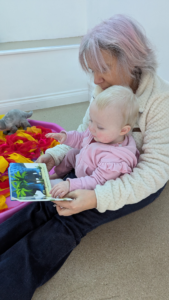
I think one of the biggest misconceptions new parents have is the idea that babies need constant entertainment and endless new experiences to stay interested. But actually babies love familiarity. Deeply. Repetition makes them feel secure. It helps them understand the world.
Which is why your baby wanting the same page, the same book or the same moment over and over again is not a sign you’re failing to stimulate them enough. It’s usually a sign they’re learning from it.
Adults get bored by repetition because our brains crave novelty. Babies are the opposite. Babies build confidence through predictability. That’s why they suddenly kick their legs excitedly before you even turn to their favourite page. They remember it. They know what’s coming. Their brain is building connections through repetition every single time.
We talk more about this in the Adventure Babies blog because so many parents feel pressure to constantly buy more toys, rotate activities and introduce new books every day when often babies are happiest revisiting familiar experiences.
Do Babies Actually Understand Books?
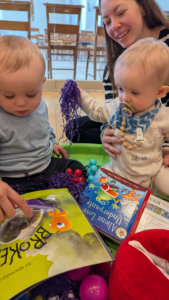
And honestly, this is why I always feel a bit sad when parents apologise because their baby won’t sit quietly and listen to an entire story properly. Babies were never really designed to experience books like tiny school children. Some will grab the pages halfway through. Some will crawl off and come back again. Some will chew the corner while staring at one picture for ten minutes straight.
That still counts.
It all counts.
The cuddling up together counts. The page grabbing counts. The staring counts. Even the chewing probably counts in some sensory-development sort of way.
The National Literacy Trust explains that sharing books from birth supports communication and bonding long before babies can understand the words themselves, and I think that’s such an important thing for parents to hear. Especially in a world where there’s so much pressure to do everything “properly.”
Why Reading to Babies Matters Even Before They Can Talk
Some of the most important reading moments don’t look impressive at all. They look like sitting in pyjamas reading the same book you secretly hate for the sixth time that day while your baby lovingly strokes a picture of a rabbit.
But in those tiny moments, something huge is happening.
Your baby is learning that books feel comforting. That stories feel safe. That reading means closeness and connection and warmth.
And that matters far more than whether you made it to the final page.
If you want to explore sensory storytelling and baby development through books in a fun, immersive way, you can find your nearest Adventure Babies class and experience the magic for yourself.