
Why Do Babies Need Sensory Play? (And Does Everything Have to End Up in Their Mouth?)
At some point during maternity leave, you may find yourself sitting on the floor watching your baby completely ignore the beautiful developmental toy you carefully chose while they enthusiastically lick the label on a muslin.
Welcome to sensory play.
Despite what Instagram might have us believe, sensory play doesn’t have to involve seventeen carefully coordinated objects arranged in a wooden tray while your baby sits beautifully in the middle looking educational. Babies have been exploring their world through their senses since long before anyone gave it a hashtag, and most of the time they manage it without our help.
They stare at sunlight moving across the wall, kick their legs in the bath, grab your hair, squash food between their fingers and become completely transfixed by the sound of a packet of wipes. Given the opportunity, they will also investigate almost everything with their mouths.
So why do babies need sensory play, what are they actually getting from it, and do you need to start sacrificing the contents of your kitchen cupboards in the name of development?
Thankfully, no.
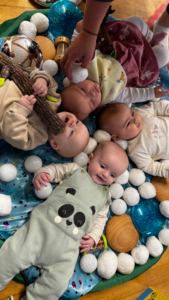
Your baby is basically a tiny researcher
Imagine arriving somewhere where you don’t understand the language, recognise the objects or know how anything works.
That’s more or less your baby’s starting point.
They can’t ask whether something is hard, soft, cold, noisy, heavy or edible, so they investigate in the ways available to them. Looking, listening, touching, moving and mouthing all give babies information about the strange new world they’ve landed in.
When your baby squeezes something soft after holding something firm, hears a sudden sound or watches an object fall, their brain receives information that gradually helps them understand what things are like and what might happen next.
None of this requires an adult hovering nearby explaining the developmental objective.
Your baby isn’t thinking, Excellent, Mother has provided me with a contrasting tactile experience.
They’re probably thinking something closer to oooooh before attempting to eat it.
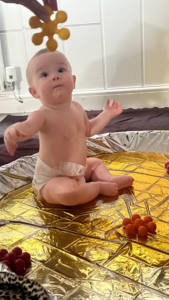
Why does absolutely everything go in their mouth?
You can offer a baby almost anything safe and interesting and there’s a reasonable chance you’ll watch it travel directly towards their mouth.
Parents sometimes worry that this means their baby isn’t playing “properly”. You’ve bought something designed for stacking, shaking or rolling and your baby has apparently decided its true purpose is chewing.
Your baby has simply failed to read the manufacturer’s instructions.
Mouthing gives babies useful sensory information because their mouths are extremely sensitive. Chewing and sucking allow them to investigate texture, shape, firmness and temperature in ways that their still-developing hands can’t always manage.
Of course, this is exactly why sensory play needs close supervision and carefully chosen, age-appropriate resources. Babies don’t possess particularly reliable health and safety departments, so that part remains our job.
Once you’ve made the experience safe, though, you don’t need to worry about whether they’re using something correctly.
Exploration is the activity.
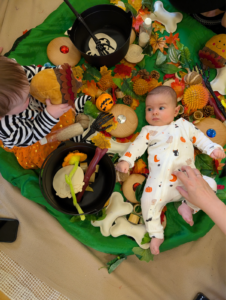
More stimulation doesn’t mean more development
This is where we think the conversation around baby sensory play sometimes gets a little muddled.
The word sensory can make it sound as though the aim is to stimulate as many senses as possible, preferably all at once. In reality, babies don’t need flashing lights, loud music, six textures and three adults enthusiastically shaking things at them simultaneously to have a valuable sensory experience.
Sometimes something incredibly simple holds their attention for ages.
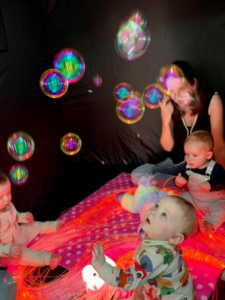
A scarf floating slowly through the air can be fascinating. Water running over tiny toes creates a completely different sensation, while a puppet appearing from behind a book gives babies something unexpected to watch. Even bubbles drifting overhead can hold their attention far longer than many expensive toys.
Your baby’s brain needs opportunities to notice and process sensory information rather than an endless stream of stimulation.
Watching counts too.
Some babies immediately launch their hands towards anything new, whereas others prefer to sit safely with their grown-up and study the situation before deciding whether they’re getting involved.
Neither baby is doing sensory play better.
So why do babies need sensory play?
Sensory experiences give babies opportunities to discover things that adults stopped finding remarkable years ago.
A baby doesn’t automatically know that squeezing one object changes its shape while another stays firm, or that hitting something can make a noise. They have to discover that objects can roll away, water moves through their fingers and different surfaces feel completely different against their skin.
All those little experiments help babies gather information about their surroundings.
Development also overlaps far more than neat milestone charts suggest. When your baby reaches towards an interesting texture, they’re using their body and coordinating their movement as well as exploring touch. Watching bubbles involves visual attention, while hearing you respond to something they’ve noticed brings communication into the experience.
Once another person joins that exploration, something that looked like “playing with a scarf” can suddenly involve movement, attention, curiosity and a tiny back-and-forth conversation.
That’s where sensory play gets really interesting.
You don’t need to narrate your baby’s entire day
Parents hear a lot about talking to babies, and conversation absolutely matters for early communication. Unfortunately, it’s quite easy to interpret that advice as meaning you should provide a continuous commentary from breakfast until bedtime.
Nobody needs that pressure.
You don’t have to become David Attenborough every time your baby approaches a sensory activity.
“Here we see the eight-month-old moving slowly towards the wooden spoon…”
Instead, notice what has caught your baby’s attention.
Perhaps they reach towards something and then look back at you. You might respond with a simple word such as “soft” or “cold”, copy the noise they’ve made or smile before leaving a little pause.
That pause gives your baby space to do something next.
The NHS encourages parents to follow what their baby is interested in, respond to their attempts at communication and allow time for them to answer. Those interactions don’t require special equipment, yet sensory play naturally creates lots of opportunities for them to happen.
The resource starts the experience, but the interaction around it can make it much richer.
Maternity leave does not require an activity timetable
This feels worth saying because modern maternity leave comes with a surprising amount of admin.
You’ve already remembered the nappies, attempted tummy time, washed approximately 400 muslins and searched whether today’s nap was too long, too short or happened at entirely the wrong time. Your cup of tea has been reheated twice and is currently sitting somewhere you can’t remember.
You do not also need to become your baby’s full-time activities coordinator.
Ordinary life contains plenty of sensory experiences.
A walk changes the sounds, temperature, light and movement around your baby without you preparing anything. Bath time brings water, splashing and different sensations, while lying beneath the washing as it moves gently overhead can apparently provide better entertainment than half the contents of a toy shop.
If your baby is fascinated by the washing machine, watch it together.
They don’t know it isn’t an official developmental resource.
Sometimes maternity leave needs fewer activities, not more.

Although letting someone else create the activity is rather nice…
There is something deeply satisfying about turning up somewhere and discovering that another person has prepared everything for you.
Particularly when that person also clears it all away afterwards.
At Adventure Babies, sensory play isn’t something we squeeze between songs because babies are supposed to do “sensory”. We use sensory experiences as part of our storytelling because babies experience books and stories very differently from adults.
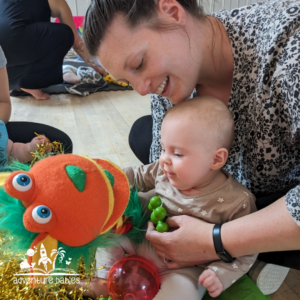
They might not understand a complicated plot, but they can hear your voice change when a character appears. A baby can watch a puppet move, feel a texture connected to the story or notice lights appearing in a darker environment.
Older babies may crawl straight towards the action, while younger ones watch from the security of their grown-up’s lap.
The story gives the experience structure, then sensory play gives babies different ways to join in.
Nobody needs to perform, and nobody has to touch everything.
That’s important to us.
Sensory play gives babies a reason to move
Babies are much more motivated to move when there’s something worth moving for.
Tummy time can become considerably more appealing when something genuinely interesting is happening within view. Once babies begin sitting, an intriguing object might encourage them to reach sideways or turn their body, while an older baby may crawl across the mat because they absolutely must investigate whatever is happening on the other side.
They’re not doing a baby workout.
They just want the thing.
That motivation naturally encourages babies to reach, turn, grasp, shift their weight and coordinate different parts of their body.
It’s one of the reasons our Adventure Babies activities happen around babies rather than expecting them to remain neatly in one position throughout the session.
Babies are designed to move, including directly through the beautifully arranged sensory activity we hoped they might sit beside.
Then they discover they can make things happen
One of my favourite stages of babyhood arrives when babies realise that their actions can change something.
They shake an object and hear a noise, then do it again.
A hand hits the water and creates a splash, which obviously requires further investigation. The second attempt produces another splash and, even better, Mum gets wet this time.
Interesting.
Repeat.
This kind of cause-and-effect exploration is one reason babies perform the same action far beyond the point where an adult feels the scientific question has been thoroughly answered.
For your baby, repetition helps establish whether the result was a coincidence or something predictable.
Sensory play offers endless opportunities for these little experiments because babies can act on materials and immediately experience what happens next.
The result might seem tiny to us, but your baby is gradually discovering, “I did that.”
That’s quite a revelation.
Repeating something doesn’t make it less valuable
Adults often assume babies need novelty because we get bored when something happens repeatedly.
Babies haven’t received that memo.
You may have floated the scarf, popped the bubbles or made the puppet disappear so many times that you’re ready to retire the activity permanently. Meanwhile, your baby is watching attempt number 23 with the intensity of someone viewing the season finale of their favourite programme.
Repetition gives babies opportunities to recognise patterns.
The first time something happens, they notice it. After repeated experiences, they may begin to recognise what’s happening and eventually anticipate what comes next.
That’s why we deliberately repeat songs, actions, characters and familiar moments within Adventure Babies rather than constantly racing towards something new.
Sometimes you’ll see a baby smile before the exciting bit has even happened.
They know what’s coming.
Those moments are brilliant.
Sensory play should be an invitation
Not every baby wants to plunge both hands into something unfamiliar.
To be fair, adults don’t either.
If someone placed a bowl of mysterious cold slime in front of you and enthusiastically announced, “Go on, get your hands in!”, you’d probably want a few questions answered first.
Babies are allowed that hesitation too.
Some need time to watch before touching something, while others approach every new experience with the confidence of a person who has never considered consequences.
Give your baby the opportunity without forcing their hands into an unfamiliar material. They may eventually reach forward, or they might decide that watching is enough for today.
Both responses give them information.
Respecting those signals also reminds us that sensory play isn’t something we do to babies.
It’s something we offer them.
You probably already own some excellent sensory toys
Before buying another product with the word sensory printed on the box, have a look around your house.
A wooden spoon has weight, temperature and texture, as well as making an excellent noise when it hits something. Muslins can float, hide objects and become peekaboo props, while water changes shape, moves unpredictably and feels completely different from almost everything else your baby encounters.
Even your own face is an extraordinary sensory experience.
It moves, changes expression, makes sounds and responds differently depending on what your baby does.
Best of all, no batteries are required.
This doesn’t mean specially designed sensory resources aren’t useful. We use plenty of them in our classes because they allow us to create experiences babies wouldn’t necessarily encounter during an ordinary Tuesday afternoon at home.
Your house doesn’t need to become Adventure Babies, though.
We’ve already got one.
What we really mean when we talk about sensory play
So, why do babies need sensory play?
Babies need opportunities to experience their world through their developing senses and bodies. Looking, listening, touching, mouthing, moving and experimenting gradually help them understand objects, people, patterns and what their own actions can do.
Sensory play gives them wonderful opportunities to explore, but it doesn’t need to be elaborate and it certainly doesn’t need to fill every waking hour.
At Adventure Babies, we’ve spent years bringing together stories, sensory experiences, movement and responsive interaction because those elements work so naturally alongside one another.
A story creates curiosity, while a sensory experience gives babies something interesting to investigate. Movement lets them explore it and, crucially, the person beside them notices what they do, responds and shares the experience.
That’s the bit we love.
If you’d like to see what purposeful sensory play looks like without spending your maternity leave creating it — or cleaning it off the floor afterwards — come and find your nearest Adventure Babies class.
And if today’s sensory activity consists of your baby lying underneath the washing while it moves in the breeze, you’re doing just fine.
They’re busy discovering the world.
You can leave the messy play to us.