When Do Babies Start Talking? What’s Normal in the First Year
“When do babies start talking?”
It’s one of the most searched baby development questions in the UK — usually typed with one eye on Google and one eye on your baby.
Because what you’re really asking is:
Are we on track?
Let’s unpack it properly — and reassure you at the same time.
Talking doesn’t begin with words.
It begins with connection.
And it starts much earlier than most people think.
Cooing (6–8 Weeks): The First Conversations
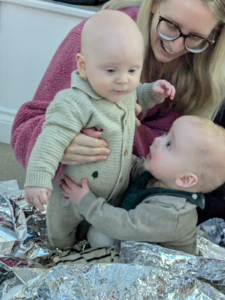
Around 6–8 weeks, many babies begin cooing. Those soft vowel sounds? That’s early communication.
They’re experimenting with their voice — and noticing that you respond.
When you copy their sounds, smile, and answer back, you’re building the foundations of conversation. Development specialists (including guidance shared by the NSPCC) call this “serve and return” interaction — and it’s crucial for brain wiring.
In our Adventure Babies classes, this is exactly why we build in face-to-face moments during storytelling. When babies lock eyes during a puppet interaction or react to a change in tone, that’s communication practice happening in real time.
Babbling (4–6 Months): Speech Muscles at Work
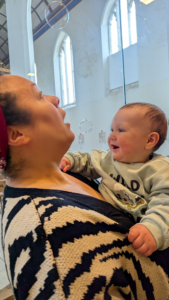
At around 4–6 months, babies start babbling:
“Ba-ba-ba.”
“Da-da-da.”
This isn’t random noise. It’s muscle training. Jaw strength. Breath control. Rhythm.
In class, when we exaggerate sounds during stories — stretching out “woooosh” or repeating “bang, bang, bang” — babies often start mimicking those patterns. Repetition helps strengthen those speech pathways.
And repetition is powerful.
That’s why we revisit key phrases and rhythms throughout a session — because hearing words over and over builds familiarity and confidence.
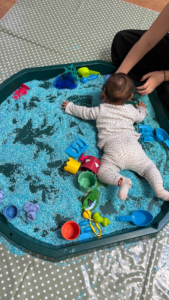
Canonical Babble (6–9 Months): It Starts to Sound Like Words
Between 6–9 months, babbling becomes clearer and more structured.
“Mamama.”
“Dadada.”
They may not mean it yet — but they’re practising conversational rhythm.
In our sensory storytelling sessions, when babies respond to sound effects, light changes, music or props, they’re learning something huge:
Communication is back-and-forth.
Language is interactive.
Even a squeal or excited kick during a story is participation.
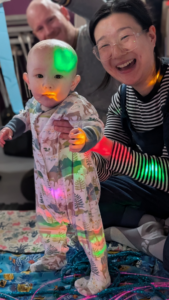
Receptive Language Comes Before Spoken Words
Here’s the part most parents don’t realise when they ask, when do babies start talking?
Understanding language (receptive language) develops before speaking.
According to the NHS, many babies will understand simple words, their name, and familiar phrases before they ever say a clear word.
By 9–12 months, your baby might:
-
Turn when you say their name
-
Look at an object you mention
-
Respond to “clap hands”
-
Recognise familiar story cues
This is why reading matters so much — even before speech.
At Adventure Babies, when we use consistent story structures, repeated phrases and familiar songs each week, babies begin anticipating what comes next. That anticipation is listening skill development.
And listening is the foundation of talking.
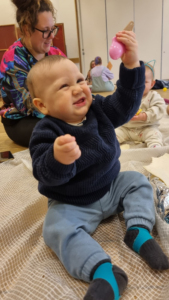
First Words (Around 12 Months)
Most babies say their first recognisable word around their first birthday — though there is a wide range of normal.
But speech development isn’t a race.
Some babies are busy mastering gross motor skills. Some are deep in social development. Some are quietly building huge receptive vocabularies before they speak.
Words come when confidence and readiness meet opportunity.
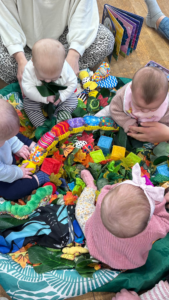
What Actually Helps Babies Start Talking?
If you’re wondering what you can do, here’s what truly supports speech and language development in the first year:
-
Narrate your day
-
Pause to let your baby “respond”
-
Copy their sounds
-
Use repetition
-
Read daily
-
Engage in sensory play
Sensory experiences are powerful because they give language meaning. When a baby feels the swish of fabric, hears a drum beat, sees twinkling lights and hears the same descriptive words alongside it — their brain connects words to experiences.
That’s why our sessions are immersive. Stories aren’t just read — they’re felt.
Long before babies speak, they’re building:
-
Listening skills
-
Vocabulary understanding
-
Attention span
-
Turn-taking skills
-
Emotional security
All of which feed directly into speech.
So… When Do Babies Start Talking?
For many babies, around 12 months.
But communication?
That starts at weeks old.
If your baby is:
-
Making sounds
-
Responding to voices
-
Engaging with stories
-
Reacting to repetition
-
Showing excitement during songs
They are developing language.
And if you’re talking, reading, responding and connecting?
You’re already doing the right things.
Speech grows out of security.
And that’s something you’re building every single day.