Is My Baby Developing Normally? What New Parents Really Need to Know (0–12 Months)
If you’ve found yourself searching “is my baby developing normally?” you are far from alone.
In fact, this is one of the most common worries new parents have in the first year.
And underneath that question is usually something more emotional:
“Am I doing enough?”
The good news is that in most cases, babies are developing normally—but not always in the neat, predictable way we’re led to expect.
🧠 What “normal” baby development actually means
There is no single fixed timeline for baby development.
Instead, there is a wide range of normal.
For example:
- Some babies roll at 4 months, others closer to 7 months
- Some babies are early talkers, others are quiet observers
- Some crawl, some shuffle, some skip crawling altogether
All of these can be completely typical.
What matters far more than timing is steady progress over time.
👶 Why every baby develops differently
Your baby is developing across lots of areas at once:
- Physical development (movement, coordination)
- Communication (sounds, gestures, facial expression)
- Social development (bonding, interaction, connection)
- Cognitive development (attention, memory, prediction)
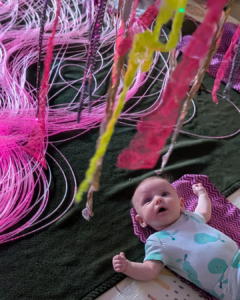
- Sensory development (touch, sound, movement, exploration)
Some babies focus more on one area before another—and that balance constantly shifts.
💛 Why this worry feels so common
When you’re in the early months of parenting, everything feels like it might be a milestone.
Add comparison (other babies, online charts, well-meaning comments), and it’s easy to feel unsure.
But here’s the truth:
👉 Baby development is not a race
👉 It is not a checklist
👉 And it is not something you need to “get right”
🧩 What actually supports baby development most
Research consistently shows that babies learn best through:
- repeated interaction
- responsive caregiving
- face-to-face connection
- language (talking, singing, reading)
- sensory exploration
- emotional security
Not pressure.
Not early achievement.
Not comparison.
📚 The power of repetition (what many parents don’t realise)
If your baby wants the same book again and again, that’s not boredom.
It’s learning.
Repetition helps babies:
- recognise patterns
- build memory
- anticipate what happens next
- develop language foundations
Every “again!” is actually the brain practising prediction.
🎵 Where Adventure Babies fits in
At Adventure Babies, we see this every day.
Babies don’t need to perform or “keep up”.
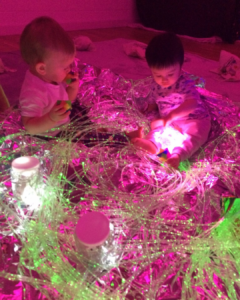
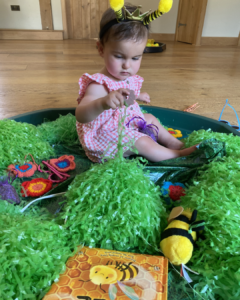
They learn through:
✨ sensory storytelling
✨ music and rhythm
✨ repetition and familiar stories
✨ movement and exploration
✨ connection with their grown-up
And often, parents leave a session thinking something simple but powerful:
“Oh… my baby is learning.”
That moment matters.
Because confidence changes everything.
🌱 The real answer to “is my baby developing normally?”
In most cases:
👉 If your baby is interacting, responding, and gradually learning new skills over time, they are very likely developing within a normal range.
But even more importantly:
👉 You don’t need to measure every moment.
You just need to be present, responsive, and connected.
That is what builds development.
💛 Final Word
If you’re worrying, it usually means one thing:
You care deeply.
And that already puts your baby in a strong position.
You don’t need to do more.
You just need to keep doing what you’re already doing—talking, playing, noticing, loving.
That is enough.
✨ Find your local Adventure Babies class
If you’d like support with baby development in a relaxed, joyful way, our sensory storytelling classes are designed to help both babies and parents feel confident.
Because when parents feel calm and connected…
babies thrive.