
Baby Activities for Dark Autumn Evenings: Simple Ways to Make the Most of the Season
There’s a moment every autumn when you look out of the window at approximately 4.37pm and wonder how it can possibly be dark already.
Your baby, naturally, has no intention of going to bed for another three hours.
Summer evenings made it easy to head outside for a walk or sit in the garden when everyone needed a change of scenery. Once autumn arrives, the stretch between late afternoon and bedtime can suddenly feel considerably longer.
If you’re looking for baby activities for dark autumn evenings, though, you don’t need to create an elaborate entertainment schedule.
In fact, darkness gives babies something they haven’t experienced much during those long summer evenings: contrast.
Lights look brighter, shadows become noticeable and familiar rooms feel slightly different. Add stories, movement, touch and plenty of interaction with you, and an ordinary autumn evening can contain more than enough for a developing baby.

Your baby doesn’t need entertaining until bedtime
This feels worth saying first.
Maternity leave can sometimes create the impression that every waking hour needs filling with something developmental.
It doesn’t.
The NHS points out that play doesn’t need to be complicated or expensive and that babies learn enormously through everyday interaction with their grown-ups.
So please don’t read a list of baby activities for dark autumn evenings and conclude that you should now be running a sensory programme from your living room every night.
Some evenings, a bath, a story and looking at the washing machine will provide quite enough excitement.
On other days, particularly when you’ve been inside since lunchtime and bedtime still feels suspiciously far away, having a few easy ideas can save everyone’s sanity.
1. Make the most of lights and shadows
Babies don’t need a miniature light show to find changes in light interesting.
Try dimming the main lights and using a lamp to make the room feel different. You can create gentle shadows with your hands, move a favourite toy slowly through the light or let your baby watch the patterns created on the wall.
For a younger baby, simply lying together and watching light and shadow can provide plenty to notice. An older baby may turn, reach or move towards something that catches their attention.
This is one reason we love the darker parts of our Adventure Babies classes. Lights against a darker background create strong visual contrasts, while the story gives the experience meaning and structure.
The important part isn’t making the room spectacular.
It’s noticing what your baby notices.
If something catches their eye, give them time to look before moving on.
2. Rediscover the torch
A torch becomes considerably more exciting when you’re under one.
Instead of shining it directly towards your baby’s eyes, use it to illuminate familiar objects or make a gentle pool of light on a wall or ceiling.
Move it slowly and see whether your baby follows it with their eyes or turns their head. Older babies may begin reaching towards the changing light.
You can also bring a favourite toy into the light and name it as it appears.
“There’s your bear.”
Then move the light away before finding it again.
Suddenly, you’ve combined visual tracking, anticipation, language and shared attention using something that was already in the kitchen drawer.
Keep the activity calm, supervise throughout and make sure any torch or battery-powered item stays safely in adult hands, particularly if it contains small batteries.
3. Build a cosy story corner
Dark autumn evenings are made for books.
You don’t need a dedicated reading nook worthy of Instagram. A blanket, a comfortable corner and a couple of familiar stories will do perfectly well.
For younger babies, let them look at your face while you read. Change your voice, repeat interesting sounds and pause when something catches their attention.
Older babies may want to turn pages, point, make sounds or spend an extraordinarily long time looking at one particular picture.
Let them.
The NHS encourages parents to look at books with babies and talk about what they can see rather than feeling they have to read every word.
BookTrust also highlights how shared reading creates opportunities for closeness and shared attention, while adults naturally adapt their pace and language in response to their baby.
So if your baby derails the story completely, you’re not doing it wrong.
The interaction is part of the point.

4. Create an autumn treasure basket
Autumn is brilliant for textures.
A simple basket containing a few safe, baby-appropriate objects can give little hands plenty to investigate. Think about contrasting textures rather than buying special sensory toys.
You might use a wooden spoon, a soft scarf, a large textured ball, a silicone brush or a piece of crinkly fabric.
Sit nearby and see what your baby chooses.
Try not to demonstrate everything immediately.
Babies can surprise us when we give them time to work things out for themselves.
One baby may repeatedly rub a texture between their fingers, while another bangs two objects together and becomes fascinated by the sound.
This is sensory play in its simplest form: noticing, exploring and discovering what happens.
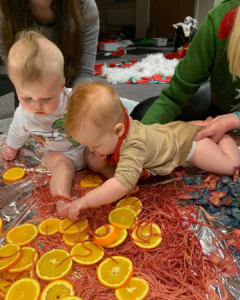
It’s also very close to our ethos at Adventure Babies. We create interesting sensory environments, but babies don’t need to interact with every resource in the same way. Watching can be exploration too.
5. Have a floor picnic without the food
Move onto the floor together and change the usual evening perspective.
A blanket can become somewhere for tummy time, rolling, reaching and relaxed play. Put one or two interesting objects nearby rather than surrounding your baby with toys.
Then join them.
The NHS describes floor play as useful for babies’ developing muscles and emphasises that a baby’s favourite playmate is often their grown-up.
That second point matters.
We sometimes spend so much time wondering which developmental toy our babies need next that we overlook the person they’re most interested in.
Your face, voice and reactions are incredibly interesting.
Admittedly, this does mean you may spend part of your autumn evening lying on the carpet making questionable noises.
Nobody said baby development was glamorous.

6. Let bath time become the activity
If the afternoon has been long, you don’t necessarily need to invent something to do before the bath.
Make the bath the thing.
For babies who enjoy water, bath time already provides an enormous sensory experience. There’s warmth, movement, sound, touch and the fascinating discovery that splashing produces a very reliable reaction from whichever parent is closest.
Talk about what your baby is doing rather than trying to lead the play.
You can name body parts as you wash them, sing a familiar song or simply respond when your baby splashes and looks delighted with themselves.
The NHS includes bath time among everyday opportunities for communication and play.
Of course, water safety matters more than any developmental benefit. Never leave a baby unattended in or around water, even briefly.
7. Bring some movement into the evening
Not every baby wants a calm activity at 5pm.
Some appear to have received an unexpected delivery of energy.
If your baby needs to move, give them space on the floor and join in. Encourage reaching towards you, roll a soft ball, sing an action song or place something interesting just within achievable reach.
For babies beginning to crawl, an ordinary cushion can create a small obstacle to move around with close supervision.
Movement isn’t simply about reaching the next milestone.
Babies learn about their bodies by using them. They discover how far they can reach, what happens when their weight shifts and which movements get them closer to something interesting.
That curiosity is something we love to encourage in our Adventure Babies classes, where stories and sensory experiences often give babies a reason to move rather than asking them to practise a movement for its own sake.

8. Try a very simple sound game
Your house already contains plenty of instruments.
A wooden spoon gently tapped against a suitable bowl creates one sound. A hand on a cardboard box creates another.
For younger babies, you can make a gentle sound and pause to see what they do.
Do they turn towards it?
Look at you?
Become very still?
Make a sound back?
Older babies may want to create the noise themselves.
The interesting part isn’t teaching them how to play an instrument. It’s discovering that actions can create sounds and that sounds can become part of an interaction between you.
Singing works beautifully too.
The NHS recommends singing to babies because it helps them tune into the rhythm of language, while copying their sounds introduces the back-and-forth pattern of conversation.
Musical ability is not required.
Fortunately.
9. Look out of the window
This may be the lowest-effort activity in the entire article.
Turn off the room light for a moment and look outside together.
Cars pass. Streetlights glow. Rain runs down the glass. Trees move in the wind and people appear before disappearing again.
Talk about whatever your baby seems interested in.
“There’s a car.”
“Look at the rain.”
“It’s dark outside.”
For a very young baby, the contrast between the dark window and bright lights may be interesting enough. An older baby might point, vocalise or look back towards you.
This is exactly the kind of ordinary interaction that supports early communication. The NHS recommends naming and pointing to things you can both see as babies grow.
No activity preparation required.
10. Finish with something familiar
Autumn evenings don’t have to remain stimulating until bedtime.
In fact, the final part of the evening is a good time to make things quieter and more predictable.
The NHS suggests a simple, soothing bedtime routine, which might include a bath, changing into night clothes, dimming the lights, sharing a story, having a cuddle or singing a lullaby.
That doesn’t mean following a rigid schedule.
Babies have different sleep patterns and families find different routines that work for them.
What can help is allowing the evening to change gear.
After movement, play and exploration, lower the lights. Put some toys away, share a familiar story and let the pace become slower.
Darkness doesn’t always need filling.
Sometimes it can help signal that the busy part of the day is ending.
Baby activities for dark autumn evenings don’t need to be complicated
This is probably the part we’d most like parents to remember.
Your baby doesn’t need ten activities tonight.
They don’t even need one from this list.
Development happens through ordinary life as well as planned play. A bath contains sensory experiences, a book creates opportunities for communication and a few minutes on the floor gives your baby time to move.
Even looking through a dark window together can become interesting when you follow what catches your baby’s attention.
That’s how we think about learning at Adventure Babies too.
Sensory is the medium. Stories give us structure. The interaction between babies and their grown-ups is where so much of the lovely stuff happens.
Our classes bring together stories, puppets, movement, sensory play, lights, messy play and plenty of opportunities for babies to investigate at their own pace. If the darker days are starting to make maternity leave feel a little longer, you can find your nearest Adventure Babies class and let us plan the activity — and clear it up — for you.
You can also explore our Adventure Babies books at home if you’d like to bring a little sensory storytelling into those cosy autumn evenings.
Perhaps dark evenings aren’t so bad after all
Before having a baby, an autumn evening might have meant lighting a candle and watching something uninterrupted on television.
Things may look slightly different now.
Yet there is something rather lovely about seeing autumn through a baby’s eyes.
The glowing streetlight is new.
The rain on the window is interesting.
A shadow moving across the wall deserves serious investigation, while a familiar story feels different when you’re curled up together as the evening gets darker outside.
So when 4.37pm arrives and bedtime still feels a very long way away, don’t panic.
Turn on a lamp.
Find a story.
Get down on the floor.
See what your baby notices.
You may discover that the darker evenings have brought you a completely new kind of playtime.