How Can I Help My Baby Learn to Communicate?
From your baby’s very first smile to their early babbles and giggles — every sound, glance and squeal is communication in the making. Before babies say their first words, they’re already learning how conversations work, simply by watching and listening to you.
It starts with connection
Even tiny newborns are wired to connect. When your baby locks eyes with you, coos, or mimics your expression, they’re practising the back-and-forth rhythm that forms the basis of conversation.
At around three months, you’ll notice your baby responding more — smiling when you smile, making little noises, and waiting for your reply. This give-and-take might look simple, but it’s the foundation of both language and social development.
🍼 Try this: talk through your day as you go — “We’re putting on your socks now! One little foot, two little feet!” — your baby doesn’t need fancy words, just your warm, familiar voice.
Why chatting matters
The more you talk, sing and respond to your baby, the more their brain develops the pathways for understanding language. Everyday moments like feeding, changing nappies or walking to the park are perfect times to connect.
Reading is another brilliant tool. When you share a story, your baby learns about rhythm, tone, and emotion — even if they’re more interested in chewing the pages!
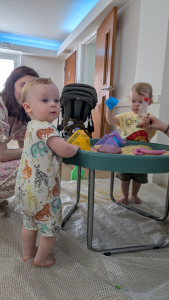
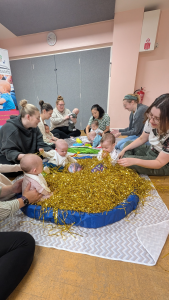
You can see this in action at our Adventure Babies sensory storytelling classes,
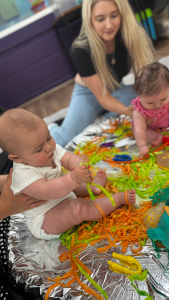
where stories, music and sensory play spark incredible reactions. Babies light up as they hear different sounds, track moving colours, and watch faces around them — all boosting their communication and social confidence.
Learning to socialise
Babies are natural people-watchers. Around 6–9 months, they start to notice other babies and show curiosity about what’s going on around them. Being around others helps them learn turn-taking, eye contact, and even empathy.
In our sessions, it’s amazing to see how quickly babies start “chatting” to one another — a squeak here, a giggle there — it’s their own adorable version of small talk!
Simple ways to help your baby communicate
You don’t need special equipment or hours of prep — small, everyday interactions make a huge difference. Try:
-
Responding to your baby’s sounds and gestures — it teaches them that communication works both ways.
-
Using lots of facial expressions — babies learn meaning by watching your face.
-
Reading and singing daily — rhyme and repetition help language stick.