From Tummy Time to First Steps: How Movement Builds Your Baby’s Brain
When people talk about babies learning to move, the focus is usually on the obvious milestones.
Rolling.
Sitting.
Crawling.
Walking.
The exciting moments when you grab your phone to capture a video and send it to every family WhatsApp group going.
But what many parents don’t realise is that these movements are doing far more than helping your baby get from one place to another.
Every wiggle, push, reach and roll is actually helping to build your baby’s brain.
Movement is one of the most powerful ways babies learn about the world — and the early physical milestones your baby reaches are quietly laying the foundations for everything from confidence and coordination to problem solving, concentration and even later skills like reading and writing.
Yes, really.
Why Movement Matters for Baby Physical Development
Your baby’s brain and body develop together.
When your baby moves, their brain is receiving huge amounts of information at the same time:
-
Where their body is in space
-
How muscles work together
-
How far they need to reach
-
What happens when they push, pull or turn
Each movement strengthens the connections between the brain and the body. Scientists call this neural pathway development — but in simple terms, it’s your baby’s brain building the wiring it needs to control movement and understand the world.
The more opportunities babies have to move, explore and experiment, the more these connections grow.
And the best part?
Babies don’t need complicated equipment or structured workouts. They just need space, curiosity and encouragement.
According to guidance from the NHS, giving babies regular opportunities for floor play and movement is one of the most important ways to support early physical development and strength building.
The Surprising Benefits of Tummy Time
Tummy time is often one of the first physical activities babies experience — and it can sometimes feel like the hardest one.
Many babies protest loudly about it at first (they’re not shy about sharing their opinions).
But tummy time plays a huge role in baby gross motor development.
When your baby spends time on their tummy, they’re strengthening the muscles they will eventually use for:
-
Rolling
-
Sitting
-
Crawling
-
Pulling to stand
-
Walking
At the same time, tummy time is also helping develop:
-
Neck and head control
-
Core strength
-
Shoulder stability
-
Hand-eye coordination
These early movements are essential building blocks for later skills like holding a pencil, turning pages in a book and writing.
So even those short tummy time sessions — with plenty of encouragement and cuddles — are doing more than you might realise.
Rolling, Reaching and Pivoting: The Brain at Work
Once babies start to move more freely, things get really interesting.
You’ll notice them reaching for objects, twisting their bodies, rolling across the floor or pivoting in circles like tiny explorers.
These movements might look random, but they’re actually complex problem-solving exercises.
Your baby is learning:
-
How to coordinate both sides of their body
-
How to judge distance and depth
-
How to balance effort and control
-
How to plan movement
Every attempt strengthens the communication between the left and right sides of the brain.
This cross-body coordination is incredibly important later in life, especially for skills like reading and writing where the brain needs to process information across different areas at once.
Crawling: One of the Biggest Brain Boosters
Crawling is one of the most powerful stages in baby physical development.
It requires babies to coordinate:
-
Arms and legs moving in alternating patterns
-
Balance and core strength
-
Visual tracking
-
Spatial awareness
This movement pattern strengthens the communication between the two hemispheres of the brain, helping information travel faster and more efficiently.
Researchers often link crawling with later skills like:
-
Reading fluency
-
Concentration
-
Hand-eye coordination
-
Writing control
Not every baby crawls in the same way (or at all), and that’s completely normal. Babies find their own unique ways to move and explore.
What matters most is that they have plenty of opportunities to move freely and experiment with their bodies.
Movement Builds Confidence Too
There’s another beautiful part of baby physical development that often goes unnoticed.
Every time your baby tries something new physically — rolling, reaching, pulling themselves up — they’re also developing confidence.
They learn that:
-
Trying something new is exciting
-
Practice leads to progress
-
It’s okay to wobble and try again
These early experiences help babies develop a natural sense of curiosity and resilience.
And that confidence often shows up in other areas too — exploring toys, interacting with people, and eventually learning through books and stories.
How Adventure Babies Classes Support Baby Physical Development
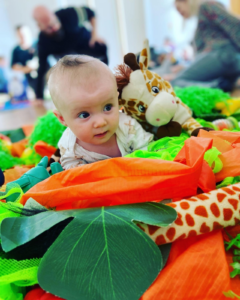
At Adventure Babies sensory storytelling classes, we see this connection between movement and brain development every single week.
When babies are immersed in sensory storytelling, they naturally begin to move more.
They reach for textures, twist to see new objects, crawl towards lights, and stretch to explore props.
The story becomes a motivation for movement.
Our classes are carefully designed to encourage babies to:
-
Reach and grasp sensory materials
-
Roll and pivot on soft play areas
-
Explore different textures and surfaces
-
Follow lights, sounds and story props
-
Engage their whole body while listening to stories
It’s not just about entertainment — it’s about supporting baby physical development in a playful, magical way while helping babies fall in love with books from the very beginning.
You can explore Adventure Babies sensory storytelling classes near you to see how movement, sensory play and books come together to support early development for babies from newborn to around 12 months.
Every Baby Develops at Their Own Pace
One of the most common worries parents share is whether their baby is “doing things on time.”
The truth is, baby physical development milestones happen across a wide range of ages.
Some babies roll early but crawl later.
Some skip crawling entirely and go straight to cruising.
Some take their time observing before they dive into movement.
All of these variations can be completely normal.
The most helpful thing parents can do is simply provide opportunities for movement and exploration, while remembering that babies are wonderfully individual in how they grow.
Joining baby classes can also give parents reassurance as they see lots of babies developing at slightly different speeds while enjoying the same sensory experiences.
FAQs About Baby Physical Development
What are the main baby physical development milestones in the first year?
Most babies progress through stages such as lifting their head, rolling, sitting, crawling, pulling to stand and eventually taking their first steps. These milestones can happen across a wide range of ages and still be completely normal.
Why is tummy time important for babies?
Tummy time helps strengthen your baby’s neck, shoulders, arms and core muscles. These muscles are essential for rolling, sitting, crawling and eventually walking.
How much tummy time should my baby have each day?
Short sessions several times a day are usually recommended. Even a few minutes at a time helps build strength, and the amount can gradually increase as your baby becomes more comfortable.
Do all babies crawl before walking?
No. Some babies crawl, others shuffle or roll, and some move straight to pulling up and walking. Babies often find their own unique ways to move and explore.
How does movement affect brain development in babies?
Movement helps build neural connections in the brain. Activities like reaching, rolling and crawling strengthen coordination between the two sides of the brain, which supports later skills like concentration, coordination and learning.
How can I support my baby’s gross motor development at home?
Simple activities help a lot. Give your baby plenty of safe floor space to explore, encourage tummy time, place toys slightly out of reach, and allow time for free movement instead of always using seats or swings.
Are baby classes good for baby physical development?
Yes. Baby classes that combine sensory play, movement and storytelling — like Adventure Babies classes — encourage babies to reach, twist, roll and explore in new ways, supporting both physical development and early learning.