Your Baby Heard You Before They Were Born: Why That Matters More Than You Think
If you’ve ever talked, sung, or even just thought out loud during pregnancy, here’s something incredible to hold onto:
Your baby was already listening.
Long before their first cry, long before their first smile… your voice was familiar. Recognisable. Comforting.
And the most amazing part?
That early connection doesn’t disappear at birth — it becomes the foundation for your baby’s communication, bonding, and emotional security.
Why Baby Hearing Development Starts Before Birth
Baby hearing development begins much earlier than most parents realise.
By around 16–18 weeks of pregnancy, your baby can start to detect sounds. By 24 weeks, their hearing is more developed, and they’re tuning into the rhythm and patterns of voices — especially yours.
Inside the womb, sound is softened and filtered, but your voice carries clearly through your body. That means your baby isn’t just hearing noise…
They’re learning:
- The rhythm of your speech
- The melody of your voice
- The emotional tone behind your words
This is where early communication truly begins.
How Talking to Your Baby in Pregnancy Supports Newborn Voice Recognition
It might have felt a little strange at the time — chatting to your bump, narrating your day, or singing in the car.
But talking to your baby in pregnancy plays a powerful role in newborn voice recognition.
After birth, babies:
- Turn towards their parent’s voice
- Settle more quickly when they hear it
- Show a clear preference for familiar sounds
That’s why your baby may calm almost instantly when you speak — even if nothing else is working.
You’re not “just” comforting them.
You’re activating something deeply familiar and neurologically wired.
According to the National Literacy Trust, early exposure to language and sound plays a crucial role in communication and language development later in life — reinforcing just how important these early interactions are.
What Happens After Birth? (This Is Where It Gets Powerful)
When your baby is born, they enter a world that is completely new — bright, loud, unpredictable.
But there is one thing they already know.
You.
Your voice becomes:
- A source of calm in overwhelming moments
- A tool for connection and reassurance
- The starting point for early “conversations”
This is why newborns respond so strongly to:
- Gentle talking
- Singing
- Repetition of familiar phrases
They’re not just listening — they’re recognising.
The Link Between Hearing and Early Communication
Before babies ever say a word, they are building the foundations of communication through listening.
This includes:
- Recognising sounds
- Understanding rhythm and turn-taking
- Beginning to connect sounds with meaning
Your baby’s early exposure to your voice helps shape:
- Language development
- Social interaction skills
- Emotional understanding
If you’ve ever wondered whether those early interactions really matter — they do more than you think.
In fact, your baby is already starting to “communicate” with you long before words appear. (You might also love our blog on The First Conversations You Didn’t Know You Were Having With Your Baby.
Why Repetition Strengthens Your Baby’s Brain
Ever noticed how babies love the same song or story again… and again… and again?
This is closely linked to baby hearing development and memory building.
Repetition helps babies:
- Strengthen neural pathways
- Recognise familiar patterns
- Feel safe and secure
- Begin to anticipate what comes next
And when that repetition includes your voice?
It becomes even more powerful.
If this fascinates you, read more in our blog: How Repetition Builds Your Baby’s Brain.
How Adventure Babies Builds on This From Day One
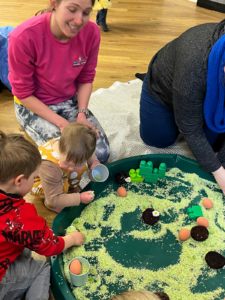
At Adventure Babies, everything we do is designed to build on the connection you’ve already started.
Our sensory storytelling classes are carefully created to:
- Use repetition to support memory and recognition
- Encourage singing and sound play to develop communication skills
- Create space for your voice to be central to your baby’s experience
- Introduce familiar story structures that babies quickly learn to love
You’ll notice your baby:
- Becoming more engaged week by week
- Recognising songs and cues
- Responding to your voice in new ways
- Growing in confidence within a familiar environment
Because ultimately, it’s not about getting it “right”.
It’s about connection.
You’ve Been Building This All Along
If you take one thing from this, let it be this:
You didn’t start communicating with your baby at birth.
You started months ago.
Every word, every song, every quiet moment — it all mattered.
And it still does.
So keep talking.
Keep singing.
Keep showing up with your voice, exactly as you are.
Because to your baby, it’s already their favourite sound in the world.
Ready to Support Your Baby’s Communication and Development?
If you’d love to build on your baby’s hearing development, strengthen early communication, and enjoy meaningful bonding time together…
👉 Find your nearest Adventure Babies class
👉 Book your space today and experience sensory storytelling designed for your baby’s development
Our classes are warm, welcoming, and designed for real life — giving you simple, powerful ways to support your baby’s development every single week.