
Baby Cognitive Development: Your Baby’s First Cognitive Milestone (And Why It Matters More Than You Think)
When parents talk about baby milestones, the conversation often jumps straight to the visible ones — smiling, rolling, sitting, crawling. But baby cognitive development starts long before these skills appear.
But long before your baby is on the move, something incredibly important is already happening in their brain.
One of the earliest cognitive milestones babies develop is an understanding of cause and effect.
It’s subtle. Easy to miss. And absolutely foundational to how your baby will learn about the world.
What Is Cause and Effect in Baby Cognitive Development?
Cause and effect is your baby beginning to realise:
“When I do something… something happens.”
At first, this understanding is very small and very instinctive. But it marks the start of intentional learning.
In the early months, this might look like:
- Kicking their legs and watching them move
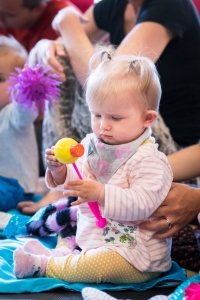
- Swiping at an object and hearing a sound
- Crying and being comforted
- Smiling and getting a smile back
Each of these moments teaches your baby that their actions have meaning — and that the world responds to them.
When Does This Early Cognitive Milestone Appear?
Cause and effect typically begins to develop from around 2–4 months, continuing to strengthen throughout the first year and beyond.
As babies grow, this understanding becomes more deliberate:
- Repeating actions on purpose (kicking, banging, dropping)
- Watching closely to see what will happen next
- Testing reactions from people and objects
That classic phase where everything gets dropped from the high chair? That’s not mischief — it’s learning.
Why Cause and Effect Is So Important for Cognitive Development
This early cognitive milestone forms the foundation for many future skills, including:
- Problem solving
- Memory and recall
- Attention and focus
- Motivation to explore
- Emotional understanding
Before a child can reason, plan or concentrate, they need to understand that their actions can influence outcomes.
In other words, cause and effect is where learning begins.
How Play Supports Baby Cognitive Development
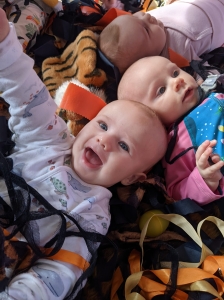
Babies don’t learn this through instruction. They learn it through play, repetition and responsive interaction.
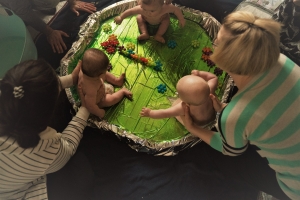
Simple, sensory-rich experiences give babies endless opportunities to explore cause and effect in a safe, supportive way.
This includes:
- Touching different textures
- Moving their bodies and seeing the result
- Making sounds and hearing them echoed back
- Interacting with props that respond to movement
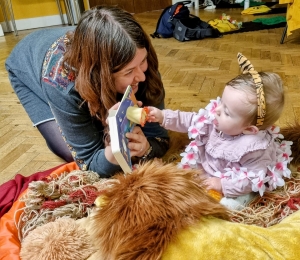
Crucially, it also comes from adults responding warmly and consistently. When a baby’s actions are noticed and responded to, their brain strengthens the connection.
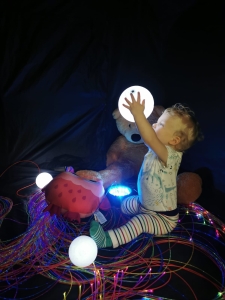
Supporting Baby Cognitive Development in Adventure Babies Classes
In Adventure Babies classes, cause and effect learning is woven naturally into every sensory story. You can explore our classes here: Find an Adventure Babies class near you.
As babies explore:
- Lights, sounds and textures
- Movement and music
- Interactive props and shared experiences
They begin to notice patterns:
When I reach, something happens. When I move, the story changes. When I engage, the world responds.
These playful, low-pressure moments support early cognitive development while also nurturing physical movement, communication and curiosity.
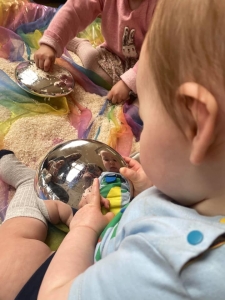
If your baby seems content to observe rather than interact, or repeats the same action again and again — that’s okay.
Cognitive development isn’t about rushing skills or producing outcomes.
It’s about giving babies time, space and rich experiences to explore the world at their own pace.
And often, the smallest moments — a kick, a reach, a smile — are where the biggest learning begins.
Trusted UK Guidance on Baby Cognitive Development
If you’d like evidence-based reassurance about early learning, the NHS Start for Life website offers clear, parent-friendly guidance on how babies learn through movement, interaction and play:
Many parents find this a helpful companion to sensory-led baby classes and everyday play at home.
Adventure Babies classes are designed to gently support early cognitive development through sensory storytelling, movement and play — helping babies discover the magic of learning, one experience at a time.