Baby Babbling Stages: What Your Baby’s Sounds Really Mean
If you’ve ever sat there thinking:
“Is that babbling?”
“Should there be more of it?”
“Why is my baby shouting ‘DADADADA’ like they’re headlining Glastonbury at 6am?”
Welcome to the wonderfully loud world of baby babbling stages.
Babbling can feel chaotic. Random. Sometimes suspiciously enthusiastic at inconvenient times.
But here’s the truth: it’s one of the most important parts of early speech and language development.
And it’s not random at all.
It’s rehearsal.
First Comes Cooing (Around 6–8 Weeks)
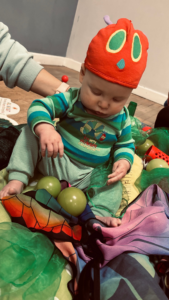
Before we even reach the official baby babbling stages, babies usually start with cooing.
Those soft little “oooh” and “aaah” sounds around 6–8 weeks are your baby experimenting with their voice.
They’re discovering:
-
I can make sound.
-
That sound gets attention.
-
Attention feels good.
When you copy them or answer back, you’re teaching something powerful: communication is back and forth.
That early “serve and return” interaction is highlighted by organisations like the NSPCC as crucial for brain development.
So yes, when you’re having a “conversation” with your 2-month-old? It counts.
Reduplicated Babble: The “Bababa” Phase (Around 4–6 Months)
This is the stage most parents recognise.
Repeated syllables:
“Bababa.”
“Dadada.”
“Mamama.”
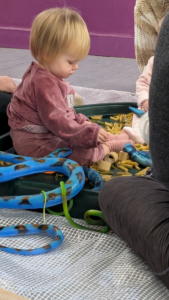
This is called reduplicated babble — and it’s a key milestone in the baby babbling stages.
Even if they’re not meaning it yet (sorry), huge development is happening.
Oral Motor Muscles Are Getting Stronger
Babbling strengthens the jaw, lips and tongue. These oral motor muscles are essential for forming clear speech later.
It’s basically strength training. Just noisier.
Auditory Processing Is Developing
When babies babble, they hear themselves. Then they adjust.
That loop builds auditory processing — the brain’s ability to recognise and interpret sounds.
According to the NHS, regular talking and responding to babies supports early speech and language development from birth.
Babbling is practice. Listening to themselves is feedback.
That feedback refines future speech.
Variegated Babble: Mixing It Up (Around 6–9 Months)
Then comes the remix phase.
Instead of repeating one sound, babies begin combining different syllables:
“Bamagada!”
“Dadaboo!”
“Gadaba!”
This is called variegated babble — and it’s a big leap in the baby babbling stages.
Why? Because now they’re experimenting.
They’re testing sound combinations. Playing with rhythm. Trying out patterns.
This stage also links closely to:
-
Social turn-taking
-
Confidence in sound-making
-
Conversational rhythm
You say something.
They respond.
You answer back.
That’s the foundation of talking.
Why Babbling Is More Than “Just Noise”
When parents worry about baby babbling stages, it’s usually about volume or frequency.
“Are they doing enough?”
“My friend’s baby sounds more advanced.”
Here’s what babbling actually strengthens:
-
Oral motor muscles
-
Auditory processing
-
Listening skills
-
Social interaction
-
Confidence to experiment
Confidence matters.
The more a baby feels their sounds are welcomed and responded to, the more they keep practising.
And practice builds language.
How Adventure Babies Supports Babbling
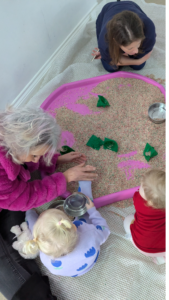
At Adventure Babies, we absolutely lean into the noise.
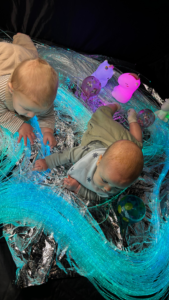
Our immersive storytelling sessions are designed to provide rich sound exposure in a playful, pressure-free way.
During class, babies experience:
-
Repetition and rhythm
-
Exaggerated sound effects
-
Musical storytelling
-
Face-to-face interaction
-
Group vocal play
Group sessions are particularly powerful. Babies hear other babies babbling, which often encourages them to join in.
It becomes a kind of baby sound orchestra — and it’s brilliant.
Through sensory storytelling, we link sound, movement and emotion. That layered experience strengthens listening skills and builds confidence in communication long before first words appear.
If you enjoyed this, you might also like our blog on Reading to a Newborn: Why It Matters More Than You Think, which explores how listening develops before talking.
What If My Baby Is Quiet?
There’s a wide range of normal within baby babbling stages.
Some babies narrate their entire day.
Some prefer to observe before joining in.
What matters more than constant noise is:
-
Do they respond to voices?
-
Do they react to sound?
-
Are they attempting some vocal play?
If you’re ever concerned, your health visitor is always the best person to speak to.
But often, development is unfolding exactly as it should.
FAQs: Baby Babbling Stages
When do baby babbling stages start?
Cooing usually begins around 6–8 weeks. Reduplicated babble (“bababa”) often appears around 4–6 months. Variegated babble typically develops between 6–9 months.
Is babbling a sign my baby will talk soon?
Babbling is a necessary step before clear words. However, first words often appear around 12 months, and there’s a wide range of normal.
What if my baby isn’t babbling much?
Some babies are quieter. Look for engagement, responsiveness and attempts at sound-making. If you’re unsure, speak to your health visitor for reassurance.
Does babbling help brain development?
Yes. Babbling strengthens oral motor muscles, supports auditory processing and builds the confidence needed for speech.
How can I encourage babbling?
-
Copy your baby’s sounds
-
Pause to let them respond
-
Use repetition
-
Read and sing regularly
-
Join baby classes with rich sound exposure
The Bottom Line
Baby babbling stages aren’t random noise.
They are:
Rehearsal.
Muscle training.
Brain wiring.
Social practice.
So next time your baby launches into an enthusiastic “DADADADADA” performance in the supermarket aisle?
Smile.
That’s communication in progress.
And it’s exactly where it should be.