
Why Does My Baby Keep Dropping Things From the Highchair? The Science Behind Their Favourite Game
There’s a particular stage of parenting when you realise you’ve become an unpaid retrieval service.
Your baby is sitting happily in their highchair. You’ve prepared a lovely meal, found the bib and congratulated yourself on getting everyone fed at a vaguely sensible time.
Then it begins.
A piece of toast hits the floor.
You pick it up.
A spoon follows.
You pick that up too.
Your baby looks you directly in the eye, gives you the most enormous smile and slowly releases the next piece of food over the edge.
And somehow, you’re the one who hasn’t understood the game.
If you’ve ever wondered why do babies drop things on purpose, you’ll be pleased to know there’s a fascinating developmental reason behind this behaviour. Your baby isn’t plotting your downfall. Well, probably not.
They’re actually conducting a series of experiments, and unfortunately, you’ve been appointed chief research assistant.
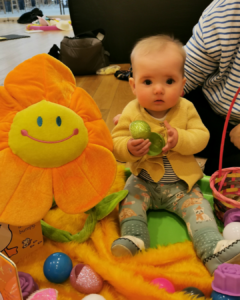
Why do babies drop things on purpose?
The short answer is that babies are discovering what happens when they act on the world around them.
Drop a spoon. It falls.
Drop a piece of toast. It falls too.
Drop a plastic cup. It makes a completely different noise.
Drop something while looking at Mum. She bends down, picks it up and makes that funny face again.
Brilliant. Let’s repeat that.
This is an early example of cause-and-effect learning, one of the foundations of cognitive development.
Your baby is beginning to understand that their actions can produce predictable results. They’re also discovering that different objects behave differently.
And here’s the interesting part. They’re not necessarily repeating the action because they’ve forgotten what happened last time.
They’re repeating it because the result is worth exploring again.
In fact, what looks like a completely pointless game to us can be a surprisingly rich learning experience for a baby.
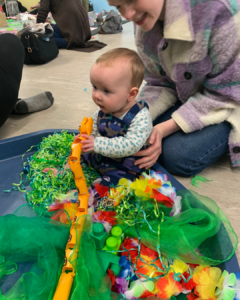
Your baby is a scientist. You’re the lab assistant.
Imagine discovering gravity for the first time.
You have absolutely no understanding of physics, but you’ve noticed something extraordinary. When you release an object, it travels downwards.
Every. Single. Time.
Wouldn’t you want to test that?
Babies don’t understand gravity in the way older children and adults do, but they gradually learn about the physical behaviour of objects through experience.
Research into infant learning shows that babies develop expectations about how objects move, fall and interact with their surroundings.
And when something behaves unexpectedly, it can capture their attention.
So your baby’s highchair experiments aren’t quite as random as they appear.
They’re discovering that objects continue to exist when they’re no longer holding them, that things fall when released and that their own actions can make things happen.
Of course, they’re also discovering that dropping a spoon is a highly effective way of getting an adult’s attention.
Which brings us to the next part.
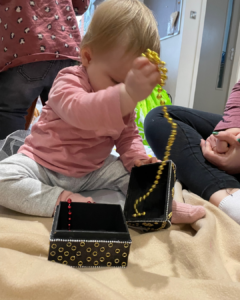
Why does my baby laugh when I pick it up?
This might be the most infuriatingly adorable part of the whole experience.
Your baby drops something.
You retrieve it.
They laugh.
You return it.
They drop it again.
At this point, you may begin to suspect you’re being deliberately mocked.
But what’s happening is actually rather lovely.
Your baby is learning about social interaction and turn-taking.
They do something, you respond, and they begin to anticipate what will happen next.
That back-and-forth exchange is an important part of early communication.
Long before babies can have conversations, they’re learning that interactions involve actions, responses and shared attention.
And the exaggerated sigh you make while picking up the spoon for the eighth time?
Unfortunately, that might be the funniest thing they’ve seen all day.
Babies are particularly interested in faces, voices and familiar reactions. Your response can become part of the entertainment.
At Adventure Babies, we see this love of repetition and interaction all the time. Babies quickly learn which actions make something interesting happen, particularly when an adult joins in.
It’s one of the reasons simple games can be so engaging.
When do babies start deliberately dropping things?
Many babies become particularly interested in dropping and releasing objects during the second half of their first year.
Around six to nine months, babies are developing better control over their hands and becoming more able to grasp, transfer and release objects.
As they approach their first birthday, their movements often become increasingly deliberate.
But there’s a difference between accidentally dropping something and intentionally letting it go.
At first, your baby might simply lose their grip.
Later, they may begin to notice what happens when they release an object and experiment with doing it again.
Eventually, they might even look at you before dropping it.
That’s when you know you’ve been recruited.
Of course, development varies from baby to baby, and not every child becomes obsessed with throwing food from a highchair.
Some prefer emptying containers, knocking down towers or repeatedly opening and closing cupboard doors.
Different activity. Similar curiosity.
You can explore more about your baby’s development through the NHS Start for Life resources.
The connection between dropping things and object permanence
Here’s something parents often don’t realise.
Dropping games can also give babies opportunities to explore object permanence.
Object permanence is the understanding that something continues to exist even when you can’t see it.
It’s a skill that develops gradually throughout infancy.
When a toy disappears over the edge of the highchair, your baby has an opportunity to discover that it hasn’t vanished from existence.
It’s still somewhere.
And if you pick it up and return it, they get to see that for themselves.
Over time, babies become increasingly interested in looking for objects that have disappeared from view.
This is also why games like peekaboo can become so entertaining.
One minute you’re there. The next you’ve disappeared behind your hands. Then you’re back again.
Absolutely hilarious, apparently.
Although it’s important to remember that dropping things doesn’t automatically mean your baby has mastered object permanence. Several developing skills contribute to these games, and they don’t all emerge at exactly the same time.
Why repetition is so important for your baby’s brain
One of the questions I hear regularly from parents is why babies want to do the same thing over and over again.
The same book.
The same game.
The same action that you’ve already repeated approximately forty times.
Surely they must be bored?
Actually, repetition can be incredibly useful for learning.
When babies repeat an action, they get another opportunity to notice what happens, refine their movements and build expectations.
Think about learning any new physical skill.
The first few attempts often feel awkward. With experience, movements become more coordinated and predictable.
Babies are doing something similar as they learn to control their hands.
Releasing an object deliberately requires coordination. They have to hold it, position their hand and open their fingers at the right moment.
That may sound simple, but it’s quite an achievement for someone who only recently discovered their toes.
Repeated dropping also lets babies explore differences.
Does a soft toy make the same sound as a wooden block?
Does something bounce?
Does it roll away?
Does Mum make the same noise every time?
The answers are all interesting when the world is still so new.
Is dropping food a sign my baby has finished eating?
Sometimes, yes.
And this is where things become slightly less straightforward.
Although dropping objects can be a developmental game, babies also throw or drop food for other reasons.
They may be full, tired, distracted or simply more interested in exploring than eating.
Sometimes they’re experimenting with how food feels and moves.
Other times, they’re telling you they’ve had enough.
The trick is to look at the bigger picture.
If your baby has been eating happily and suddenly starts dropping everything, they may be losing interest in the meal.
If they’re still reaching for food, bringing it to their mouth and enjoying themselves, some dropping may simply be part of learning to self-feed.
Try to keep your response calm and avoid turning every dropped piece into a big performance.
And remember, your baby isn’t being naughty.
They’re still learning how mealtimes work.
The NHS weaning guidance has useful advice about responsive feeding, suitable finger foods and helping babies develop confidence with eating.
Should you keep picking everything up?
This is the question every parent really wants answered.
And the good news is that you absolutely do not have to spend your entire mealtime crawling around beneath the highchair.
It’s perfectly fine to set gentle boundaries.
You might retrieve something once or twice, then calmly explain that it will stay on the floor until the meal has finished.
For older babies, simple, consistent language such as “Food stays on the tray” can help introduce expectations, even though they won’t understand or follow them reliably straight away.
You can also offer opportunities to practise dropping things outside mealtimes.
Because here’s the thing: the developmental interest is real, but it doesn’t have to happen with your lovingly prepared lunch.
And nobody needs to be washing the same spoon fourteen times.
Three easy ways to explore dropping games without sacrificing your dinner
One of my favourite things about baby development is that you rarely need complicated activities to support it.
You just need to understand what your baby is interested in.
Try a dropping basket. Give your baby a few large, safe objects and a wide container. Let them experiment with putting objects in and taking them out. You can model dropping an object into the basket and watch what happens.
Explore different sounds. Offer age-appropriate soft toys, fabric balls or other safe objects that make different noises when dropped onto a suitable surface. Your baby may enjoy noticing the difference between a gentle thud and a soft rustle.
Play a simple hiding-and-finding game. Partly cover a favourite toy with a lightweight cloth and encourage your baby to find it. Keep the activity suitable for their stage and supervise throughout.
Avoid small objects that could be choking hazards, and never leave babies unattended with play materials.
The point isn’t to turn play into a lesson.
It’s to give your baby opportunities to follow their curiosity.
What does dropping things have to do with sensory storytelling?
Quite a lot, as it happens.
When I started Adventure Babies back in 2013, I wanted babies to experience stories rather than simply sit and listen to them.
And one of the things I’ve learned from watching babies explore is that they don’t always interact with resources in the way adults expect.
You might introduce a beautiful sensory object to accompany a story, only for a baby to become fascinated by picking it up, releasing it and watching where it goes.
That’s not a failure to engage with the activity.
It’s the baby exploring something that interests them.
Through sensory storytelling, babies have opportunities to reach, grasp, move, investigate textures and discover how objects behave.
We also encourage parents to respond to their babies’ interests, because those shared moments of attention and interaction are valuable in their own right.
A baby doesn’t need to understand every word of a story to benefit from spending time exploring it with someone they love.
Our Adventure Babies classes bring books to life through sensory play, puppets, movement and lots of opportunities for little ones to investigate at their own pace.
And yes, sometimes that means watching something get dropped repeatedly.
We know the feeling.
What if my baby doesn’t drop things?
Not every baby becomes a highchair-throwing enthusiast.
Some babies are more interested in banging objects together, transferring toys between their hands or exploring different textures.
Others prefer watching what happens before deciding whether to join in.
There’s a wide range of typical development, and one particular game doesn’t tell you everything about how your baby is progressing.
Look at their development more broadly.
Are they becoming more interested in objects? Reaching, grasping and exploring in different ways?
If you’re worried about their hand movements, notice a loss of previously acquired skills or have concerns about their overall development, speak to your health visitor or GP.
But please don’t feel that you need to encourage your baby to start throwing things just because you’ve read that it supports learning.
Trust me, there’s a reasonable chance they’ll discover it without any encouragement.
So, why do babies drop things on purpose?
Because they’re curious.
Because they’re learning that their actions have consequences.
Because their hands are becoming more coordinated, their understanding of objects is developing and they’re discovering the joy of getting a reaction from another human being.
And sometimes, because they’re finished with their toast.
The wonderful thing about babies is that so much learning happens during moments that look completely ordinary.
The dropped spoon. The disappearing toy. The enormous grin when you return something for the tenth time.
These aren’t necessarily grand developmental achievements that you’ll record in a baby book, but they’re little glimpses into how your child is beginning to understand the world.
So next time your baby deliberately launches their lunch onto the kitchen floor, you can take some comfort in knowing that there’s probably some learning going on.
You might still be mildly irritated.
That’s allowed too.
Want to discover more about the fascinating things your baby is learning through play?
At Adventure Babies, we’ve been bringing stories to life for babies and toddlers since 2013, combining sensory exploration with opportunities for movement, communication and shared discovery.
Our classes are designed to be engaging for babies at different developmental stages, while giving parents a welcoming place to meet other families and enjoy time together.
Find your nearest Adventure Babies class and come and discover just how much learning can happen through play.
And the best bit? We tidy up afterwards. 💛