From Squeals to Syllables: Helping Your Baby Discover Babbling
Your baby has discovered a new sound. Unfortunately, it sounds like a tiny pterodactyl, and they would like to demonstrate it in the supermarket.
Meanwhile, you’re listening for a “ba”, a “ma” or anything that sounds vaguely like a word. If you’re wondering how to encourage baby babbling, those squeals deserve a little appreciation too. Your baby is exploring what their voice can do, long before they can tell you where they’ve hidden your phone.
Between the coos, raspberries and repeated syllables, something lovely starts to happen: your baby discovers that making a sound can bring you into the conversation.
What counts as babbling?
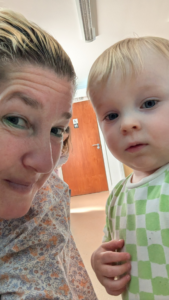
Parents often use “babbling” to describe every happy baby noise. More specifically, babbling involves speech-like syllables, such as “ba”, “da” or “ma”. Later, babies repeat or combine them into strings: “bababa” or “badaga”.
Earlier coos, gurgles and squeals form part of the journey towards those sounds. Making a syllable means coordinating breath, voice and movements of the mouth. That little “ba” involves more work than it might sound.
During the second half of the first year, many babies develop clearer, repeated syllables. Around nine months, you may hear longer strings such as “dadada”. These ages offer a rough guide, rather than a deadline for your baby’s next performance. Berkshire Healthcare’s guide to babbling explains how early sounds develop.
How to encourage baby babbling: start by answering
Imagine the scene: you’re halfway through changing a nappy when your baby announces, “Agoo!”
“Really?” you reply. “Tell me more.”
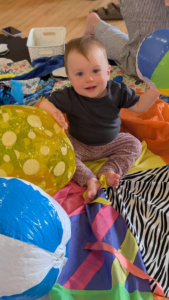
For a moment, the two of you have a conversation about absolutely nothing. Yet that exchange gives your baby something useful: experience of making a sound, getting a response and having another turn.
Try copying a sound they already make. Then pause and watch. A smile, wriggle or quiet look can be their response too.
The NHS advice on helping your baby learn to talk recommends repeating your baby’s sounds to support listening and conversational turn-taking. You don’t need to correct their pronunciation or persuade them to produce a particular syllable.

The pause matters more than you might think
When a baby gives you a brilliant new noise, the temptation is to launch straight into encouragement.
“That was lovely! Can you do it again? Say mama! What about dada?”
Understandable? Completely. But leave a little room between your turns. Your baby needs an opportunity to join in, and filling every gap can make that harder.
Offer one sound or a short comment, then wait without demanding an answer. If they look away or become unsettled, let the conversation finish. Another chance will come along.
A baby conversation can be wonderfully slow. There’s no awkward silence when neither of you has anywhere urgent to be.

Your face belongs in the conversation
Your baby doesn’t only listen to your voice. They also watch your expression and the way your mouth moves.
Choose a comfortable moment when they can see your face. A cuddle, floor play or a nappy change can work well. Keep sounds gentle and playful, and turn down background noise occasionally so your voice is easier to hear.
Cambridge University Hospitals recommends face-to-face babble play, copying sounds and reducing background noise. Their guidance offers a useful reminder: bring your voice closer rather than making it louder.
No theatrical performance required. To your baby, your ordinary face already has plenty going on.

Give the everyday things a soundtrack
If you’re trying to work out how to encourage baby babbling, you can start with the day you already have.
“Up!” as you lift them. “Splash!” as they kick in the bath. “Woof, woof” when a dog passes the pushchair.
Follow whatever catches their attention. When your baby stares at the dog, talking about the dog gives your words a shared focus. You can also wave while saying “bye-bye”, helping them connect gestures with language.
The NHS guide to talking with babies aged six to twelve months suggests using routines, sounds and gestures, while leaving time for babies to respond. Even when they don’t copy you, they can still enjoy listening and playing.
Some days, your conversation will mainly concern a missing sock. That still counts.
Books can become a two-way chat
Reading with a baby rarely looks like the peaceful scene on the front of a parenting magazine.
Picture a familiar evening: you open the book, your baby grabs a corner, and the main character goes straight into their mouth. Before you’ve finished the first sentence, someone has opinions about turning the page.
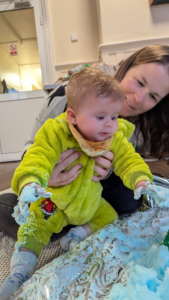
You can follow their interest. Point to a picture, make a playful sound and pause. If they squeal at the animal, answer them before carrying on.
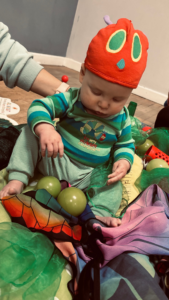
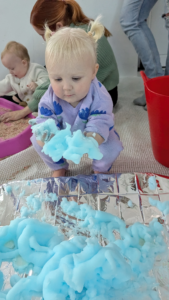
The NHS recommends looking at books together and talking about the pictures; you don’t have to read every word. Our Adventure Babies sensory storytelling classes bring stories together with props and sensory experiences, creating opportunities to look, listen and share a response.
What if your baby saves every sound for home?
Perhaps your baby delivers an impressive monologue on the changing mat, then stays completely quiet when someone else wants to hear it.
That doesn’t make the sounds at home any less real. Cambridge University Hospitals notes that babies may be less chatty in a clinic and suggests bringing a video of their usual babbling to an appointment. A short recording can help you share what you hear when your baby feels comfortable.
Try to enjoy those moments without turning every one into a test. Your baby doesn’t owe the family group chat an encore.
When to ask for support
Babies develop at different rates, but you never need to wait for a particular birthday before raising a concern.
If you’re worried about your baby’s sounds, hearing or communication, speak to your health visitor or GP. Mention any skills they previously used but have stopped showing. The NHS explains how to get advice about speech and language development.
A little conversation is enough
As a former teacher and the founder of Adventure Babies, I care about the small exchanges that can look unremarkable from the outside. A shared look, an answered squeal or a pause during a story gives parent and baby a moment together.
Knowing how to encourage baby babbling doesn’t mean narrating every minute of your day. Start with one relaxed exchange: listen, answer and leave a little space.
Today’s conversation might contain three raspberries and a very serious “ba”.
What matters is that someone is listening.
Find your local Adventure Babies class and join us for stories, sensory play and time together—with other parents who understand the excitement of a brand-new noise.