Pointing, Waving and Reaching: The Gestures Before First Words
There’s a lovely moment in your baby’s first year when they spot something interesting across the room, stretch out a tiny finger and point.
You look.
They look at you.
Then they look back at the thing.
It might be the dog, a light, a bird outside or something deeply exciting like the washing machine. What they’ve noticed hardly matters, because something much bigger has just happened.
Your baby has essentially said, “Did you see that too?”
No word was needed.
Long before babies can tell us what they want, they’re already communicating through their bodies. Reaching, waving, pointing, looking, lifting their arms and copying our movements can all become part of the journey towards spoken language.
So, when do babies start pointing and waving, and why do these seemingly simple gestures matter so much?
The answer takes us into one of the most fascinating developments of your baby’s first year.
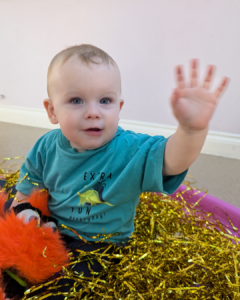
Your baby was communicating long before they pointed
We tend to think of communication as talking, but babies would strongly disagree.
From their earliest weeks, they communicate through crying, eye contact, facial expressions, body movements and sounds. Over the following months, those signals become increasingly intentional.
Your baby might lift their arms because they anticipate being picked up. Perhaps they reach towards the toy they want, turn their body away when they’ve had enough or become visibly excited when they recognise a familiar game.
Gradually, something changes.
Instead of you simply interpreting your baby’s behaviour, your baby begins to discover that they can deliberately influence you.
A reach can make you hand them something.
A raised arm can make you pick them up.
A wave can make Grandma wave back.
That’s a rather powerful discovery when you’re not even one yet.
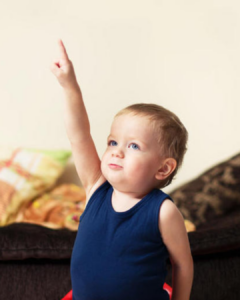
So, when do babies start pointing and waving?
There isn’t one precise week when every baby suddenly discovers gestures.
During the second half of the first year, many babies become increasingly interested in copying actions and using their hands and bodies to communicate. NHS guidance for babies aged six to twelve months recommends using gestures alongside words, such as waving while saying hello or goodbye, because babies may begin copying the gesture before they can say the word.
By around their first birthday, pointing, waving and other gestures often form a noticeable part of a baby’s communication.
Development doesn’t follow a neat timetable, though.
One baby may become an enthusiastic waver while another concentrates on reaching. Someone else may point constantly but have absolutely no interest in performing “bye-bye” on request for an audience of relatives.
Very sensibly, babies develop according to their own priorities.
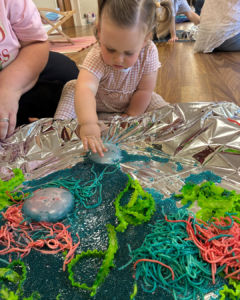
Not all pointing means the same thing
This is where things get particularly interesting.
Imagine your baby points towards their cup because they want you to give it to them.
That gesture has a clear purpose: I want that.
Now imagine a bird lands outside. Your baby points towards it, looks at you and perhaps makes a little noise. They don’t want you to retrieve the bird, which is fortunate for everyone involved.
Instead, they’re communicating something closer to:
“Look at that!”
This kind of pointing is fascinating because your baby isn’t simply trying to obtain something. They want to share their attention with another person.
Developmental researchers call this joint attention: two people focusing on the same thing while also having some awareness that they’re sharing the experience.
It sounds complicated.
In real life, it can look like a baby pointing excitedly at a pigeon.
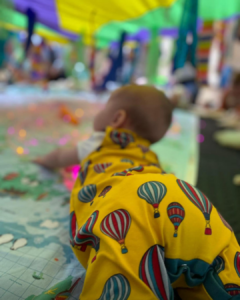
That tiny finger can open a conversation
Once your baby begins directing your attention, you suddenly have a clue about what they want to talk about.
That’s incredibly useful for language development.
Your baby points towards a dog.
You follow their gesture and say, “Dog! You saw the dog.”
They squeal.
You add, “Big dog!”
Your baby has chosen the subject, you’ve supplied some language, and the interaction has grown from there.
This is very different from spending the entire day naming random objects in the hope that enough words will eventually stick.
Following your baby’s attention lets you attach language to something that has already interested them.
The NHS guidance on helping babies learn to talk encourages parents to talk about what their baby is looking at and to use gestures alongside words. It’s wonderfully simple advice because you don’t need special resources to do it.
You need to notice.
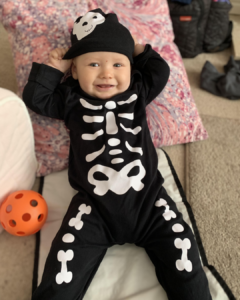
Reaching comes with its own story
Before that very deliberate pointing finger appears, reaching often does a lot of communicative heavy lifting.
At first, reaching is closely tied to physical development. Babies learn to coordinate their eyes and hands, judge distance, open their fingers and eventually grasp the thing they’ve been staring at.
Then reaching can become increasingly social.
Your baby stretches towards the bubbles because they want more. They lean towards a favourite puppet, hold their arms towards you or reach for the book they recognise.
Now movement and communication are beginning to overlap.
This is one of the reasons we don’t separate areas of development too rigidly at Adventure Babies.
A baby reaching for a puppet might be practising balance and hand-eye coordination while communicating interest, remembering a familiar character and sharing attention with their grown-up.
One tiny reach can have quite a lot going on behind it.
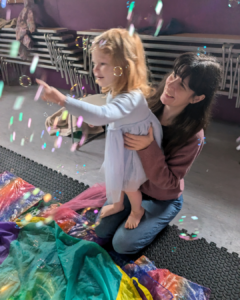
Waving is more sophisticated than it looks
A baby’s first wave is often brilliantly unreliable.
You wave goodbye to someone.
Nothing.
Five minutes later, halfway down the road, your baby begins waving enthusiastically at a lamp post.
Still counts.
Before babies can use a gesture appropriately, they need plenty of opportunities to see it, connect it with what is happening and practise the movement themselves.
Eventually, the gesture begins carrying meaning.
That’s an important idea.
A wave is a symbol. The physical movement itself isn’t goodbye, yet your baby gradually learns that people use this particular action to communicate a particular message.
Words work in a similar way. The collection of sounds we use for “dog” isn’t inherently dog-like; babies gradually learn what those sounds represent.
Gestures therefore provide a fascinating bridge between physical actions and symbolic communication.
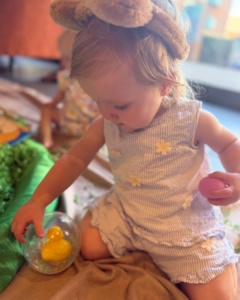
Your baby’s hands may speak before their mouth does
Parents understandably wait for first words.
“Mama” gets recorded.
“Dada” gets debated extensively over whether it was intentional.
Meanwhile, babies may already have developed an entire little communication system that receives considerably less fanfare.
A reach can mean that.
Raised arms can mean up.
Turning away can mean no more.
A wave can mean bye.
Pointing can mean look.
Your baby may even combine a gesture with a sound, expression or look towards you to make their meaning clearer.
That is communication.
Recognising these attempts can change the way we interact with babies because we stop waiting for them to become conversational partners.
They already are.
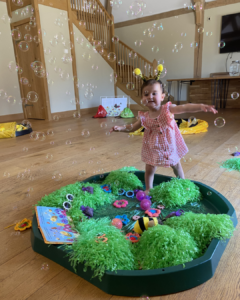
Stories give babies something worth pointing at
This is one of the reasons books are so central to our Adventure Babies classes.
When you share a book with a baby, you naturally create opportunities for joint attention.
There’s a picture to look at, a character to recognise, something to reach towards and often a grown-up making a ridiculous noise that deserves further investigation.
An older baby may touch or point towards a picture. A younger baby might stare intently at it before looking back towards their grown-up.
Both give us an opportunity to respond.
Rather than feeling that you need to read every word, try following your baby’s attention instead. If they become fascinated by the duck on page two, stay with the duck.
Point to it.
Name it.
Make the noise.
Pause.
See what your baby does next.
You may never reach page three, but you’ve still shared something valuable.
Why gestures appear everywhere at Adventure Babies
Our classes are full of opportunities for babies to communicate before they can talk.
A puppet appears and a baby reaches towards it. Bubbles float overhead and another baby points. Someone spots an object in a sensory tray before looking back towards Mum as if to check she’s seen it too.
Stories, songs and repeated actions also give babies opportunities to watch gestures before eventually joining in themselves.
What matters isn’t whether they copy us perfectly.
We’re interested in the interaction happening around the experience.
When a baby reaches, looks, points, waves or makes a sound, we want the grown-up with them to notice that communication and respond.
Perhaps you name what they’ve spotted. Maybe you copy their noise, move the object closer or simply wait to see what happens next.
Those tiny exchanges are exactly why we describe Adventure Babies as much more than sensory stimulation.
Sensory play gives babies something interesting to explore.
Responsive interaction turns that interest into communication.
You don’t need to teach your baby to point
Once parents discover that pointing is linked with communication and language, there’s a temptation to turn it into another milestone to practise.
You really don’t need to spend breakfast asking your baby to point at the banana.
Instead, let gestures grow through ordinary interactions.
Point towards the aeroplane you can hear outside. Wave when someone leaves. Hold your arms out before picking your baby up and notice whether they begin anticipating what comes next.
During play, follow their reach instead of always directing their attention somewhere else.
Books are particularly useful because you can point naturally while talking about pictures, then give your baby plenty of time to respond.
Babies learn an enormous amount from seeing communication used meaningfully.
The pause after a gesture matters too
Sometimes adults are so keen to help babies communicate that we accidentally do all the communicating for them.
Try leaving a little space.
Your baby reaches towards something.
Wait.
Perhaps they make a noise.
You respond.
They look at you.
You name the object.
Suddenly you’ve created a tiny back-and-forth conversation without your baby saying a single recognisable word.
This idea of noticing, responding and then pausing is something we think about a lot at Adventure Babies.
Babies need language around them, but they also need room to contribute.
Their turn might arrive through their hands rather than their voice.
What if my baby isn’t pointing or waving yet?
If you’ve searched when do babies start pointing and waving because another baby at your class has suddenly become an Olympic-level pointer while yours hasn’t, remember that development varies.
Look at your baby’s communication more broadly.
Are they making sounds, watching faces, reaching, smiling, looking towards things that interest them or trying to get your attention in other ways?
Individual gestures don’t develop in isolation.
Government early-years guidance uses pointing and gestures as one of several communication observations around 12 months, while NHS services also emphasise that children develop at different rates.
If you have concerns about your baby’s overall communication development, hearing or responsiveness, speak to your health visitor or GP. You don’t need to wait until your child is talking before asking for advice.
Before the first word comes a whole lot of conversation
First words are wonderful, but they aren’t the beginning of communication.
Long before your baby says “dog”, they may stare at one.
Then reach towards it.
Later, perhaps they’ll point.
They may look back at you to make sure you’ve noticed too.
You respond, name it and wait.
Your baby smiles.
That’s a conversation.
Once you start noticing these exchanges, the months before first words look completely different. Your baby isn’t waiting quietly for language to arrive; they’re learning how communication works through looks, movements, sounds, gestures and thousands of interactions with you.
So, when do babies start pointing and waving?
For many babies, you’ll see these gestures emerging during the second half of their first year and becoming increasingly purposeful as they approach their first birthday. Try not to focus too heavily on the precise date.
Watch what your baby’s hands are already telling you instead.
And if you’d like to give them a whole room full of interesting things worth looking at, reaching for, pointing towards and sharing with you, come and join us at your nearest Adventure Babies class.
Because your baby’s first conversations may begin long before you hear their first word.