How to Read to a Baby: Why Sitting Still Isn’t the Point
There is a particular kind of optimism involved in sitting down with your baby and a lovely new book.
In your head, it’s going to be gorgeous. Baby nestled against you, gazing adoringly at the pictures while you read every beautifully chosen word.
Your baby has other plans.
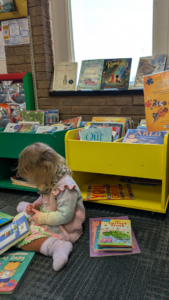
By page three they’ve grabbed the book, licked the corner, turned five pages at once and become considerably more interested in a light fitting.
If you’ve ever wondered how to read to a baby who appears to have absolutely no respect for the plot, we have some excellent news.
They aren’t doing storytime wrong.
In fact, the interesting bit might be everything they’re doing around the story.
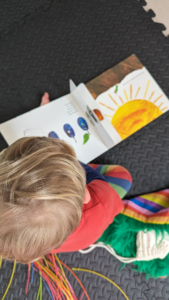
How to read to a baby? Forget about finishing the book
Adults are very attached to beginnings, middles and ends.
Babies couldn’t care less.
They might spend ages staring at one picture, insist on going backwards or become completely obsessed with a tiny dog in the corner that has absolutely nothing to do with the story.
Let them.
When your baby reaches for something, looks at a picture, makes a noise or turns to look at you, they’re giving you an opportunity to respond.
“You’ve seen the dog!”
“Woof!”
Pause.
Perhaps they smile. Maybe they kick their legs. They might make a noise back at you.
You’ve just had a tiny conversation.
And that back-and-forth interaction is much more important than making it triumphantly to THE END.
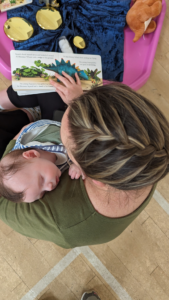
There’s actually research behind this
This isn’t simply us giving parents permission to abandon page seven.
Updated guidance from the Education Endowment Foundation’s Early Years Evidence Store highlights interactive reading as an evidence-informed way of supporting young children’s communication and language.
Interactive reading simply means helping children become active participants in sharing a book rather than expecting them to listen passively. The EEF also highlights stories, repetition, pictures, props and physical actions as useful ways of supporting language.
Which made us smile.
Because that’s essentially what we’ve been doing at Adventure Babies through sensory storytelling since 2013.
Much of the research behind early-literacy approaches involves preschool-aged children rather than tiny babies, so we’re not going to tell you that waving a puppet at your six-month-old will transform their vocabulary overnight.
What the evidence does reinforce is something much more useful: stories can become opportunities for interaction rather than something adults simply perform to children.
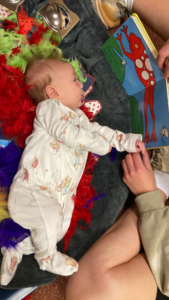
Your baby doesn’t need words to join in
This is perhaps the biggest misconception about reading with babies.
We tend to think participation means talking.
Babies have a much broader repertoire.
A squeal counts.
So does reaching.
A smile counts.
Kicking both legs wildly because the lion has appeared again definitely counts.
Even staring intently at something can tell you, “I’m interested in this.”
The trick is noticing.
If your baby becomes fascinated by something on the page, stay there for a moment. Name it. Make a noise. Change your voice. Wait to see what they do.
Storytime suddenly becomes something you’re doing together.
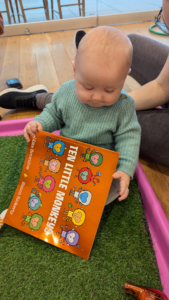
This is why Adventure Babies stories rarely stay inside the book
If you’ve been to one of our Adventure Babies classes, you’ll know we’re not particularly good at keeping stories contained.
Characters have a habit of appearing as puppets.
Rain might suddenly be something babies can hear or feel.
An animal gets a funny voice.
A picture leads to movement, music or sensory play.
The story spills out into the room.
That’s intentional.
At the heart of our Adventure Babies classes is sensory storytelling: using books as a starting point for babies and their grown-ups to explore, communicate and play together.
The sensory element isn’t there simply because babies enjoy interesting things to touch.
It gives them something to notice.
And when your baby notices something, you have something to share.
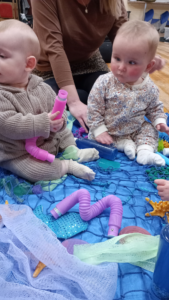
The developmental bit happens between you
This is one of the most important things we’ve learnt from years of working with babies and families.
The prop isn’t the clever bit.
Neither is the puppet.
Even the book isn’t doing all the work.
You are.
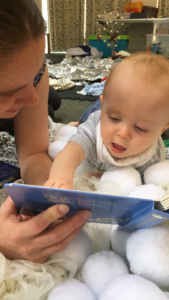
Your baby looks at something.
You notice.
You respond.
They react.
You respond again.
That’s where things become interesting.
It’s why we increasingly think about sensory play not simply as “stimulation”, but as a way of creating opportunities for attention, exploration and connection.
A feather is just a feather.
But your baby touching it, looking surprised, hearing you say “soft!” and then reaching out to experience it again?
That’s a shared learning experience.
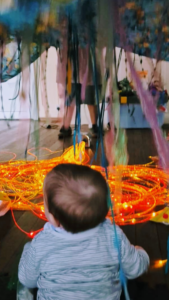
You don’t need to quiz your baby
Once parents hear that reading should be interactive, there’s a danger that storytime starts resembling an interview.
“Where’s the duck?”
“What colour is the ball?”
“Can you say DOG?”
Steady on. They’re eight months old.
For babies, commenting often feels far more natural than questioning.
If they’re looking at the duck, say, “There’s the duck.”
If the bear falls over, try, “BOOM!”
If they laugh, do it again.
There is no correct response you’re waiting for.
Your baby doesn’t need to demonstrate that they’ve learnt something. You’re simply putting language around whatever has already captured their attention.
That’s a much more relaxed way to read.
For both of you.
Sometimes the best thing you can do is wait
We’re remarkably good at filling silence around babies.
We talk. Sing. Shake things. Point things out. Move on to the next toy.
Try doing something slightly different.
Pause.
Make the animal noise and wait.
Turn the page and let your baby look before you speak.
Hold up the puppet and watch their face.
You might be surprised by what happens when you give them enough time to respond.
It doesn’t need to be a word. It could be the smallest smile or movement.
You’re showing your baby that communication goes both ways.
Repetition isn’t boring to babies either
There will probably come a point when your baby develops strong opinions about a particular book.
You will know every word.
Grandma will know every word.
Possibly the dog will know every word.
Your baby will still want it again.
Adults crave novelty. Developing brains get enormous value from familiarity.
Repetition gives babies another chance to notice patterns, recognise sounds and anticipate familiar moments. It’s one reason we use repeated language and familiar patterns within sensory storytelling.
So when your baby requests the same experience for what feels like the 4,000th time, remember that they aren’t trying to break you.
Probably.
You can also explore our Adventure Babies books and sensory resources if you’d like more ways to make stories playful at home.
Please don’t turn storytime into another parenting job
This may be the most important part.
Parents are bombarded with messages about development.
Do more tummy time.
Provide enrichment.
Stimulate their senses.
Talk constantly.
Buy the educational thing.
Make every wake window count.
It’s a lot.
Reading with your baby doesn’t need to become another item on that list.
You don’t need a special voice.
You don’t need to read for twenty minutes.
You certainly don’t need a baby who sits beautifully.
Pick up a book when it suits you. Have a cuddle. Look at a few pages. Make a ridiculous noise. Follow whatever your baby finds interesting.
So, what is the ‘right’ way to read to a baby?
There really isn’t one.
Read the words.
Ignore some of the words.
Talk about the pictures.
Make noises.
Let them touch the pages.
Follow their gaze.
Go backwards.
Read the same page six times.
And yes, occasionally allow them to chew the corner.
The important thing isn’t producing the perfect storytime.
It’s building the idea that books are associated with voices, closeness, curiosity, laughter and time spent with someone they love.
That’s what we’ve championed through sensory storytelling at Adventure Babies since 2013.
So next time your baby grabs the book halfway through your beautifully expressive rendition and starts enthusiastically whacking it against the floor, don’t worry.
Your literary critic may have terrible manners.
But they’re still joining in.
And perhaps that’s the real answer to how to read to a baby:
Don’t just read the story to them.
Let them become part of it.