
Does My Baby Know I Love Them? How Babies Experience Love Before They Understand the Words
There are moments in parenthood when love feels enormous.
It is there when your baby falls asleep against your chest, when they recognise your face across a room or when a tiny hand closes around your finger.
Then there are the other moments.
The feed that has gone wrong. The nap that never happened. The crying that you cannot seem to solve. The long afternoon when you are tired, touched out and wondering whether you have done anything particularly well.
It is often during those harder moments that parents quietly ask: does my baby know I love them?
The reassuring answer is yes—but probably not for the reasons social media would have us believe.
Your baby does not measure your love by the number of enrichment activities you provide, the neatness of their routine or whether you have enjoyed every minute of maternity leave. They experience it through patterns of care.
You return. You respond. You comfort them. You learn the difference between the cry that means hunger and the wriggle that means, “I have had quite enough of this now.” You get it wrong, adjust and try again.
Love, from a baby’s perspective, is not one perfect bonding moment. It is hundreds of ordinary experiences gradually teaching them: someone is here, my signals matter and I am safe with this person.

How does a baby know they are loved?
Before babies understand spoken language, they are extraordinarily attentive to voices, faces, touch, smell, movement and emotional tone.
A newborn may settle when they hear a familiar voice. An older baby may look towards you for reassurance when something unexpected happens. They may stretch out their arms, brighten when you appear or relax against your body after being upset.
These responses are not your baby offering a formal assessment of your parenting. They are signs that familiarity, comfort and trust are taking shape.
Babies learn about relationships through repeated interactions. When they cry and someone comes, when they make a sound and somebody answers, or when they turn away and an adult allows them a pause, they begin to discover that communication has meaning.
The NHS describes bonding as something built through everyday responses: comforting a crying baby, answering their noises, playing, talking, reading, singing and making eye contact. It is not dependent on one dramatic moment immediately after birth. (NHS: building a close relationship with your baby)
Your baby does not need to understand the sentence “I love you” to experience what it means. They are learning it through your actions long before the words themselves make sense.
Love is a pattern, not a performance
Modern parenting can make love feel strangely performative.
We see beautifully prepared sensory activities, immaculate nurseries and babies apparently delighted by every carefully selected wooden toy. It can create the impression that loving a baby properly requires constant creativity, stimulation and emotional availability.
In reality, babies build relationships through much more ordinary experiences.
A nappy change can become a moment of connection when you pause and respond to your baby’s expression. A feed can provide reassurance through closeness and familiarity. Getting dressed can involve eye contact, a repeated phrase or a little game that your baby begins to recognise.
None of these moments needs to be impressive enough to photograph.
Attachment grows through everyday care over time. NHS Scotland describes attachment as a relationship that develops through experiences such as feeding, changing nappies, playing and offering comfort.
This matters because it takes some of the pressure away. You do not have to manufacture meaningful moments all day. Much of the relationship is already being built while you are simply caring for your baby.

Does my baby know I love them when they are crying?
Crying can be one of the hardest parts of early parenthood, particularly when you have tried feeding, winding, changing, rocking and walking around the kitchen in increasingly desperate circles.
When your baby continues to cry, it can feel as though your comfort is not working.
But comfort is not always the same as stopping the crying.
Sometimes your baby is tired, uncomfortable, overwhelmed or struggling with a sensation they cannot yet regulate. You may not be able to remove the feeling immediately. Being held, spoken to and accompanied through it still matters.
Your presence tells your baby that distress does not make you disappear.
The NHS encourages parents to imagine what a crying baby may be experiencing and to offer cuddling and comfort. It also reminds parents that learning a baby’s individual signals takes time.
This does not mean you must remain perfectly calm through every difficult evening. Parents have nervous systems too. You may need to place your baby somewhere safe, take a breath, ask another trusted adult to step in or give yourself a moment to reset.
Needing support does not weaken your bond. It helps protect both of you.
Bonding does not always happen instantly
We often talk about bonding as though every parent should feel an overwhelming rush of love the moment their baby arrives.
Some do.
For others, love develops more gradually.
Birth may have been frightening or traumatic. A baby may need medical care. Feeding may be difficult. Exhaustion, anxiety, postnatal depression or the sheer shock of suddenly being responsible for another human being can affect how those early weeks feel.
You can care deeply for your baby while still feeling uncertain, numb, overwhelmed or unlike yourself.
Bonding is a relationship, not a test you pass in the delivery room.
The NHS explains that parents can continue building closeness through everyday contact, talking, playing, comforting and reading together. Even where early skin-to-skin contact has been delayed, bonding can continue to grow.
If you are worried that you feel disconnected from your baby, or you are struggling with persistent low mood, anxiety or frightening thoughts, speak to your health visitor, GP or another healthcare professional. Asking for help is an act of care, not evidence that you are failing.
Your baby does not need perfect attunement
Attunement means noticing and responding to another person’s emotional state and signals.
It sounds lovely. It can also sound like one more thing parents are supposed to do flawlessly.
In real life, no parent understands every cry, expression or movement correctly.
You may assume your baby is bored when they are tired. You may continue a game when they need quiet. You may offer a feed when what they wanted was to be held—or offer a cuddle when they are furious that the bottle has not appeared quickly enough.
Healthy relationships do not depend on getting every response right on the first attempt.
What matters is the ongoing process of noticing, adjusting and reconnecting.
Your baby turns their face away, so you soften the interaction. They become unsettled, so you change position. They look back, and you respond again.
This process is sometimes called repair. The interaction loses its rhythm for a moment, then you find one another again.
Repair teaches babies something important: relationships can cope with imperfect moments.
Love is not demonstrated by preventing every upset. It is shown in the willingness to return after things have become difficult.
The tiny conversations building your relationship
Babies initiate interaction long before they can speak.
They may look at you, kick, vocalise, reach, point or change their expression. When you notice and respond, you create a back-and-forth exchange.
The NSPCC explains that babies’ brains are supported not simply by adults talking or singing at them, but by genuine interaction in which an adult responds to what the baby does. (NSPCC: bonding with your baby)
Imagine your baby makes a long “oooo” sound.
You copy it.
They pause and stare at you.
You smile and repeat it.
This may look like a very small game, but your baby is discovering that their sound can influence another person. They are learning about turn-taking, facial expression, anticipation and the pleasure of being answered.
You do not need to lead every interaction. Sometimes the most powerful thing you can do is watch for what your baby offers first.
Looking away is not rejection
Babies often look away during play, stories or face-to-face interaction.
It can feel surprisingly personal, especially when you are trying very hard to create a lovely bonding moment.
But looking away is often a baby’s way of regulating how much information they are taking in.
Faces are stimulating. Voices, movement, colour and touch all demand processing. A baby may briefly turn away, become still, rub their eyes or lose interest when they need a pause.
The NHS encourages parents to notice when babies are ready to play, cuddle, feed, sleep or rest. Learning these signals helps parents understand when to continue an interaction and when to slow it down.
Allowing your baby to pause is itself a responsive act.
You are showing them that they do not need to keep performing your version of connection. They can look away and return when they are ready.
Why familiar voices matter so much
Your voice is one of your baby’s earliest sources of familiarity.
They hear its rhythm, pitch and emotional tone before they understand its vocabulary. Over time, repeated phrases begin to carry meaning.
“It’s all right.”
“Here I am.”
“Shall we find your book?”
Your baby may not understand every word, but they begin to recognise what usually comes next. The words become part of a predictable experience involving your face, smell, touch and presence.
This is why talking to a baby matters even when the conversation appears one-sided. Your voice is not simply delivering vocabulary. It is helping create a feeling of continuity.
Singing and storytelling can be particularly comforting because they contain rhythm and repetition. You do not need a polished singing voice or dramatic performance skills. To your baby, the familiar voice is the important part.
How books help babies experience love
Sharing a book with a baby is sometimes discussed mainly as preparation for school.
It does support early communication, attention and language, but that is only part of its value.
A book creates a small shared world between you.
Your baby hears your voice, studies your face and experiences physical closeness. You follow their attention, pause when they become interested and repeat the parts they appear to enjoy. Over time, the book itself becomes familiar, but so does the pattern of being together.
BookTrust reports that early shared reading supports bonding, communication, brain development and family wellbeing. It can establish predictable rhythms and provide a calm focus for babies and adults.
The important phrase is shared reading.
Your baby does not need to sit silently while you complete every page. They may grab the book, chew a corner, turn back to the same picture or lose interest halfway through.
That does not mean the reading has failed.
If you have shared a voice, a look, a cuddle, a sound or a moment of attention, the book has already done something valuable.
Babies can fall in love with books before they can read
A lifelong love of reading does not suddenly begin when a child learns to decode words at school.
It begins much earlier: in someone’s arms, hearing a familiar voice make a story feel exciting, comforting or funny.
This is particularly relevant during the Government’s National Year of Reading 2026, which is encouraging people of all ages to rediscover reading for pleasure. The initiative is led by the Department for Education with the National Literacy Trust as its delivery partner.
At Adventure Babies, we believe babies should be included in that reading conversation from the very beginning.
Our Adventure Babies books have been created especially for early shared storytelling. With engaging characters, rhythmic language and plenty of opportunities to add voices, movement and sensory play, they help parents make books part of their baby’s everyday world.
You do not need to produce a full sensory experience every time you read. One repeated sound, a slowly moving scarf or an expressive voice can make the story memorable.
Before babies can read books, they can fall in love with them—and the person sharing the story is a huge part of that love.
Sensory storytelling is really shared attention
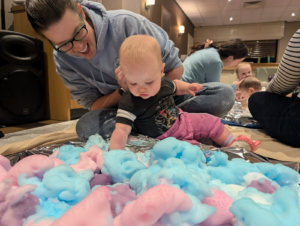
At first glance, an Adventure Babies class may appear to be about the puppets, textures, lights, messy play and movement.
Those experiences are important, but the relationship around them matters just as much.
A puppet moves and your baby watches. You notice their reaction and respond. A light appears and your baby looks between it and your face. You both reach towards a sensory tray and share the surprise of what is inside.
These are moments of shared attention.
Your baby is not experiencing the activity alone. They are exploring it alongside the person they know best.
At Adventure Babies classes, we bring stories to life in ways that give babies opportunities to look, reach, listen, move and communicate. We also give parents time to observe what captures their baby’s attention.
One baby may dive straight into the activity. Another may stay close to their parent and watch carefully. A younger baby may spend most of the session listening to the voices and looking at changes in light.
Every response is valid.
Our role is not to push babies to participate in one particular way. It is to create meaningful experiences that parents and babies can enjoy together.
What if you do not enjoy playing with your baby?
There can be a lot of pressure to enjoy baby play.
Some parents naturally love sitting on the floor making puppet voices. Others feel self-conscious, bored or completely unsure what to do. Neither response determines how much you love your baby.
You may be brilliant at comforting, walking, singing, reading, chatting during a nappy change or taking your baby outside. Connection does not have one approved format.
This is one reason classes can be useful. They remove the pressure to invent every activity yourself.
The story, ideas and sensory setting are prepared for you. You can concentrate on watching your baby, responding to them and sharing the experience.
You may also discover which kinds of play feel most natural for you. Perhaps your baby loves dramatic voices. Perhaps they are fascinated by movement. Perhaps they prefer quietly examining one object rather than being surrounded by several.
Understanding your baby’s preferences can make play feel less like a performance and more like a genuine relationship.
Why parent community matters to babies too
A parent-baby relationship does not exist in isolation.
It is easier to offer patience and responsive care when you feel supported yourself.
Yet early parenthood can be unexpectedly lonely. You may spend whole days with another person while missing adult conversation. You may wonder whether everyone else is coping better or whether your baby is the only one who feeds, cries, refuses to nap or becomes overwhelmed in public.
Being around other parents can soften that isolation.
You see real babies behaving like real babies. Some are sleeping. Some are feeding. One is attempting to crawl out of the activity. Another has cried throughout the bit their parent thought they would love.
Nobody is getting it completely right because there is no completely right version.
The community surrounding a parent has a developmental role too. When parents feel understood, welcomed and less judged, they have more emotional space to enjoy their babies.
Adventure Babies has always been about more than filling 45 minutes with activities. It is about creating a place where babies can develop through stories and sensory play while parents become part of a community that understands this stage of life.
Does my baby know I love them on the difficult days?
Yes.
Your baby does not only experience your love during the photogenic moments.
They experience it when you keep walking the floor at 2am. When you try a different position because the first one did not help. When you ask someone else to take over because you are reaching your limit. When you apologise to a baby who cannot yet understand the words but can hear the gentleness in your voice.
They experience it when you return after frustration.
When you begin again after a difficult feed.
When you sit beside them even though you cannot fix what is wrong.
Love is not the absence of irritation, exhaustion or doubt. It is the relationship that continues around those feelings.
Your baby does not need more proof
Parents are surrounded by messages about what babies supposedly need.
More stimulation. More classes. More carefully planned play. More developmental products. More one-to-one attention.
Babies do need responsive interaction, opportunities to explore and loving care. But you do not need to prove your love by turning every hour into a learning opportunity.
Sometimes love looks like reading a story.
Sometimes it looks like lying on the floor together.
Sometimes it looks like putting your baby somewhere safe while you make a cup of tea and gather yourself.
Sometimes it looks like asking for help.
Your baby is not keeping score of the activities you completed. They are gradually learning the deeper pattern underneath family life: when I need someone, people try to respond. When things become difficult, connection can return.
That is how babies experience love.
You bring the most important part of every class
At Adventure Babies, we create the books, stories, sensory environments and developmental opportunities.
But you bring the part your baby values most.
Your familiar voice. Your face. Your smell. Your response when they become excited, cautious or overwhelmed. The relationship that gives every new experience a sense of safety and meaning.
You do not need to arrive with a baby who is well rested, sociable or ready to join in. They can watch, cuddle, feed, wriggle, crawl, cry or sleep.
You are both welcome exactly as you are.
Find your nearest Adventure Babies class and join a community built around brilliant books, thoughtful baby development and the wonderfully imperfect experience of growing together.
Because your baby does know you love them.
Not because you do everything perfectly—but because, in a thousand ordinary ways, you keep showing them.