
How to Help Your Baby Crawl Without Trying to Teach Them to Crawl
There is a strange moment in babyhood when the floor suddenly becomes very interesting.
Your baby spots the muslin cloth, the remote control, the dog’s tail or the one object you were absolutely certain was out of reach. They stretch, wriggle, rock, push backwards and become increasingly furious that their body has not yet worked out how to follow their intentions.
Crawling can look as though it appears overnight. One day your baby seems fairly content to stay where you put them; the next, they are moving towards the most unsuitable object in the room with astonishing determination.
In reality, crawling has usually been developing quietly for months.
When parents search for how to help baby crawl, they are often hoping for a particular exercise that will encourage their baby forwards. But crawling is not one skill that can simply be taught. It is the result of strength, balance, coordination, body awareness, motivation and confidence gradually beginning to work together.
The best way to support it is not to train your baby to crawl. It is to give them plenty of safe, enjoyable reasons to move.
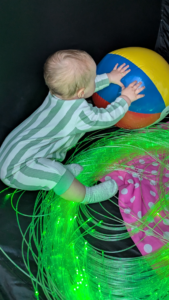
Crawling begins long before your baby moves forwards
Before your baby can travel across the floor, they have to learn an extraordinary amount about their own body.
They need to begin controlling their head, shoulders and trunk. They need to work out how to push through their arms, shift their weight and free one hand to reach without collapsing sideways. Their hips and legs must become strong enough to support and propel them, while their balance system continually tells them where they are in relation to the floor.
These abilities do not usually arrive in a neat sequence.
Your baby may become brilliant at rolling in one direction but refuse to roll back. They may push high onto straight arms, then spend several weeks travelling backwards because that is where the force takes them. They may pivot in circles, shuffle on their bottom, commando crawl or develop a movement style that looks entirely their own.
The NHS says babies often begin crawling at around seven to ten months, but it also stresses that not every baby crawls in the same way—or crawls at all. Some babies bottom shuffle or find another way to move before walking.
This is why crawling should not be treated as a single deadline. It is one possible part of a much broader movement journey.
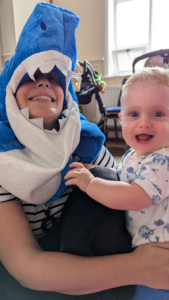
Why motor development is about more than strong muscles
Strength matters, but motor development is not simply a baby version of a gym programme.
Every movement depends on the brain receiving information from several systems at once. Your baby needs to know where their limbs are, how much pressure is travelling through their hands and knees, whether their body is tipping and how far away the desired object might be.
This information comes through the senses.
The firmness of the floor tells your baby how much force to use. Pressure through the palms and knees helps them understand where their body is supported. Looking at a toy gives them information about distance. Moving the head changes what the balance system experiences.
Motor development is therefore closely connected to sensory development. Babies do not learn to move in isolation from the world around them. They learn because the world gives them something worth moving towards.
The Department for Education’s early-years guidance describes gross and fine motor development as beginning with sensory exploration and growing through tummy time, crawling and playful movement with objects and adults.
That is an important distinction. Babies do not develop movement only by strengthening individual muscles. They develop by using their whole body to explore meaningful experiences.
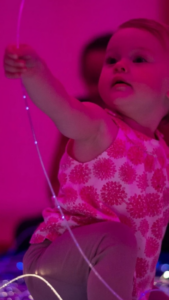
How to help baby crawl through floor time
The most useful place for early motor development is often the simplest: the floor.
A safe, firm surface gives your baby room to kick, roll, stretch, twist, pivot and discover what happens when they push against something. On the floor, the body receives clear feedback. Your baby can experiment without being held upright or positioned by an adult for the entire experience.
That does not mean you need to place your baby on the floor and step away. Floor time is often most successful when an adult joins in.
Lie opposite your baby. Move your face into view. Place an interesting object close enough to be achievable. Talk to them, copy their expression or allow them to reach for your hand.
The aim is not to make your baby exercise. It is to make being on the floor feel worthwhile.
NHS guidance recommends regular supervised floor play and tummy time because these experiences help babies develop the muscles needed for rolling, sitting and crawling.
A baby who spends time freely moving on the floor can explore positions in their own way. They may repeat one tiny action many times before it becomes part of a larger movement.
That repetition is not wasted effort. It is how the nervous system learns.
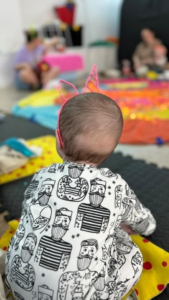
What if your baby hates tummy time?
Few phrases produce more parental guilt than “tummy time”.
Parents know it is supposed to be good for babies, yet many babies react to being placed face-down as though they have been personally betrayed.
Tummy time is difficult because your baby is working against gravity. Lifting the head, pushing through the arms and stabilising the upper body demand effort. A baby who cannot yet see much from the position may also find it frustrating or lonely.
The answer is not necessarily to insist on one long session.
Short, frequent experiences can be more manageable. You might begin with your baby lying across your chest while you are fully awake, across your lap or supported over a rolled towel. You can place yourself at their eye level or put an interesting object within comfortable view.
West London NHS guidance suggests beginning with very short periods and gradually building them up. It also notes that side-lying can provide a useful alternative for babies who struggle with being flat on their tummy.
Timing matters too. Tummy time immediately after a full feed is unlikely to be anyone’s favourite activity.
Some days your baby may tolerate only a minute. That minute still counts.
The goal is not to win a tummy-time endurance competition. It is to help your baby gradually become more comfortable using their body in different positions.
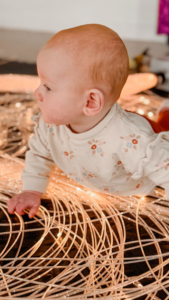
Reaching is one of the hidden foundations of crawling
Reaching may look like an arm skill, but it involves the whole body.
To reach successfully, your baby must stabilise one part of their body while moving another. They may need to shift weight onto one arm, rotate through the trunk and judge the distance between their hand and the object.
This is why reaching across the body is particularly interesting. When a baby reaches from one side towards something on the other, they begin coordinating the two sides of the body.
You can support this naturally by placing an object slightly to one side rather than always directly in front of them. A puppet, scarf, lightweight ball or textured object can create a reason to turn and reach.
Keep it possible.
There is a popular habit of repeatedly moving a toy further away just as the baby nearly reaches it. Adults often mean this as encouragement, but it can quickly become frustrating. Imagine reaching for your cup of tea while someone slides it across the table every time your fingers get close.
An object should be interesting enough to motivate movement but close enough for your baby to experience success.
That success matters. It teaches them that their movement can change what happens.
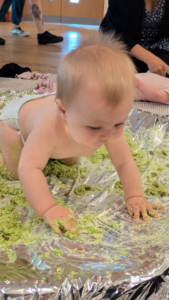
Why babies sometimes crawl backwards first
A baby who is desperate to move towards something may push with their arms and accidentally travel backwards.
This can produce a deeply offended expression.
Moving backwards happens because the upper body may initially be stronger or better coordinated than the lower body. When the baby pushes through the hands, the force sends them away from the object rather than towards it.
This is not a mistake that needs correcting. It is useful feedback.
Your baby is discovering how force travels through their body. With time, they may begin bringing the knees underneath themselves, rocking on hands and knees or finding another way to move forwards.
Before coordinated crawling appears, babies may spend days or weeks doing what looks like very little: rocking, shifting, collapsing, trying again and becoming stuck underneath furniture.
These experiments are the work.
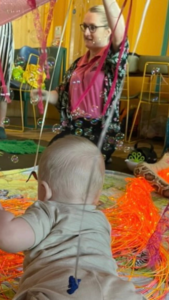
Is commando crawling normal?
Not all crawling looks like the classic hands-and-knees movement seen in baby milestone illustrations.
Some babies move on their tummy using their arms. This is often called commando crawling, belly crawling or army crawling. Others bottom shuffle, roll to their destination or create a combination of movements.
NHS children’s health guidance describes belly crawling and bottom shuffling as common variations. Some babies use these methods for a period before moving onto hands and knees, while others continue until they begin pulling to stand or walking.
Variation is normal, but it is still useful to notice how your baby uses their body.
Do they use both arms and both legs? Do they turn their head comfortably in either direction? Can they reach towards both sides? Is one limb consistently left behind?
The aim is not to scrutinise every movement anxiously. It is simply to become familiar with your baby’s usual patterns so that you can ask for advice if something feels markedly uneven or difficult.
Should you place your baby on their hands and knees?
Parents often want to show babies what crawling feels like by arranging them into position.
Brief support can sometimes help a baby experience weight through the hands and knees, especially when they are already beginning to move towards that posture. You might gently support their middle with your hands or a rolled towel while they explore the position.
However, repeatedly placing a baby into a posture they cannot reach or leave independently does not necessarily help them understand how to get there.
The transition is part of the skill.
Moving from sitting towards the floor, rotating the body, bringing the knees underneath and learning how to return to sitting all require control and planning. A baby who is always placed directly into the final position misses the opportunity to practise those routes.
Rather than arranging your baby perfectly, create space for them to experiment imperfectly.
They may get one leg stuck. They may lower themselves with no elegance whatsoever. They may begin a transition, change their mind and roll away.
This is motor problem-solving.
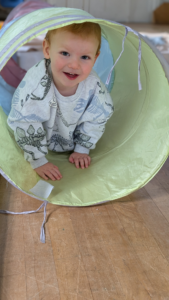
Movement is driven by curiosity
Babies rarely move because they are interested in meeting a developmental milestone.
They move because they want the spoon, the crinkly book, the light on the wall or the parent who has moved just beyond reach.
Motivation is a central part of motor development.
A baby may have the physical ability to reach or roll but show little interest until the right object appears. Another baby may be highly motivated but still need time for their strength and coordination to catch up with their ambition.
This is why thoughtful play environments are so effective. They give babies a reason to use emerging skills.
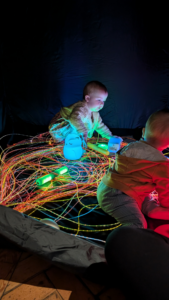
At Adventure Babies, a baby might follow a puppet across the story space, rotate towards a moving light, reach into a shared tray or push up to see what has appeared on the other side of a book. The movement is not separated from the experience. It happens because the baby wants to discover more.
Our sensory storytelling classes are designed so that babies can participate from their own stage. One baby may lie on their back watching fabric move. Another may roll towards it. Another may crawl straight through the middle of the story and attempt to leave with the puppet.
Nobody has failed to join in.
What sensory play contributes to motor development
Sensory play is often described as though it is mainly about touching interesting textures. In reality, it can support movement in much richer ways.
A lightweight scarf may encourage a baby to reach higher or across their body. A rolling ball invites visual tracking and weight shifting. A crinkly object gives immediate feedback when it is grasped. A shared sensory tray may encourage a baby to push up, lean forwards or move between sitting and the floor.
Different surfaces also give the body different information.
A smooth object may require a more controlled grasp. A textured object may be easier to hold. A firm surface makes pushing easier, while a very soft or slippery surface can make movement harder.
This does not mean babies need elaborate equipment.
A wooden spoon, muslin cloth, board book, soft ball or safe household object can all create meaningful opportunities for reaching and movement. The developmental value lies less in the cost of the object and more in what the baby can do with it.
Our Adventure Babies books and mini parachutes can also be used to encourage tracking, reaching, grasping and shared play at home. A slowly moving parachute gives babies time to follow with their eyes, turn their head, stretch their arms and anticipate where it will move next.
The key word is slowly. Babies need time to organise a response.
Fine motor skills are developing alongside crawling
Crawling is usually discussed as a gross motor milestone because it involves the larger muscles of the body. But fine motor skills are developing alongside it.
As babies begin reaching more accurately, they refine how they open their hands, close their fingers and adjust their grip. They may first scoop an object with the whole hand, then gradually use the fingers and thumb with more precision.
The shoulders and trunk provide a stable base for these smaller hand movements. When the upper body becomes stronger, the hands can work with greater control.
This is one reason physical and fine motor development should not be treated as separate subjects. Pushing through the hands, shifting weight and reaching from a stable position all contribute to later control.
Turning pages, grasping fabric, exploring textured objects and transferring something from one hand to the other may look like quiet play, but the body is doing sophisticated work.
Crawling and the brain
Movement gives babies information that cannot be learned simply by watching.
When your baby travels towards an object, they experience distance, direction, speed and space through their whole body. They begin learning that the sofa is nearer than the doorway, that some objects move when pushed and that a parent remains present even when partly hidden from view.
Crawling also changes the baby’s relationship with adults.
Before they can move independently, adults decide where they go and what they reach. Once babies become mobile, they begin making more of those decisions themselves. They can approach, retreat, pause, investigate and return.
That growing independence is exciting, but it can also make babies more cautious. A newly mobile baby may suddenly become more aware of distance from a parent or more hesitant around unfamiliar people and spaces.
Motor development is therefore not only physical. It affects thinking, confidence, communication and emotional development too.
Does crawling help babies learn to read?
Claims about crawling sometimes become exaggerated.
You may see statements suggesting that babies must crawl in a particular way for their brain to develop correctly or that skipping crawling will inevitably cause later problems with reading, writing or coordination.
Development is more complex than this.
Crawling can offer useful experiences involving coordination, balance, strength, spatial awareness and movement between the two sides of the body. However, not every typically developing baby uses a classic crawl, and no single movement guarantees or determines later academic ability.
It is reasonable to value crawling without turning it into a test of future intelligence.
Babies benefit from varied opportunities to move, reach, turn, push, grasp and explore. That broader movement experience matters more than forcing every child through one identical route.
How much floor time does a baby need?
There is no single perfect daily total that suits every baby and family.
The most useful approach is to offer regular opportunities across the day rather than relying on one formal movement session. A few minutes after a nappy change, time on a mat while you sit nearby or a short period before getting ready to go out can all contribute.
The NHS advises that babies who are not yet mobile should be physically active several times each day through activities such as reaching, grasping, pulling, pushing, moving the head, body and limbs, and supervised floor play.
The point is not to record every minute.
Instead, consider whether your baby spends much of their awake time contained in seats, carriers, pushchairs or equipment. These all have practical uses, but babies also need regular opportunities to move without the equipment deciding their posture for them.
A helpful question is not, “Have we completed enough tummy time?”
It is, “Has my baby had several chances to move freely today?”
What about baby walkers and seats?
Equipment that holds babies upright can be tempting, particularly when they enjoy seeing the world from that position.
However, time spent supported in a seat or walker is not the same as learning to organise the body independently. The equipment may hold the baby in a position before they have developed the balance and control to reach it themselves.
This does not mean every seat must disappear from the house. Parents need safe places to put babies while showering, cooking or dealing with daily life.
The issue is balance.
Equipment should not replace floor play or become the main place where an awake baby spends their time. Free movement gives babies the opportunity to choose positions, make mistakes and build control gradually.
When crawling creates a whole new safety problem
Once a baby begins moving, their reach seems to expand instantly.
Objects that appeared safely distant become accessible. Cables, pet bowls, low shelves, houseplants and tiny items on the floor suddenly require attention.
It is worth baby-proofing before you think crawling is imminent, because early movement can be unpredictable. A baby who has never travelled forwards may roll, pivot and shuffle far enough to surprise you.
Try looking at the room from floor level. What can be pulled, tipped, swallowed or climbed? Are furniture and televisions secure? Are blind cords, medications, cleaning products and button batteries completely inaccessible?
The purpose of a safe environment is not to remove every interesting experience. It is to allow babies enough freedom to explore without adults needing to stop them every few seconds.
Movement develops through practice, and practice is easier when the answer is not constantly “no”.
When should you ask for advice?
Motor development varies, and a baby reaching a milestone later than a friend’s baby does not automatically indicate a problem.
However, parents should seek advice if their baby loses a skill they previously had, appears unusually stiff or floppy, consistently uses one side much more than the other or seems unable to change position comfortably.
Healthier Together recommends speaking to a healthcare professional promptly if a baby stops doing something they could previously do, feels very stiff, is difficult to move during dressing or nappy changes, or seems unusually floppy while awake.
The NHS also advises contacting a health visitor if a baby is not showing signs of becoming mobile by around twelve months.
You can speak to your health visitor or GP whenever you have concerns. You do not need to wait for a milestone deadline, and asking for guidance does not mean that something is necessarily wrong.
How to help baby crawl without making development a race
Crawling attracts attention because it is so visible.
You can see when another baby crosses the room while yours remains happily seated. You can notice the difference between the baby who is pulling to stand and the one who has only recently begun tolerating tummy time.
What you cannot see as easily is all the development taking place underneath.
Your baby may be strengthening their shoulders, refining their balance, learning to rotate through the trunk or working out how to shift weight without falling. They may be watching other babies and storing information before attempting the movement themselves.
Development is not a race across the mat.
Babies do not need to be hurried towards the next stage. They need space, opportunity, encouragement and interesting reasons to explore what their bodies can do.
Offer regular floor time. Place appealing objects within achievable reach. Let your baby try, pause and try again. Celebrate the curiosity behind the movement rather than only the final milestone.
And when they finally crawl towards the object you selected especially to support their development, do not be surprised if they ignore it completely and head straight for your phone.
At Adventure Babies, we create sensory storytelling experiences that encourage babies to reach, roll, turn, push, grasp and move through curiosity rather than pressure. Our classes welcome every stage—from tiny babies beginning to lift their heads to determined crawlers who would quite like to investigate the entire venue.
Find your nearest Adventure Babies class and discover how stories, movement and sensory play can support your baby’s development while giving both of you a joyful reason to get down on the floor.