How to Encourage Your Baby to Talk: The Conversations That Begin Long Before First Words
Your baby may be months away from saying “mama”, “dada” or the name of the family dog, but that does not mean language development is waiting to begin.
From the moment your baby starts to recognise your voice, watch your face or quieten when you speak, they are already learning some of the most important lessons behind communication. They are discovering that sounds carry meaning, that people take turns and that a look, wriggle or tiny noise can make another person respond.
When parents search for how to encourage baby to talk, they are often hoping for an activity that will unlock speech: a particular book, toy, song or clever exercise that will move things along. The reassuring truth is that babies do not learn language through one perfect activity. They build it gradually through hundreds of ordinary exchanges with the people who know them best.
That might sound wonderfully simple. It can also feel rather vague. What does a useful early conversation actually look like when one of you cannot speak yet? And how can you support your baby without turning every moment together into a developmental task?
how to encourage baby to talk
Your baby is communicating before they can talk
Speech, language and communication are closely connected, but they are not quite the same thing.
Speech is the physical production of sounds and, eventually, recognisable words. Language is the system of words, meanings and patterns we use to understand and express ideas. Communication is broader still. It includes eye contact, facial expressions, gestures, body movements, cries, pauses and the back-and-forth rhythm between two people.
This means your baby does not have to say a word to begin communicating.
A newborn may become still when they hear your voice. A three-month-old may make a soft sound and wait to see what happens. An older baby may look between you and an interesting object, point, reach or use a particular squeal to get your attention.
These moments can look tiny, but they are the beginnings of conversation.
Speech and Language UK’s guidance for babies aged 0–6 months notes that babies commonly begin watching faces, recognising familiar voices and using coos, squeals or other sounds to attract attention. Between six and twelve months, their babble often becomes more varied, and they may begin using noises, looks and gestures deliberately to involve another person. Every baby develops at an individual rate, but these early exchanges form the foundations beneath later words.
How to encourage your baby to talk without talking constantly
New parents are often told to narrate everything they do.
“I’m opening the cupboard. Now I’m getting your cup. Here is the blue cup. We’re putting water in the cup.”
There is nothing wrong with describing daily life. Hearing plenty of warm, meaningful language is valuable. But feeling responsible for providing a continuous commentary can become exhausting, and talking constantly does not automatically make an interaction more useful.
Babies need opportunities to hear language, but they also need pauses in which they can process it and respond.
Imagine that your baby is sitting on your lap in the garden and notices a bird hopping along the fence. Instead of beginning a long explanation about birds, you might follow their gaze and say, “You saw the bird.”
Then wait.
Your baby might widen their eyes, kick, turn towards you or make a sound. You can answer that response: “Yes, it hopped away.”
That is not simply an adult delivering vocabulary to a passive baby. It is a shared conversation built around something your baby noticed first.
The NHS advises parents to talk about what their baby is already looking at and to respond when the baby tries to copy a sound. This kind of interaction connects words with a real object or experience while showing the baby that their attention and communication matter.
The pause is important. It gives your baby time to take in your face, voice and words. It also creates a space they may eventually learn to fill.
The surprisingly important skill of shared attention
One of the strongest foundations for language is something called shared attention or joint attention. This happens when you and your baby are focused on the same thing and are aware, in some way, that you are sharing the experience.
Your baby looks at a dog. You look at the dog too. You say, “Dog.” Your baby glances back at you, perhaps checking your reaction.
Now the word is not floating around on its own. It is attached to a real animal, your expression, the sound of barking and the excitement of having noticed something together.
Shared attention helps babies work out what adults are referring to. It is much easier to understand the meaning of “leaf” when someone says it while you are both watching a leaf move than when the same word is spoken during an unrelated stream of conversation.
Summer is full of these opportunities. You may be watching leaves flicker above the pushchair, dipping small toes into water, hearing an aeroplane or noticing the strange sensation of grass. You do not need to transform each moment into a formal lesson. Follow what has already captured your baby’s attention, offer a few useful words and wait to see what they do.
Language grows more naturally when it is connected to a baby’s own curiosity.
Why your baby needs time to answer
Adults can find baby conversations surprisingly difficult because babies respond slowly and subtly. We are used to receiving words back almost immediately. When there is silence, we tend to fill it.
Your baby, however, may need several seconds to organise a response.
They might change their expression, move their body, look away and back again or produce a sound that seems unrelated. When you pause long enough to notice these responses, you begin treating your baby as an active conversational partner rather than an audience.
Try copying one of your baby’s sounds and then waiting.
If they say “ba”, you might say “ba” back with an interested expression. They may repeat it, change it or simply stare at you. Either way, they are learning that sounds can travel between people.
This kind of imitation is not about teaching the baby to pronounce the sound correctly. It is about introducing the rhythm of communication: I do something, you respond, and then I have another turn.
The NHS describes early sounds, giggles and rhymes as important steps on the journey towards talking, because they help babies become familiar with a trusted adult’s voice and with the pleasurable back-and-forth nature of interaction.
Babbling is not meaningless noise
Babbling can sound delightfully random, but it represents an extraordinary period of experimentation.
Your baby is learning what happens when they move their lips, tongue and jaw in different ways. They are exploring volume, pitch, rhythm and repetition. Over time, their babble may begin to include repeated syllables such as “ba-ba”, “da-da” or “na-na”.
At first, these sounds may not refer to anyone or anything. A baby saying “dadadada” has not necessarily chosen a first word. However, babbling gives them valuable practice in producing the sound patterns they hear around them.
Babies also begin to absorb the musical qualities of their home language: its rhythm, emphasis and rise and fall. That is one reason expressive speech, songs, rhymes and animated storytelling can be so engaging. Babies are not only listening for dictionary meanings. They are noticing how language sounds and feels.
You do not need to correct babble or turn it into a word every time. Respond with interest. Repeat it, vary it or attach language naturally when it fits.
If your baby looks towards a ball and says “ba”, you might respond, “Ball. You found the ball.” The aim is not to test whether they can reproduce it. It is simply to connect their communication with a meaningful word.
Why repetition matters more than novelty
Adults often assume that babies need constant novelty to stay stimulated. In language development, repetition is enormously valuable.
A baby may hear the word “splash” in the bath, while paddling in a tray of water, during a rainy walk and in a favourite story. Across those different experiences, the meaning gradually becomes richer.
At first, “splash” may simply be part of a stream of sound. Later, your baby begins to connect it with movement, water, excitement and a familiar adult reaction. Eventually, they may anticipate the word before you say it or attempt part of the sound themselves.
Repeated books are particularly useful because the language remains familiar while your baby’s understanding changes. A story that seemed to hold little interest at three months may produce smiles, anticipation or attempts to turn the pages several months later.
You are not boring your baby by sharing the same story again. You are giving their brain another opportunity to recognise patterns, predict what comes next and notice something they missed before.
Books offer language that everyday conversation may not
Daily conversation is essential, but it tends to be practical. We talk about socks, feeds, nappies, doors, dogs and where we have put the muslin cloth.
Books take babies into a wider world of words.
A story may include creatures, places, actions, emotions and rhythms that rarely arise during an ordinary morning at home. It may offer repeated phrases, playful noises or a satisfying pause before a familiar event.
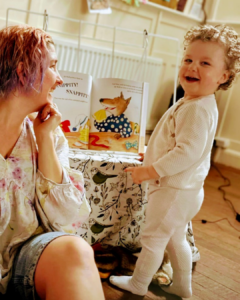
BookTrust explains that early shared reading supports bonding, communication and language development while introducing babies to the rhythm and pleasure of books. It does not need to look like a formal reading lesson. Your baby can examine one page, chew the corner, turn the book upside down or wander away before the ending. The valuable part is the shared interaction around the book.
When you read with expression, your baby hears contrasts in pitch, speed and emotion. When you pause at the same place each time, they begin to anticipate. When you point to a character your baby is already studying, you connect a word with their focus.
Our own Adventure Babies books and sensory storytelling bags were created to make this kind of shared reading playful and accessible. The stories can be enjoyed on their own, but parents can also bring them to life through movement, expression and simple sensory experiences. You do not need to recreate a full class at home. A fluttering scarf, a funny voice or a repeated sound can be enough to make the language memorable.
What sensory play has to do with speech and language
It is easy to think of sensory play and language as separate areas of development. One involves touching, moving and exploring; the other involves listening and words.
For babies, they are deeply connected.
A word becomes more meaningful when it is experienced through several senses. Your baby might hear the word “soft”, see a feather move, feel it brush against their hand and watch your face respond. The spoken word is now attached to a richer experience.
A word such as “under” becomes easier to explore when a puppet disappears under a cloth. “Shake” becomes meaningful when your baby hears and feels an object move. “Up” can be paired with your hands, voice and a repeated lifting movement.
This is not about bombarding babies with as much stimulation as possible. More noise, colour and movement are not automatically more developmental. The most useful sensory experiences have a clear focus and leave enough space for the baby to notice, respond and recover.
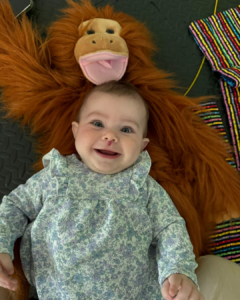
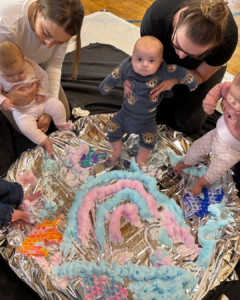
At Adventure Babies classes, sensory play grows from the story rather than appearing as a random collection of props. Babies hear a word or idea, see it represented and then explore it through movement, texture, sound or light. This gives language context.
One baby may reach immediately for the object. Another may study it from a parent’s lap. A younger baby may simply watch the movement and listen to the repeated language. All three are participating at their own developmental level.
Your face is one of your baby’s best language resources
You do not need an educational toy to support communication. Your face is already one of the most interesting and informative things in your baby’s world.
When you speak, your baby can watch how your mouth moves. They also see how your eyebrows, eyes and expression change with the meaning of your voice. A playful “Oh no!” looks and sounds very different from a soothing “It’s all right.”
These cues help babies begin to interpret intention and emotion before they can understand every word.
Face-to-face interaction works best when it feels natural rather than forced. You do not need to hold your baby in front of you and insist that they look. Babies often glance away when they need a break, particularly when they are tired or the interaction has become intense.
Looking away is not a failure to engage. It may be your baby’s way of regulating themselves.
Pause, soften your voice or give them a moment. When they look back, the conversation can begin again. Learning that communication can stop and restart safely is part of social development too.
Should you use baby talk?
Many adults naturally use a warmer, more melodic style of speech with babies. The pitch may rise, words may be stretched slightly and expressions may become more animated.
This is sometimes called infant-directed speech. It is not the same as deliberately mispronouncing every word. You can use real language while still making your tone lively and engaging.
Instead of repeatedly simplifying “dog” to “doggy-woggy”, you might say, “There’s the dog. He’s running quickly!” with an expressive voice.
Babies often find this musical style easier to attend to because the rhythm and emotional cues are clearer. The important thing is that it feels responsive and affectionate rather than like a performance you must maintain all day.
Parents who speak more than one language should also feel confident using the languages that come most naturally to them. NHS guidance states that growing up with more than one language can be advantageous and does not require families to abandon their home language in favour of English. Rich, comfortable interaction matters more than forcing yourself to speak in a language that feels less natural.
Do you need special activities to encourage baby to talk?
Not really. You need moments in which language has a reason to exist.
During dressing, pause before pulling a sock onto a foot and say, “Sock on.” When your baby splashes, respond to the action they have created. When they reach towards something, name it rather than immediately handing it over in silence.
Peekaboo can introduce anticipation, turn-taking and repeated language. Rolling a ball between you can create a predictable exchange. Looking in a mirror offers faces, expressions and opportunities to name familiar people.
The activity itself does not have to be impressive. What matters is the interaction built around it.
Try to avoid asking too many questions your baby cannot yet answer. Adults often say, “What’s this? What colour is it? Can you say ball?” because we are trying to help. But repeated questions can make an interaction feel like a test.
Comments are often more useful.
Instead of “What’s that?”, try, “You found the shiny ball.”
Instead of “Can you say duck?”, try, “The duck is splashing.”
Your baby still hears the important word, but without being required to perform.
When will your baby understand words?
Understanding usually develops ahead of spoken language.
Before your baby can say “up”, they may raise their arms when they hear it. Before saying “bye-bye”, they may recognise the phrase and respond to the accompanying wave.
Speech and Language UK notes that many babies approaching their first birthday begin understanding familiar words and phrases, especially when they are paired with actions and repeated in meaningful situations. They may also respond to their name, turn towards a speaker and use sounds or gestures to get attention.
This hidden understanding can make it seem as though a first word appears suddenly. In reality, the baby may have been collecting information about that word for weeks or months.
That is why it is worth talking, reading and responding even when you cannot see an obvious result. Much of early language development is taking place quietly beneath the surface.
What if your baby is quiet in groups?
Some babies arrive at a class and vocalise throughout. Others become completely silent while they watch the room.
A quiet baby is not necessarily an unengaged baby.
Group environments contain many things to process: unfamiliar voices, faces, movement, music, distance and changes in light. Some babies respond by joining in noisily. Others concentrate so intensely that their usual babble temporarily disappears.
Watching is a valid form of participation. Your baby may begin vocalising later in the car, at home or during a repeated game when the experience feels more familiar.
Adventure Babies classes are not designed to test whether a baby can copy a sound on cue. They offer rich, repeated opportunities for communication while allowing babies to respond in their own way. A look towards a puppet, a kick during a familiar phrase or a hand reaching towards the story tray can all be part of the conversation.
When should you seek advice about speech and language?
Development varies considerably during the first year, and milestone lists should never be treated as deadlines. However, parents know their babies well, and it is always appropriate to ask for professional advice if something feels concerning.
Speak to your health visitor or GP if your baby does not seem to respond to sound, has stopped using skills they previously had, rarely reacts to familiar voices or faces, or if you have any broader concerns about hearing or communication.
You do not need to wait until your baby is expected to speak in sentences before raising a concern. Hearing, attention, social interaction and early sound-making all contribute to later language.
Speech and Language UK provides clear age-related guidance and support for families, while Great Ormond Street Hospital’s birth-to-twelve-month language guide explains some of the communication changes parents may notice across the first year.
Asking for advice does not mean something is necessarily wrong. It simply means you are taking your concern seriously.
The most powerful language activity is a relationship
When we think about how to encourage baby to talk, it is tempting to focus on the number of words we say, the books we buy or the activities we organise.
Those things can help, but language does not grow from input alone. It grows through connection.
Your baby learns that communication matters when their sound makes you smile, their look causes you to follow their attention and their gesture changes what happens next. They learn that conversation is pleasurable when you copy their babble, wait for their response and return to a favourite story without demanding that they prove what they know.
You do not need to talk constantly, fill every silence or turn your home into a language classroom.
Notice what your baby is interested in. Add a little language. Pause. Respond.
That is a conversation—and it has probably been happening between you for longer than you realise.
At Adventure Babies, our sensory storytelling classes bring books to life through voices, puppets, movement, texture, light and shared play. Every activity is designed to offer babies meaningful opportunities to listen, communicate, explore and connect, whether they are cooing enthusiastically or quietly taking in the whole room.
Find your nearest Adventure Babies class and come and discover how much language can grow from one brilliantly shared story.