How Do Babies Learn? The Surprising Science Behind Your Baby’s First Year
“Have we actually done anything today?”
It’s one of the questions I’ve heard more times than I can count.
Usually it’s said with a little shrug while parents are packing away the changing bag after class.
“We had a slow morning really. We stayed in our pyjamas for ages, popped to the supermarket and then came here.”
I always smile when I hear it.
Because while that morning might have felt uneventful to you, I can almost guarantee it wasn’t ordinary for your baby.
On the way to the supermarket they watched raindrops race each other down the car window. They noticed the pattern on your jumper while you fastened them into their car seat. They listened to the steady click of the indicators as you turned corners. They heard someone laughing outside the bakery. They watched a dog shake the rain from its fur. They felt the cool air on their cheeks as the supermarket doors slid open.
None of those moments were planned.
None of them looked educational.
Yet every single one was helping your baby build their understanding of the world.
If you’ve ever found yourself Googling “How do babies learn?”, the answer is probably far more reassuring than you expected.
The truth is, babies don’t learn because someone is teaching them. They learn because they are experiencing life.
And once you understand that, those ordinary days suddenly feel extraordinary.
Your baby’s brain is growing faster than it ever will again
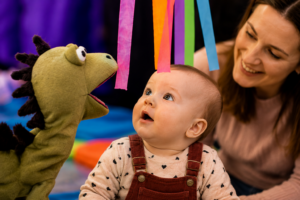
One of the most incredible facts about the first year of life is that your baby’s brain develops at a breathtaking pace.
By the age of three, around 80% of brain development has already taken place, creating millions of neural connections that form the foundations for communication, movement, memory, emotional wellbeing and learning throughout life. That’s why the experiences babies have in these early months matter so much—not because they need formal lessons, but because every loving interaction literally helps build their brain. The Harvard Center on the Developing Child explains beautifully how these everyday experiences shape healthy brain architecture through responsive relationships rather than expensive toys or structured teaching.
That’s quite a responsibility.
But it’s also wonderfully freeing.
Because those brain-building experiences don’t require flashcards or educational apps.
They happen when you smile back at your baby.
When you sing while changing their nappy.
When you read the same story for the twentieth time.
When you cuddle them after a nap.
When you chat to them about absolutely nothing while folding the washing.
If you’ve ever worried you weren’t doing enough, I hope that’s a comforting thought.
You probably already are.
The first year isn’t really about milestones
It’s so easy to become focused on the next big milestone.
The first smile.
The first roll.
The first crawl.
The first word.
They’re exciting because they’re easy to see. They’re the moments family members ask about and the ones we proudly share with grandparents on FaceTime.
But after watching thousands of babies grow through Adventure Babies over the last decade, I’ve realised something.
Milestones are only ever the visible tip of the iceberg.
Underneath every first word are thousands of conversations.
Underneath every first step are months of wriggling, reaching, rolling, balancing and falling.
Underneath every child who loves books is a baby who spent months chewing them, throwing them, patting the pages and listening to someone they adore read That’s Not My Puppy for what feels like the millionth time.
The milestone is simply the moment all of that hidden learning becomes visible.
If you’ve ever worried because your baby isn’t doing something “yet”, our guide to When Do Babies Start Talking? explores why communication develops long before first words, and why there’s so much more happening beneath the surface.
Babies don’t separate learning from living
Adults are brilliant at putting learning into neat little boxes.
Now we’re reading.
Now we’re playing.
Now we’re eating.
Now we’re going for a walk.
Babies don’t see those boxes.
For them, everything is connected.
The walk to the park isn’t separate from language because you’re chatting together as you go.
Snack time isn’t separate from physical development because tiny fingers are learning how to grasp soft banana.
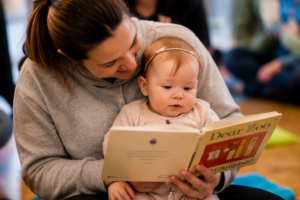
Reading a story isn’t only about books because your baby is watching your facial expressions, listening to the rhythm of your voice, feeling the texture of the pages and making emotional connections with the person holding them.
Every experience overlaps with another.
Every new skill supports the next.
It’s beautifully messy.
And that’s exactly how the developing brain is designed to learn.
The secret ingredient most people overlook? Repetition.
If there is one thing parents often apologise for, it’s reading the same book over and over again.
“They only want Dear Zoo.”
“We’ve read That’s Not My Lion fifteen times today.”
Good.
Honestly.
Keep going.
To adults, repetition feels boring because we already know what’s coming.
To babies, repetition is where learning happens.
Every time they hear the same words, they begin recognising patterns. They start predicting what comes next. They connect sounds with meaning. Their memory strengthens. They notice tiny details they missed yesterday.
Research from the BookTrust shows that sharing books from birth supports language development, attention and emotional bonding, even long before babies understand the words.
So the next time you feel guilty for reading the same story again, remember this:
Your baby isn’t asking for repetition because they’ve run out of imagination.
They’re asking because their brain is busy building pathways.
We’ve written more about this in our blog on Why Babies Love Repetition, because it’s one of the most powerful (and least appreciated) ways babies learn.
Your baby is a tiny scientist
Have you ever wondered why your baby insists on dropping their spoon from the highchair again…
…and again…
…and again?
It probably isn’t because they’re trying to test your patience.
Although, admittedly, it can feel like that.
They’re running an experiment.
Does it always fall?
Does it make the same sound?
Will Mum pick it up again?
What happens if I drop it from this side?
They’re testing theories.
They’re collecting evidence.
They’re discovering gravity months before they ever learn the word.
Scientists call this hypothesis testing.
Babies call it Tuesday.
This curiosity is one of the greatest gifts babies are born with.
Our job isn’t to create curiosity.
It’s to protect it.
Sometimes that means letting them spend ten minutes watching the washing machine go round because, honestly, it’s fascinating if you’ve only been alive for six months.
Sometimes it means accepting that the cardboard box is far more exciting than the expensive toy inside it.
And sometimes it means slowing down enough to let them explore the world at their own pace instead of rushing them on to the next activity.
Why sensory experiences matter so much
One of the biggest misconceptions about baby learning is that babies learn best by being shown things.
Actually, they learn by experiencing them.
Touching.
Listening.
Watching.
Smelling.
Moving.
Feeling.
When babies explore with all of their senses at once, they create richer, stronger connections in the brain.
That’s exactly why every Adventure Babies class brings stories to life with sensory props, music, movement, puppets, textures, lights and shared experiences. We aren’t adding sensory activities because they’re fun (although they absolutely are). We do it because that’s how babies naturally learn best.
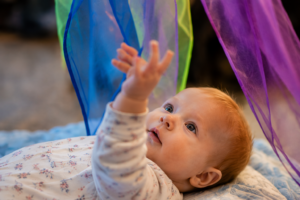
As your baby reaches for scarves floating overhead, splashes through sensory play, listens to different character voices or cuddles into a favourite story, they’re developing communication, attention, memory, motor skills and emotional security all at the same time.
Learning doesn’t happen in separate compartments.
Neither do our classes.
If you’re wondering whether baby classes are worth it, you might also enjoy reading Are Baby Classes Really Good for My Baby’s Development?, where we explore what the research actually tells us.
Sometimes learning looks like doing… absolutely nothing
One of my favourite moments in class is watching a baby who appears completely distracted.
The story is unfolding.
Everyone else is watching the storyteller.
They’re staring at another baby.
Or watching ribbons gently move above their head.
Or completely fascinated by a beam of light.
Parents often lean over and whisper apologetically,
“Sorry… they’re not concentrating today.”
But here’s something fascinating.
Babies don’t learn by focusing on one thing for long periods like adults do.
Their brains are constantly deciding what’s worth investigating next. They move their attention rapidly between faces, sounds, movement and objects, collecting little pieces of information everywhere they look.
According to Speech and Language UK, babies develop communication through warm, responsive interactions and by listening to the conversations happening around them—not through formal teaching.
Sometimes the richest learning happens while your baby simply watches.
If you’ve ever noticed your little one becoming fascinated by other babies, that’s no coincidence either. Watching other children is one of the earliest ways babies begin understanding communication, emotions and social interaction.
Wonder is learning.
Observation is learning.
Even those quiet moments count.
So… how do babies learn?
Not through worksheets.
Not through pressure.
Not through being entertained every waking minute.
Babies learn through loving relationships. Through stories. Through play. Through movement. Through curiosity. Through repetition. Through being talked to, cuddled, listened to and included in everyday life.
Perhaps the biggest surprise is this:
Your baby doesn’t need a perfect childhood.
They simply need enough rich, responsive moments with people who love them.
If that sounds familiar, it’s because it’s exactly what we aim to create every week at Adventure Babies. Our sensory storytelling classes combine the latest understanding of baby development with the simple magic of sharing stories together, giving babies the experiences their growing brains thrive on while helping parents feel confident, connected and supported too.
So the next time you catch yourself thinking, “We haven’t really done much today,” remember this.
If your baby spent the day watching your face, hearing your voice, exploring the world around them and feeling safe in your arms…
They’ve been learning all day long.
Further reading
If you enjoyed this article, you might also like:
Or, if you’d like to experience sensory storytelling for yourself, find your nearest Adventure Babies class and discover why thousands of families choose us to support their baby’s development from birth.