
Why Do Babies Put Everything in Their Mouth? (And Why It’s One of the Cleverest Things They Do)
“Please don’t eat the book.”
It’s probably one of the phrases you’ve said most since becoming a parent.
Closely followed by…
“Not the TV remote.”
“Definitely not the dog’s toy.”
“How did you even find that leaf?”
There comes a point in every baby’s first year when it feels like their entire mission in life is to taste absolutely everything they can get their tiny hands on.
It’s exhausting.
You spend your day rescuing muslins from dribbly mouths, fishing toys out from under the sofa and wondering why the beautiful sensory toy you carefully chose has been completely ignored in favour of chewing the label.
If this sounds familiar, we have some good news.
Your baby isn’t trying to test your patience.
They’re learning.
In fact, putting things in their mouth is one of the smartest, most important ways your baby discovers the world during their first year of life.
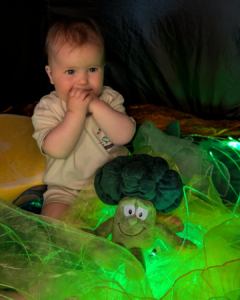
Your baby is conducting hundreds of tiny experiments every day
When we think about learning, we often imagine babies stacking blocks, turning the pages of books or taking their first wobbly steps.
We don’t usually think about chewing.
But before babies can ask questions, point at interesting things or crawl over to investigate every corner of the room, they have one incredible tool for exploring.
Their mouth.
During the first year, your baby’s mouth is one of the most sensitive parts of their whole body. It contains thousands of nerve endings that help them gather detailed information about the objects around them.
To us, a wooden spoon is just a wooden spoon.
To your baby it’s smooth, cool, hard, slightly heavy and surprisingly satisfying to chew.
A crinkly book isn’t just fun because it makes a noise. It feels completely different from a silky scarf. A rubber teether feels different again.
Every texture tells your baby’s brain something new.
Every safe object they explore is another piece of the puzzle helping them understand the world around them.
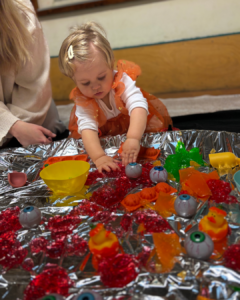
Babies aren’t looking for entertainment. They’re looking for information.
One of the biggest surprises for new parents is realising that babies don’t always play with toys the way we expect them to.
You buy the beautifully designed sensory toy…
…and they spend twenty minutes fascinated by the cardboard box.
You read them a gorgeous new book…
…and they immediately try to chew the corner.
It can leave parents wondering whether they’re doing something wrong.
You’re not.
Your baby simply has different priorities.
Adults often explore with our eyes.
Babies explore with every sense they have.
Looking.
Touching.
Listening.
Smelling.
And yes… tasting.
When babies mouth an object they’re asking questions without using words.
What does this feel like?
Is it soft?
Can I squash it?
What happens if I bite it?
Does it feel different if I hold it another way?
It’s a bit like having a tiny scientist living in your house.
The only difference is that instead of writing down the results, your baby is wiring them into their rapidly developing brain.
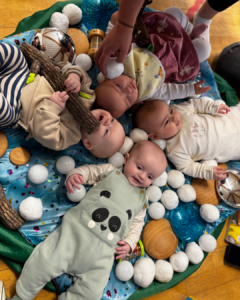
What chewing has to do with brain development
Every time your baby explores a new object, millions of tiny messages travel between their senses and their brain.
Those repeated experiences help build the neural pathways that support learning throughout childhood.
They’re not just discovering textures.
They’re learning how their body works.
How their hands and mouth work together.
How different materials behave.
How to judge pressure.
How to coordinate movement.
It’s all laying foundations for future skills that might seem completely unrelated right now, like feeding themselves with a spoon, turning the pages of a favourite book, holding a crayon or eventually learning to write.
The amazing thing about baby development is that the smallest moments often have the biggest impact.
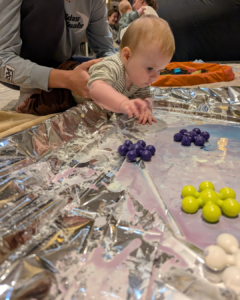
It’s not just about teething
It’s easy to blame everything on teething.
And yes, sore gums can definitely make babies want to chew more.
But babies begin putting objects into their mouths long before many of those first teeth appear.
That’s because curiosity is driving this behaviour just as much as comfort.
Your baby isn’t chewing because they’re bored.
They’re chewing because they’re learning.
That’s why you’ll often notice them carefully examining one object after another, almost as if they’re comparing them.
Because, in a way, they are.
The surprising link between chewing and talking
Here’s something many parents don’t realise.
The muscles your baby is using to suck, chew, blow raspberries and explore objects are the very same muscles they’ll later use for speech.
That doesn’t mean chewing teaches babies to talk overnight, but these early experiences are all part of the remarkable way different areas of development work together.
When you chat about what your baby is exploring—
“That book feels bumpy.”
“Can you hear the crinkle?”
“That spoon is nice and smooth.”
—you’re helping connect sensory experiences with language.
Your baby might not answer yet, but they’re listening.
They’re watching your face.
They’re learning the rhythm of conversation.
This is one of the reasons we spend so much time talking, singing and sharing stories during our Adventure Babies classes. Babies don’t learn language by being taught flashcards. They learn through rich, meaningful experiences with people who are talking, laughing and exploring alongside them.
If you’re interested in how these early experiences support language, have a read of our blog on How Storytime Helps Your Baby’s Brain Grow and our guide to How to Stimulate Your Baby’s Brain, where we explore how simple everyday moments build powerful brain connections.
Why we never worry when babies chew the props
Every week in our Adventure Babies sensory storytelling classes, we watch babies become completely absorbed in exploring a story.
One baby might spend ages stroking a silky scarf.
Another is fascinated by the bubbles.
Someone else is determined to investigate the puppet.
And there’s almost always one little explorer who’s convinced the corner of the sensory book is the most interesting thing in the room.
Parents often laugh and apologise.
“Sorry… she puts everything in her mouth.”
We always smile.
Because she’s doing exactly what babies are supposed to do.
Behind that tiny moment of curiosity is an extraordinary amount of learning.
She’s exploring texture.
Strengthening the muscles in her mouth and hands.
Building sensory pathways in her brain.
Listening to language.
Sharing an experience with the person she loves most.
That’s why our classes aren’t about expecting babies to sit perfectly still and listen to a story from a distance.
We bring stories to life with music, movement, sensory play and beautiful books because that’s how babies naturally learn best—through doing, exploring and experiencing together.
So… should I stop my baby putting things in their mouth?
The short answer is no.
The goal isn’t to stop the behaviour.
The goal is to make it safe.
Choose age-appropriate toys, check them regularly for damage, avoid small objects that could be a choking hazard and always supervise your baby while they play. The NHS has excellent guidance on safe play and your baby’s development, and it’s well worth bookmarking for reassurance as your little one grows.
If you’re ever concerned about your baby’s development or their mouthing behaviour seems unusual, your health visitor or GP will always be happy to advise.
One day, they’ll stop chewing your books…
It doesn’t feel like it now.
Right now you’re probably gently removing another board book from a very determined mouth.
But before long, that same little person will be pointing at the pictures.
Turning the pages themselves.
Finishing your favourite rhymes.
Choosing the same bedtime story every single night.
Those early months of chewing, squeezing, scrunching and exploring aren’t getting in the way of reading.
They’re the very beginning of your baby’s reading journey.
So the next time you catch your baby trying to eat a book, take a breath before you rescue it.
To you, it’s a soggy corner.
To your baby, it’s another wonderful way of discovering the world.
Continue your adventure…
If you’ve enjoyed learning about how babies explore through their senses, you might also like:
- How to Stimulate Your Baby’s Brain
- How Storytime Helps Your Baby’s Brain Grow
- Why Babies Love Repetition (Even When You’re Bored of the Same Book!
If you’d like to see sensory storytelling in action, find your nearest Adventure Babies class and discover how stories, songs, movement and sensory play help babies build a lifelong love of books while supporting every area of their development.
Helpful resources
For more evidence-based advice on your baby’s development and early communication, we recommend: