
How to Stimulate Your Baby’s Brain: The Secret Skill Most Parents Have Never Heard Of
As parents, we’re constantly told about baby milestones.
Rolling.
Sitting.
Crawling.
Walking.
Talking.
But what if I told you one of the most important things happening in your baby’s first year isn’t something you can see at all?
In fact, it’s happening inside their brain every second they’re awake.
And chances are, nobody has ever told you about it.
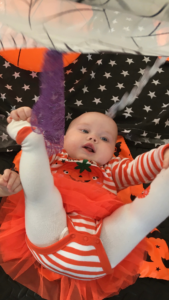
Your Baby Is Becoming a Tiny Scientist
When we think about babies learning, we often imagine them absorbing information like little sponges.
But that’s not quite what’s happening.
Researchers now understand that babies are actually more like scientists.
From the day they’re born, they’re constantly making predictions about the world around them.
What will Mum’s face do next?
What sound comes after this song?
What happens when I shake this toy?
What comes next in this story?
Their brain is continually asking:
“What do I think is about to happen?”
Then comparing that prediction to what actually happens.
This process is one of the most important foundations of baby brain development.
Why Prediction Matters More Than You Think
Every time your baby correctly predicts something, their brain strengthens important neural connections.
These predictions help build:
- Language skills
- Memory
- Attention
- Emotional security
- Social understanding
- Problem-solving abilities
In other words, your baby isn’t just learning facts.
They’re learning how the world works.
And the more predictable and meaningful experiences they have, the more opportunities their brain has to build these powerful connections.
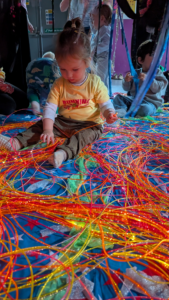
This Is Why Babies Love Repetition
Many parents worry their baby must be bored.
The same book.
The same song.
The same game.
Again.
And again.
And again.
But here’s the surprising truth:
Your baby isn’t asking for repetition because they’ve run out of ideas.
They’re asking for repetition because their brain is learning.
The first time they hear a story, they’re taking it all in.
The fifth time, they’re starting to recognise patterns.
The tenth time, they’re predicting what comes next.
And every successful prediction gives their developing brain valuable information.
So if your baby insists on hearing the same story for the twentieth time this week?
That’s not a parenting failure.
It’s brain development in action.
Why Stories Are So Powerful For Baby Development
Stories are prediction-making machines.
A familiar rhyme has a rhythm your baby begins to anticipate.
A favourite book has pages they start to recognise.
A repeated phrase creates excitement as they learn what’s coming next.
Long before babies can speak, they are actively participating in stories through attention, memory and prediction.
This is one reason reading from birth is so valuable.
It’s not about teaching babies to read.
It’s about helping them build the brain architecture that will support learning for years to come.
If you’d like to learn more, read our guide to why reading to your baby from birth matters.
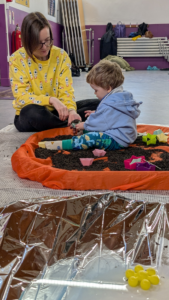
The Hidden Power of Sensory Experiences
Here’s where things become even more exciting.
When stories are paired with sensory experiences, babies receive information through multiple pathways at once.
They hear.
They see.
They touch.
They move.
They explore.
This creates rich opportunities for the brain to connect ideas and make sense of the world.
A baby hearing about snow while feeling a soft sensory material.
A baby listening to animal sounds while seeing visual props.
A baby experiencing movement, music and storytelling together.
These aren’t just fun moments.
They’re meaningful learning experiences.
What This Means For Parents
The good news?
You don’t need expensive toys.
You don’t need complicated activities.
You don’t need to turn your home into a nursery classroom.
Some of the most powerful things you can do are beautifully simple:
Read books together.
Sing songs repeatedly.
Play peekaboo.
Talk about your day.
Share sensory experiences.
Respond to your baby’s attempts to communicate.
The magic isn’t in doing more.
It’s in creating meaningful moments that your baby’s brain can learn from.
For more simple ideas, explore our collection of baby development articles and parent resources.
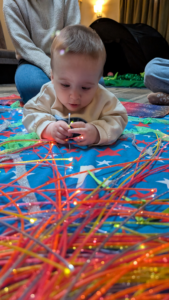
Why We Created Adventure Babies
At Adventure Babies, everything we do is built around how babies actually learn.
Our sensory storytelling baby classes aren’t designed simply to entertain babies for an hour.
They’re designed to immerse babies in rich, multi-sensory experiences that support language development, attention, memory, social connection and curiosity.
We combine books, music, movement and sensory play because we understand that learning isn’t happening in isolated parts of the brain.
It’s happening through experiences.
And when babies are captivated by a story, exploring new textures, listening to language and sharing special moments with their grown-up, something remarkable is happening beneath the surface.
Their brains are building the foundations for future learning.
One magical story at a time.
If you’d like to experience this for yourself, you can find your nearest Adventure Babies class here.
What The Experts Say
This understanding of baby development is supported by leading child development research.
The Harvard Center on the Developing Child explains that early experiences build the architecture of the developing brain, creating the foundations for future learning, behaviour and health.
Similarly, the NHS Start for Life highlights the importance of talking, reading, singing and playing with babies from birth to support healthy development.
The National Literacy Trust also emphasises that sharing books and stories with babies supports communication, language and emotional development long before children learn to read independently.
The Takeaway
If you’ve ever wondered how to stimulate your baby’s brain, the answer may be simpler than you think.
You don’t need flashcards.
You don’t need educational gadgets.
You don’t need to constantly introduce something new.
What your baby needs most are meaningful, repeated, engaging experiences with the people who love them.
Because while it may look like you’re “just” reading a story…
Your baby is busy predicting, learning and building a brain.