Messy Play for Babies: Why It Matters (Even If You’d Rather Not Do It at Home)
Why messy play for babies feels like a good idea… until you think about the clean-up
Most parents don’t need convincing that messy play for babies is “good for development.”
The problem is usually what comes after.
The glitter in the carpet. The paint on the sleeves. The yoghurt in places yoghurt should absolutely never be.
So it’s no surprise that while messy play shows up in every parenting article and baby development guide, it doesn’t always make it into real life at home.
And honestly? That makes complete sense.
Because parenting a baby is already full enough without adding a full-scale sensory explosion in your living room.
But here’s the thing—babies don’t just like messy play. They need it.
The benefits of messy play for baby development (what’s actually happening underneath the mess)
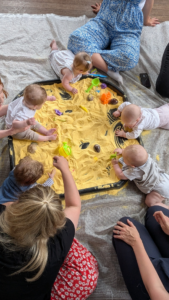
When we talk about messy play for baby development, we’re really talking about how babies learn about the world.
Everything is new to them—texture, temperature, resistance, movement. When they squish, splash, smear or grab something unfamiliar, they’re not just “playing”… they’re building their brain.
Each sensory experience helps strengthen neural connections linked to:
- Problem solving
- Fine motor skills
- Curiosity and exploration
- Early language development (yes—even before words come)
It’s not about the mess itself. It’s about the information their brain is collecting through their senses.
But knowing that doesn’t suddenly make your kitchen floor easier to clean.
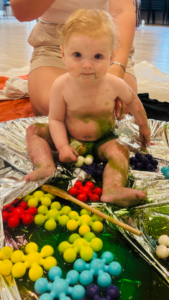
Why messy play at home doesn’t always happen (and why that’s normal)
There’s a big gap between intention and reality here.
At home, messy play requires:
- Preparation
- Supervision
- Containment strategy (sometimes optimistic)
- And a level of post-play energy most parents simply don’t have
So even though it sounds like something you “should” be doing, it often ends up on the list of things that get postponed until “later” (which usually means never this week).
And that can leave parents feeling like they’re missing something important.
You’re not.
It just means the environment matters more than the activity itself.
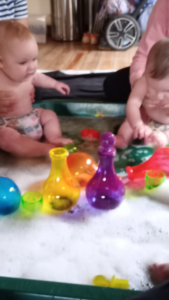
Why babies engage more in messy play in group baby classes
Something really interesting happens when babies are in a different space.
In a group setting, messy play becomes less about “what is this chaos?” and more about curiosity.
They watch other babies. They mirror behaviour. They test reactions in a safe, supported environment. And most importantly—they feel free to explore without the usual home boundaries.
This is where sensory storytelling baby classes, like those at Adventure Babies, really come into their own.
Because the experience isn’t just about the materials—it’s about:
- The story that frames the play
- The shared environment
- The calm confidence of being in a group of other parents who are all in the same stage of life
You can explore more about how sensory storytelling supports early development here
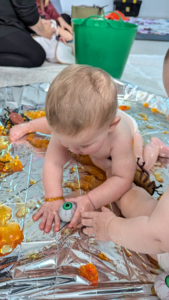
Messy play for babies without the stress (and without your living room looking like a crime scene)
This is usually the turning point for parents.
It’s not that they don’t want to do messy play.
It’s that they don’t want the version that comes with three loads of laundry and a mop bucket.
That’s where group sensory baby classes change things.
At Adventure Babies, messy play isn’t an “extra activity”—it’s part of a guided experience where everything is prepared, contained, and designed for babies to explore freely.
You get all the developmental benefits:
- Sensory exploration
- Motor skill development
- Social awareness
- Early communication cues
Without needing to set it up… or clear it up afterwards.
It also tends to shift something for parents too. Instead of managing the mess, they get to actually watch the learning happen.

Why messy play in baby classes also helps parents (not just babies)
There’s something really powerful about being in a space where you’re not the only one dealing with the chaos of early parenting.
In group baby classes, messy play becomes shared. Normal. Even fun.
Parents chat. Babies explore. And nobody is worrying about the state of the rug at home.
That sense of community is often what keeps families coming back week after week—not just the activities themselves.
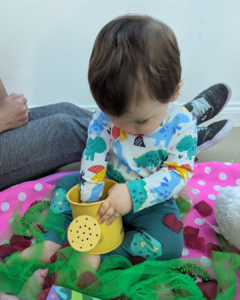
Final thoughts: messy play doesn’t have to happen at home to matter
If messy play feels overwhelming at home, that doesn’t mean your baby is missing out.
Because at this stage, it’s not about doing everything perfectly.
It’s about giving your baby experiences that help them explore, learn, and connect with the world around them.
And if someone else can handle the clean-up? Even better.