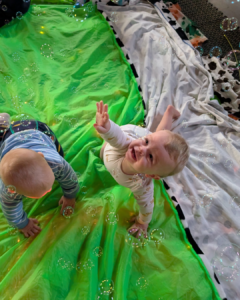
Why Your Baby Plays Differently Around Other Babies (And Why It Matters)
When do babies interact with each other? It’s a question most parents don’t think to ask until they’re in a room watching it unfold in real time.
Because at home, everything feels familiar. You know your baby’s rhythm, what they like, what they avoid, how they play. Then you step into a group setting—like an Adventure Babies class—and suddenly they seem different. Quieter. More watchful. Sometimes more adventurous than you’ve ever seen them before.
And it can be hard to work out what that actually means.
The truth is, interaction between babies doesn’t start with sharing or playing together in the way adults expect. It starts much earlier, in small, almost invisible moments of awareness, curiosity, and observation.
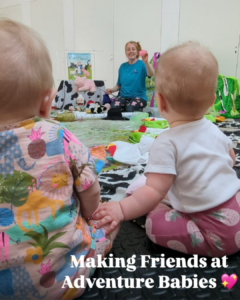
When do babies interact with each other? It begins with watching, not playing
Most real interaction between babies develops far later than people imagine. But the foundations start surprisingly early.
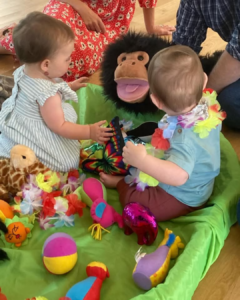
In a group like an Adventure Babies session, you’ll often see babies sitting side by side doing very different things—but constantly aware of each other.
One baby might be focused on a sensory prop. Another might be watching them more than the activity itself. There’s no obvious “playing together” happening, but there is something important happening underneath it: recognition.
They’re beginning to understand that other babies are separate people who act, react, and explore in ways worth paying attention to.
This stage—often called parallel awareness—is the quiet starting point of social development. And it’s easy to underestimate because it doesn’t look like interaction yet.
But it is.
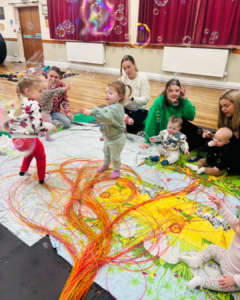
Why babies behave differently around other babies
One of the most consistent things you notice in baby classes is that babies will often try something new only after seeing another baby do it first.
Something they’ve ignored at home suddenly becomes interesting. Something they’ve avoided gets a cautious touch. Not because the activity has changed—but because the context has.
Another baby makes it feel safe enough to try.
You can almost see the internal process: watch, pause, check in, reach out, retreat, try again.
It’s subtle, but it’s powerful. And it’s one of the earliest forms of social learning in action.
This is where group environments like Adventure Babies really matter—not because they force interaction, but because they create the conditions where curiosity naturally overrides hesitation.
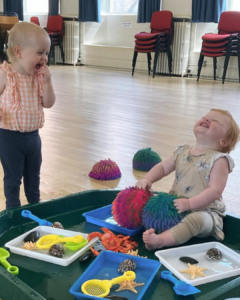
From watching to joining in: how interaction actually builds
When you observe babies over time in a consistent group, a pattern starts to emerge.
At first, it’s all observation. Then comes interest—leaning forward, shifting position, tracking movement. Then comes experimentation: a touch, a reach, a brief moment of engagement before retreating again.
And gradually, those moments start to connect.
What began as watching slowly becomes participation.
This is the real beginning of interaction—not sudden, not forced, but layered and gradual.
And it’s exactly what makes environments like Adventure Babies so valuable. Babies aren’t just experiencing activities—they’re experiencing them alongside other babies, which changes how they process and respond to everything.
Why this matters for babies and parents
For babies, these early group experiences support far more than social skills. They build confidence, curiosity, and flexibility. They help babies understand that the world isn’t just predictable and familiar—it’s shared, responsive, and full of other people to notice and learn from.
But the impact isn’t only on babies.
Parents often tell us they see their child differently after attending classes. You notice things you don’t always see at home: patience, persistence, hesitation, boldness. You start to understand their personality a bit more clearly, rather than focusing only on milestones or comparisons.
And just as importantly, it gives parents space to connect too. To step out of the day-to-day bubble and share experiences with others who are in exactly the same stage of life.
That combination—baby development and parent connection—is what makes group experiences so powerful.