
Crossing the Midline: The Tiny Movement That Builds Your Baby’s Brain
There’s a small, almost unnoticeable movement your baby makes that has a surprisingly big impact on how their brain develops.
It’s not a milestone you’ll see on a checklist.
It’s not something people tend to talk about at baby groups.
But it matters.
A lot.
It’s called crossing the midline—and once you know what to look for, you’ll start seeing it everywhere.
What Does “Crossing the Midline” Actually Mean?
Imagine an invisible line running straight down the centre of your baby’s body—from the top of their head, down their nose, chest and tummy.
Crossing the midline is what happens when your baby reaches across that line.
For example:
-
Reaching their right hand over to grab something on the left
-
Rolling their body from one side to the other
-
Bringing one hand across to explore the opposite side of their body
It sounds simple. And it is.
But inside your baby’s brain, it’s doing something incredibly important.
Why This Tiny Movement Matters So Much
When your baby crosses the midline, both sides of their brain—the left and the right hemispheres—have to communicate.
That communication is what helps build:
-
coordination
-
balance
-
body awareness
-
and later on… skills like reading and writing
According to the NHS, early movement experiences play a key role in shaping how the brain develops and connects.
And organisations like the National Institute of Child Health and Human Development highlight how physical movement supports cognitive development in early childhood.
So when your baby reaches across their body, it’s not just a physical milestone.
It’s a neurological one.
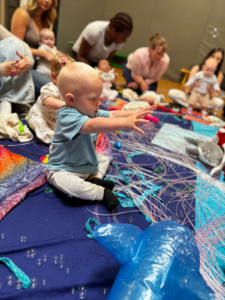
What It Looks Like in Everyday Baby Life
This isn’t something you need to “teach” in a formal way.
In fact, it often shows up naturally in play.
You might notice your baby:
-
twisting to reach a toy just out of reach
-
rolling from back to tummy
-
passing objects from one hand to the other
-
reaching across themselves during tummy time
These moments can look small. Easy to miss.
But they’re building the pathways your baby will later use for more complex skills.
The Link to Reading, Writing and Coordination
This is the part most parents never get told.
Crossing the midline is directly linked to skills your child will use years down the line.
Things like:
-
tracking words across a page when reading
-
using both hands together (one stabilising, one writing)
-
coordinating movements smoothly and efficiently
Without strong communication between both sides of the brain, these tasks can feel harder.
That’s why these early movements matter so much—they lay the groundwork long before formal learning begins.

Why Floor Play Is So Powerful
In a world of containers, seats, and structured setups, one of the most valuable things you can give your baby is space to move freely.
Because crossing the midline doesn’t happen when a baby is restricted.
It happens when they can:
-
twist
-
reach
-
roll
-
stretch
-
explore
Floor play gives your baby the freedom to discover their body—and how it moves across space.
And it doesn’t need to be complicated.
In fact, simple is often best.
How Sensory Play Naturally Encourages Midline Crossing
This is where sensory play becomes incredibly powerful.
When something interesting is placed just slightly out of reach—something textured, colourful, or intriguing—your baby is motivated to move towards it.
To reach.
To stretch.
To cross their body.
They’re not being “taught.”
They’re being invited.
At Adventure Babies, this is something we weave into our classes without it ever feeling forced.
Through sensory storytelling, babies are naturally encouraged to:
-
reach across their bodies for props
-
move between positions
-
explore textures placed intentionally within their space
It’s all carefully designed so that these important movements happen organically—within a calm, engaging, and developmentally supportive environment.
If you’d like to experience this in person, you can find your nearest class here:
The Power of Reaching (More Than You Think)
When your baby reaches across their body for something, they’re doing more than grabbing a toy.
They’re:
-
strengthening connections between brain hemispheres
-
building coordination and control
-
developing spatial awareness
-
preparing for future learning skills
It’s a tiny action with a big impact.
If you’re interested in how movement links to wider development, you might also enjoy:
Simple Ways to Encourage Crossing the Midline at Home
You don’t need special equipment or complicated activities.
Just small tweaks to how you play:
Place toys slightly to one side rather than directly in front
Encourage reaching across the body during play
Give plenty of time for tummy time and floor exploration
Use sensory items that spark curiosity and movement
And most importantly—give your baby time.
These movements develop naturally when they have the opportunity to explore.
FAQs: Crossing the Midline in Babies
What is crossing the midline in babies?
It’s when a baby moves a hand, arm, or leg across the centre of their body, helping both sides of the brain work together.
Why is crossing the midline important?
It supports coordination, balance, and communication between brain hemispheres—key for later skills like reading and writing.
When do babies start crossing the midline?
It often begins in early infancy and develops over time through rolling, reaching, and play.
How can I encourage my baby to cross the midline?
Through simple floor play, placing toys to one side, and offering engaging sensory experiences that encourage reaching.
Do baby classes help with this?
Yes—especially classes that encourage movement, exploration, and sensory interaction in a structured but gentle way.
The Takeaway
Crossing the midline might be a small movement.
But it’s building something big.
Every reach across the body, every twist, every stretch…
Is helping your baby’s brain connect, coordinate, and prepare for what comes next.
And the best part?
It happens through something as simple—and joyful—as play 💛