
Why Babies Love Predictable Patterns (And Why It Helps Their Brain Grow)
There’s a moment most parents recognise—but don’t always understand.
You stack the cups.
Your baby knocks them down.
You stack them again.
They knock them down again.
And again.
And again.
At some point, you find yourself wondering… is this doing anything?
The answer is yes.
This is your baby’s brain at work—building one of the most important skills they will ever develop: pattern recognition.
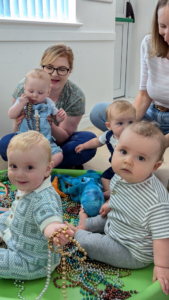
The Real Reason Your Baby Repeats the Same Play
From the outside, it can look like babies are stuck in a loop. The same game. The same action. The same outcome.
But inside their brain, something far more sophisticated is happening.
Your baby is asking:
-
What happens if I do this?
-
Does it happen the same way every time?
-
Can I predict it?
And when the answer is yes?
That’s when learning locks in.
Repetition in play isn’t about entertainment. It’s about testing and confirming patterns—the building blocks of how your baby will eventually understand language, solve problems, and even grasp early maths concepts.
Research from the Harvard University Center on the Developing Child shows that repeated experiences strengthen neural connections in the brain. In simple terms, the more predictable something is, the easier it is for your baby to understand and remember it.
So when your baby drops the spoon for the tenth time, they’re not being cheeky.
They’re running an experiment.

From “Again!” to Understanding the World
What makes repetition so powerful isn’t just the action—it’s the predictability.
Let’s go back to those stacking cups.
The first time they fall, it’s surprising.
The second time, it’s interesting.
By the fifth or sixth time, your baby starts to anticipate what will happen.
And that anticipation is everything.
Because it means your baby has:
-
Noticed a pattern
-
Stored it in their memory
-
Begun to predict the outcome
That ability to predict is a huge cognitive leap. It’s the beginning of understanding cause and effect, sequence, and logic.
It’s also why babies often show excitement just before something happens—the little kick of their legs, the pause before they knock the tower, the look they give you as if to say, “watch this…”
They already know.
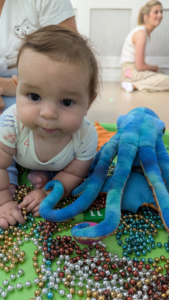
Why This Matters More Than You Think
Pattern recognition might sound like something reserved for later learning—numbers, reading, problem solving.
But it starts here.
In these small, repetitive, everyday moments.
When your baby learns that:
-
dropping something makes it fall
-
shaking something makes a sound
-
pushing something makes it move
…they are beginning to understand how the world works.
Over time, these patterns become more complex.
This is what eventually supports:
-
language (recognising sound patterns and rhythms)
-
memory (recalling familiar sequences)
-
attention (focusing on what’s predictable)
-
logical thinking (understanding what comes next)
It all builds from these early, repeated experiences.

The Link Between Repetition and Confidence
There’s another layer to this that often gets missed.
Repetition doesn’t just build understanding—it builds confidence.
When something happens the same way again and again, your baby starts to feel secure. The world becomes a little more predictable. A little less overwhelming.
They begin to trust their own expectations.
And that confidence encourages them to explore further.
It’s the difference between:
-
a baby who hesitates because everything feels new
-
and a baby who leans in because they recognise what’s happening
That sense of “I know this” is incredibly powerful.
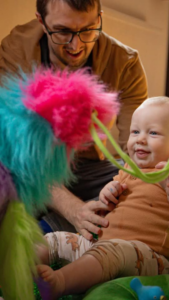
Why Playing the Same Way Beats Doing Something New
We live in a world that quietly tells parents to keep things fresh. New toys. New activities. More stimulation.
But your baby doesn’t need constant novelty.
In fact, too much change can make it harder for them to spot patterns at all.
Because patterns rely on something staying the same.
When play is repeated—when the same action leads to the same result—your baby’s brain has the chance to:
-
notice
-
process
-
remember
-
predict
Without that consistency, everything becomes noise.
This is why simple, repetitive play is often far more valuable than something complicated or “busy.”
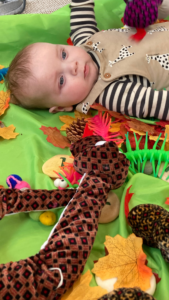
How Sensory Play Strengthens These Patterns
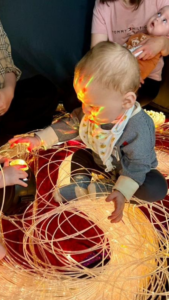
When repetition is combined with sensory experiences, something even deeper happens.
Your baby isn’t just seeing a pattern—they’re feeling it, hearing it, experiencing it with their whole body.
Think about:
-
the rhythm of pouring and scooping
-
the sound of objects tapping together
-
the feel of different textures explored in the same way
These layered experiences help strengthen the pattern in multiple areas of the brain.
It becomes richer. More memorable. More meaningful.
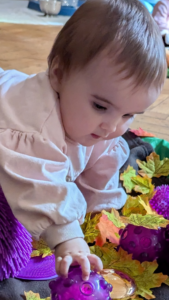
Where Adventure Babies Classes Come In
This is exactly why our classes are designed the way they are.
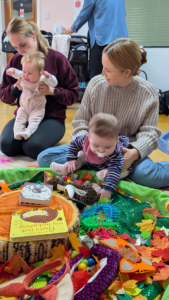
At Adventure Babies, we don’t just offer activities—we create structured, repeatable experiences where babies can begin to recognise patterns across play, sensory exploration, and storytelling.
The rhythm of the class, the familiar elements, the repeated interactions… they all help your baby feel safe enough to:
-
notice what’s happening
-
anticipate what’s coming next
-
and build those all-important brain connections
Parents often tell us their babies become more engaged, more responsive, and more confident—and this is why.
It’s not just the activity.
It’s the pattern within it.
If you’d love to experience this for yourself, you can find your nearest class here:
What This Looks Like at Home
Once you see it, you can’t unsee it.
The repeated dropping, banging, stacking, pouring, opening, closing…
It’s not random.
It’s your baby learning:
-
what happens
-
that it happens again
-
and that they can predict it
So instead of feeling like you need to move them on or introduce something new, you can pause.
Let them repeat it.
Let them explore it fully.
Let them finish the pattern.
Because in those moments that feel small—or even a little bit tedious—
Your baby is building the foundations of how they will think.
FAQs: Baby Brain Patterns & Repetitive Play
Why does my baby repeat the same play over and over?
Because repetition helps them recognise patterns, understand cause and effect, and build memory.
Is repetitive play important for brain development?
Yes—it’s one of the key ways babies develop cognitive skills like prediction, problem solving, and attention.
Should I introduce new activities to keep my baby learning?
New experiences are great, but they should be balanced with repetition. Too much novelty can make it harder for babies to process patterns.
How does this link to learning later in life?
Pattern recognition underpins skills like language, reading, maths, and logical thinking.
Are structured classes helpful for this?
Yes—especially when they include repetition, rhythm, and predictable experiences that support pattern recognition.
The Takeaway
When your baby does the same thing over and over again…
They’re not stuck.
They’re not bored.
They’re not “just playing.”
They’re discovering patterns.
And in doing that, they’re learning how the world works—one repeat at a time 💛