The Hidden Brain Skill Babies Use When They Watch Your Face
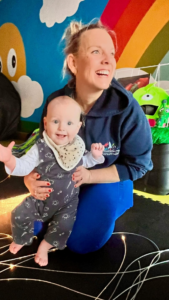
Have you ever noticed how your baby looks intently at your face?
Not just a glance — a deep, focused, almost studying kind of stare.
It might feel like they’re just being curious (or adorable), but something much more powerful is happening.
Your baby is learning one of the most important skills they will ever develop: how to communicate.
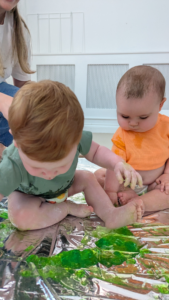
Why Babies Stare at Faces So Intensely
From birth, babies are naturally drawn to faces. In fact, faces are one of the most important learning tools your baby has.
When your baby looks at you, they’re not just looking — they’re analysing.
They are:
- watching how your mouth moves
- noticing changes in your expression
- tracking your eyes
- connecting your voice to your face
This process is sometimes described as “micro facial tracking”, and it plays a key role in baby communication development.
Your baby is learning how humans interact — long before they can join in.
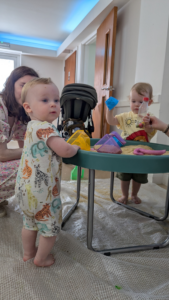
The Hidden Skill: Micro Facial Tracking
Micro facial tracking is the brain’s way of breaking down tiny movements in the face.
Your baby is learning to:
- match sounds to mouth shapes
- recognise emotional expressions
- understand the rhythm of speech
- predict reactions
This is one of the earliest building blocks of social development in babies.
- It helps them begin to understand:
- what a smile means
- what different tones of voice feel like
- how communication flows back and forth
How Facial Mimicry Builds Early Communication
Have you ever noticed your baby trying to copy your expression?
- sticking their tongue out
- opening their mouth
- widening their eyes
This is called facial mimicry, and it’s a crucial step in learning to communicate.
When babies mimic faces, they are:
- practising movement needed for speech
- learning cause and effect (“I do this, you respond”)
- building early social interaction skills
These tiny interactions are the beginning of conversation.
Before words, there is connection.
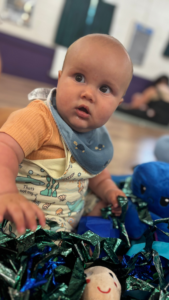
Eye Contact: The Foundation of Communication
Eye contact might feel simple, but for babies, it’s a powerful learning tool.
When your baby makes eye contact, they are learning:
- how to take turns in interaction
- how to focus on another person
- how to read social cues
This is known as serve and return interaction, where your baby “serves” a look, sound, or expression — and you respond.
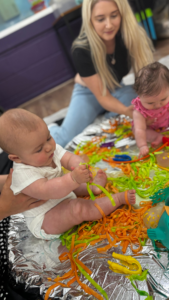
The Link Between Faces, Storytelling, and Language Learning
One of the most powerful ways to support baby communication development is through face-to-face storytelling.
When you read or tell a story, your baby is:
- watching your mouth form words
- noticing changes in tone and expression
- linking sounds to meaning
- learning the rhythm of language
This is why expressive reading is so important.
It’s not just about the words — it’s about how you say them.
Your face becomes part of the story.
Why This Matters More Than You Think
It’s easy to assume communication starts with first words.
But in reality, it begins here:
- in eye contact
- in shared smiles
- in copied expressions
- in quiet moments of watching and learning
These early interactions shape your baby’s:
- communication skills
- emotional understanding
- social confidence
- language development
How Adventure Babies Classes Support This Development
At Adventure Babies, we don’t just read stories — we bring them to life.
Our classes are designed to support baby communication development through:
- expressive, face-to-face storytelling
- exaggerated facial expressions
- songs, rhythm, and repetition
- close interaction between parent and baby
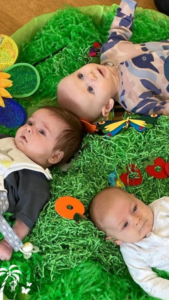
During sessions, babies naturally engage in micro facial tracking, watching and learning from both the storyteller and their parent.
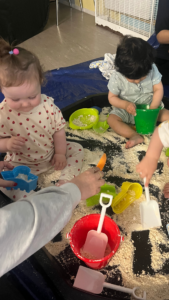
Combined with gentle sensory play, this creates a rich environment for:
- communication development
- social interaction
- early language learning
- And just as importantly, it creates beautiful moments of connection between you and your baby.
Find your nearest Adventure Babies class and experience the magic of storytelling together.
Frequently Asked Questions
Why does my baby stare at my face so much?
Babies stare at faces because they are learning how to understand emotions, sounds, and communication. Faces provide rich information that helps their brain develop.
What is facial mimicry in babies?
Facial mimicry is when babies copy expressions, such as smiling or sticking out their tongue. This helps them practise communication and social interaction skills.
Is eye contact important for babies?
Yes. Eye contact helps babies learn how to connect, communicate, and take turns in interaction, which are key foundations for language development.
Does talking face-to-face help babies learn to talk?
Absolutely. Seeing your face while you speak helps babies connect sounds, expressions, and meaning, supporting early speech development.
How can I support my baby’s communication development?
You can support your baby by:
- making eye contact
- talking and singing regularly
- using expressive facial expressions
- reading face-to-face
These simple interactions have a powerful impact on development.
Do baby classes help with communication development?
Yes. Baby classes that include interactive storytelling, songs, and face-to-face engagement can support communication and social development.
Adventure Babies classes are designed to nurture these skills in a fun, engaging, and supportive environment.