Why Is My Baby Completely Obsessed With Mirrors? (And Why That’s Brilliant for Their Development!)
If you’ve ever tried to get yourself ready in the morning with a baby on your hip, you’ll know exactly how magnetic mirrors are to tiny humans. One glimpse of their own little face and suddenly you’re invisible—move over Mum, there’s a new favourite in town.
But here’s the good news: your baby’s mirror obsession is actually incredible for their development. And at Adventure Babies, we use mirrors and reflective play in ways that spark curiosity, confidence and connection—all wrapped up in our magical storytelling sessions.
Let’s dive into what’s really going on when your baby locks eyes with… well… themselves.
✨ 1. It’s a Sensory Powerhouse
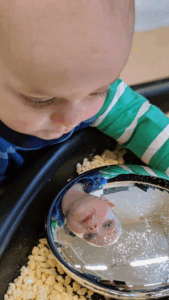
For babies 0–1, mirrors are like a sensory theme park.
Shiny? Tick. High-contrast? Tick. Moves when they move? Double tick.
They’re learning cause and effect—“If I wiggle, that other baby wiggles too!”—which is a huge early cognitive skill.
If you want to geek out on how babies build brain connections through sensory input, the Harvard Center on the Developing Child has a brilliant explainer on early brain development:
https://developingchild.harvard.edu/science/key-concepts/brain-architecture/
✨ 2. Early Social Skills Start in the Mirror
It might look like vanity (fair enough), but your baby is actually developing the foundations of:
-
Emotional recognition
-
Social responsiveness
-
Turn-taking
-
Eye contact
They’re not thinking, “I look great today,” just yet. But they are beginning to understand faces, feelings, and interaction—even if it’s with the cutest playmate they know.
✨ 3. Mirror Play Helps With Tummy Time (Even When They Hate It)
Pop a mirror in front of a tummy-time refusenik and suddenly it’s:
“Oh hey! Who’s that gorgeous baby? I’ll stay here a bit longer…”
Holding up their head to see more helps strengthen the neck, shoulders and core—vital building blocks for rolling, sitting, crawling and eventually walking.
You’ll see mirror play woven into many of our Adventure Babies classes for exactly this reason. Babies will do anything for a glimpse of themselves mid-wiggle.
✨ 4. Storytelling + Mirrors = Mind-Blowing for Little Brains
Add a mirror into a story and babies go from “interested” to “fully enthralled.”
Hold up a mirror during a peekaboo moment, a character reveal, or a sensory scene and suddenly your baby is in the story.
It supports:
-
Early language development
-
Narrative understanding
-
Memory building
-
Attention span (the holy grail!)
It also makes for some truly adorable reactions—our class leaders have seen babies try to kiss the “other baby” during a story. Ten out of ten, no notes.
✨ 5. It Builds Confidence
As babies grow, they start to realise:
“Hang on… that baby is me.”
This is called self-recognition, and it’s a major milestone that supports independence, emotional development and body awareness.
They’re learning:
-
“This is my face.”
-
“These are my hands.”
-
“These are my expressions.”
Before long they’ll be pulling faces at themselves like a tiny comedian.
✨ So Should You Encourage Mirror Play at Home? Absolutely.
You don’t need anything fancy. A baby-safe mirror works wonders during:
-
Tummy time
-
Sitting-up practice
-
Bathtime
-
Sensory play
-
Storytime (bonus points!)
And if you want inspiration for structured, developmentally rich mirror moments, you’ll see lots of reflective sensory fun woven into Adventure Babies classes.
Because when babies see themselves, they also start to see the world—and we’re here to make that world magical, playful and full of stories.