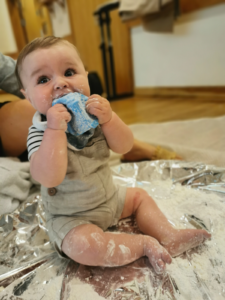
Why Everything Goes Straight Into Your Baby’s Mouth
You offer your baby a carefully chosen toy. They look at it, grab it and immediately try to eat it.
Next comes their fist. Then your sleeve. Given half a chance, your phone would join the tasting menu too.
If you’ve wondered, “Why does my baby put everything in their mouth?”, you’re watching a familiar part of early development. Babies use their mouths to explore, alongside their eyes and hands. That rather soggy toy is giving them something to investigate.
Here’s what’s happening behind all the dribble, and how you can support their curiosity safely.
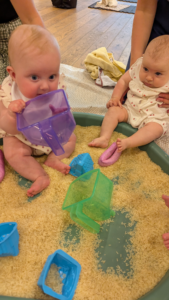
Their mouth helps them discover what things feel like
Imagine meeting an object you’ve never seen before. You might turn it over, squeeze it or run your fingers across its surface.
Your baby has plenty of questions too. However, their hands are still learning how to investigate.
Bringing a suitable toy to their mouth gives them another way to explore its texture and shape. Looking, touching and mouthing all contribute to those early discoveries.
Somerset NHS guidance on developing play describes how babies first explore objects through their hands, mouths and watching other people. Mouthing forms part of play itself.
That wobbly journey to their mouth takes practice
Watch your baby reach for a toy and try to bring it towards their face. There might be a few detours via their cheek or nose.
Even a simple movement involves several steps. They need to notice the object, reach towards it, hold on and guide their hand.
For many babies, mouthing becomes especially noticeable between three and six months, as reaching and grasping develop. The timing varies, so there’s no need to compare your baby’s technique with the determined toy-taster next to you. NHS guidance for three to six months includes putting things in the mouth as a way to explore.
That repeated reach, grab and mouth sequence gives them plenty of practice.
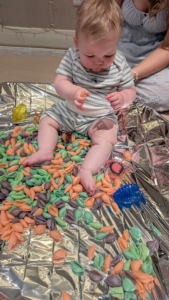
Why does my baby put everything in their mouth when they aren’t teething?
Because exploring and teething can look surprisingly similar.
Chewing can accompany teething, but a toy heading towards your baby’s mouth doesn’t automatically mean a tooth will appear tomorrow. Babies also mouth objects simply to investigate them.
It helps to consider the wider picture. Are their gums sore or red? Have you noticed other changes? The NHS guide to teething symptoms explains what to look for and reminds parents that timing varies.
You don’t need to predict the arrival of every tooth. Sometimes a baby finds a toy interesting enough to investigate again. And again.
Chewing their fists doesn’t mean they need solids
This can cause real confusion, especially when someone says, “Look at them eating their hands! They must be ready for food.”
Fist-chewing alone doesn’t show that your baby needs solids.
The NHS recommends starting solid foods from around six months, when three signs appear together. Your baby should stay sitting with a steady head, coordinate their eyes, hands and mouth to bring food to their mouth, and swallow food rather than push it back out.
You can read more in the NHS guide to your baby’s first solid foods. Until those signs come together, enthusiastic hand-chewing doesn’t need to trigger an early weaning plan.
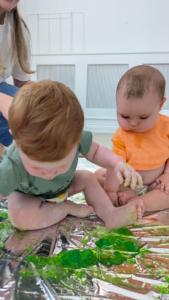
How can I let my baby explore safely?
Once you understand why babies mouth objects, the aim becomes clearer: give them suitable things to explore and keep hazards out of reach.
Choose toys that suit your baby’s age and that the manufacturer identifies as suitable for mouthing. Check them regularly for damage, loose pieces or filling that could escape.
A quick floor check helps too, especially when older children share the space. Coins, buttons and small toy parts can easily disappear beneath furniture before a baby discovers them.
Keep button batteries, small magnets and toys intended for older children well away. The NHS baby and toddler safety guide explains these risks and offers practical ways to reduce them. Stay close during play; supervision works alongside choosing safe objects.
If your baby reaches for something unsuitable, calmly remove it and offer a suitable alternative. Curiosity doesn’t need a telling-off.
Make room for simple, unhurried play
You don’t need a huge collection of toys to make this stage interesting.
Offer one or two suitable objects and give your baby time to investigate. They might look, grip, mouth, drop and reach again. There’s no need to hurry them towards the next activity.
Try describing what holds their attention: “You’ve got the bumpy ring,” or, “That feels soft.” Leave little pauses for their expressions and sounds.
Perhaps you pictured shaking a rattle together, while your baby has other plans for it. That’s fine. Following their interest can make play feel easier for both of you.
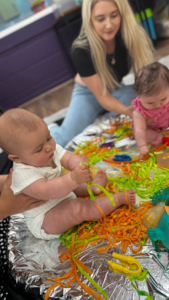
What does this look like at Adventure Babies?
At Adventure Babies sensory storytelling classes, we bring stories to life through sensory experiences, props and opportunities to explore.
A baby doesn’t need to follow a whole plot to take part. A voice, a movement or an interesting texture can capture their attention. Our classes give parents and babies shared experiences to enjoy, with room for different stages of development.
You can discover more about Adventure Babies and our approach to storytelling, play and connection. There’s also the welcome chance to meet other parents who understand just how much discussion one small person’s dribble can generate.
What if my baby doesn’t mouth many toys?
Babies vary in how they explore. Some spend longer watching before they reach; others investigate with their hands first.
Offer suitable objects without pushing anything into their mouth. If you have concerns about their reaching, grasping, feeding or wider development, speak to your health visitor. You can ask for advice without waiting for a routine review.
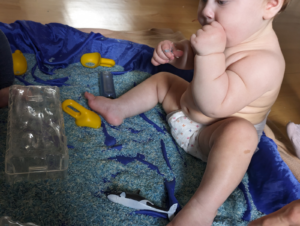
A soggy toy can tell quite a story
So, why does my baby put everything in their mouth? Often, they’re using the skills available to them to find out about the world.
That small, familiar action can involve curiosity, reaching, gripping and exploring a new sensation.
Your role is to make space for safe discoveries, stay nearby and follow their lead. Their role? Apparently, to give every suitable toy a very thorough inspection.
Ready for more discoveries together? Find your nearest Adventure Babies class and join us for stories, sensory play and company during your baby’s first year.