What Is Baby Development? A Friendly First-Look Guide for New Parents
If you’re a new parent, you’ve probably typed “what is baby development?” into Google at some point — often at 3am, half-asleep, wondering if you’re doing enough.
It sounds important (it is), a bit technical (it doesn’t have to be), and sometimes like something you might accidentally get wrong.
So let’s take a breath together.
This is a friendly, first-look guide to baby development — what it really means, why it matters, how you support it day to day, and why you absolutely don’t have to do it alone.
For more ways to support your baby at home, check out our Sensory Storytelling Activities for practical ideas you can try today.
What is baby development?
Baby development is the way your baby grows, learns and makes sense of the world — especially during their first year of life, when the brain is developing at incredible speed.
It’s not just about big moments like crawling or first words. It’s about all the tiny things happening quietly in the background:
- Watching your face while you talk
- Kicking with excitement during a nappy change
- Smiling when you sing that song again
- Dropping a toy… then dropping it again… and again
All of this counts. All of this is development.
Professionals often talk about development in a few areas:
- Physical – movement, strength and coordination
- Cognitive – thinking, curiosity and understanding
- Communication & language – sounds, babbles, gestures and words
- Social & emotional – bonding, attachment and expressing feelings
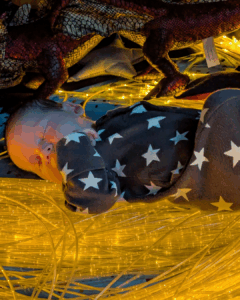
- Sensory – how babies experience sights, sounds, textures and movement
The key thing to know? These areas are beautifully connected. When your baby plays, listens, moves or snuggles — their brain is lighting up across all of them.
For a broader perspective on early childhood development, the NHS guide on child development is an excellent, high-authority resource.
What does baby development look like day to day?
In real life, baby development looks wonderfully ordinary.
It looks like:
- Chatting to your baby while making tea
- Singing on repeat (because repetition is magic)
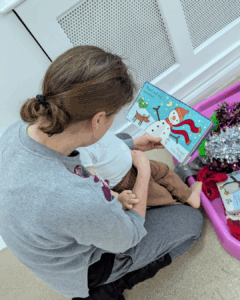
- Reading the same book for the hundredth time
- Meeting other parents and babies who are all doing things slightly differently
Your baby learns best through relationships, repetition and real experiences — especially shared ones.
How do you support baby development day to day?
Here’s the good news: you already are.
Supporting baby development isn’t about flashcards or doing more. It’s about connection — and that includes connection with other parents too.
A few simple, powerful ways to support development:
1. Talk, sing and read (together)
Your voice is one of your baby’s favourite things. Talking, singing and sharing books supports language, listening, bonding and emotional security — and it’s even better when done alongside other babies and grown-ups who get it.
2. Offer gentle sensory experiences
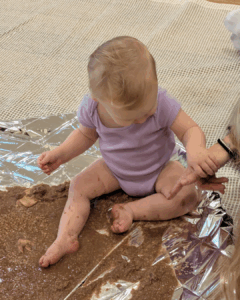
Babies learn through their senses. Different textures, sounds, movements and visuals help their brains make connections. Sensory play doesn’t need to be loud or messy — just thoughtful, playful and shared.
3. Let babies move freely
Time on the floor to wriggle, roll and explore builds strength and confidence. Watching other babies move differently can also be reassuring for parents — development isn’t one-size-fits-all.
4. Repeat without guilt
If your baby loves the same song, story or game — brilliant. Repetition helps babies feel safe and helps their brains learn patterns.
5. Find your people
Parenting can feel lonely, especially in the early months. Being part of a supportive community reminds you that questions are normal, differences are normal, and you’re not doing this on your own.

Why is baby development important?
The first year of life is a time of incredible brain growth. Millions of connections are being made every second.
But this isn’t about pressure. It’s about understanding that everyday moments matter:
- A smile returned
- A song shared
- A story read together
- A room full of babies exploring at their own pace
These experiences help build confidence, curiosity, communication and emotional security — for babies and parents.
Is my baby developing normally?
Ah, milestones — helpful and stressful in equal measure.
Development isn’t a race, and it’s not linear. Babies reach milestones at different times, in different orders, and sometimes after watching their peers do it first.
Being around other babies can actually be reassuring. You quickly see that there’s a huge range of “normal”.
Health professionals look for overall progress, not perfection or deadlines.
A gentle final word for new parents
Baby development isn’t something you do to your baby.
It’s something that happens through love, play, connection and community.
Your baby doesn’t need perfect parents — just responsive ones. And parents don’t need to know everything — just somewhere supportive to land.
That’s why communities matter. Sharing the journey, swapping stories, laughing at the hard bits and celebrating the tiny wins together.
You and your baby are doing brilliantly — and you’re always welcome here 💛